Peach Prime Consultancy provides 3D projection mapping design and consultancy services for government bodies, tourism authorities, cultural institutions, hospitality groups, and event organisers planning projection mapping shows for heritage monuments, public plazas, building facades, museum environments, theme parks, and branded events. We cover the full scope of projection mapping consultancy from narrative concept and show design through to technical projection planning, AV integration, content scripting, and show programming coordination.
Projection mapping is one of the most visually powerful tools available for transforming static built environments into dynamic, storytelling canvases. When designed and executed well, a projection mapping show on a heritage monument or public building creates a public spectacle that draws large audiences, generates substantial social media reach, and redefines the cultural and experiential identity of a public space. Peach Prime has delivered projection mapping installations at significant public landmarks including Mahakal Lok in Ujjain, children’s museums in Nashik and Kota, and other cultural institutions, building practical experience of both the creative and technical demands of high-impact projection mapping projects.
What Is 3D Projection Mapping and How Does It Work?
3D projection mapping is a visual technology that uses specialised projectors and software to project animated or video content precisely onto three-dimensional surfaces, transforming those surfaces into dynamic visual canvases. Unlike standard screen projection, projection mapping accounts for the shape, texture, and geometry of the projection surface, warping and adapting the projected content so that it appears to conform perfectly to the physical contours of the surface it is projected onto.
The result is that a building facade, a sculpture, a stage set, or any other three-dimensional surface can appear to move, transform, shatter, dissolve, or come alive with animated content that respects and plays with its physical geometry. A heritage monument can appear to be carved by animated water, overgrown by animated foliage, or transformed into a sequence of historical scenes. A museum exhibit object can appear to tell its own story through animated content that maps precisely to its surface. A theme park castle can appear to be struck by lightning or engulfed in animated fire during a night show.
The technical process involves three stages: first, a precise three-dimensional scan or survey of the projection surface is created; second, content is designed and produced specifically for that surface geometry using projection mapping software; third, projectors are positioned and calibrated to deliver the content onto the surface with pixel-accurate alignment. The complexity of the process increases with the irregularity of the projection surface, the number of projectors required to cover it, and the precision of alignment demanded by the content design.
Our 3D Projection Mapping Services
Peach Prime delivers projection mapping consultancy across three core service areas that together produce a complete projection mapping show from narrative concept to commissioned installation.
Facade Mapping | Facade mapping is the application of 3D projection mapping to building exteriors, monument surfaces, and architectural structures. We design facade mapping shows for heritage monuments, civic buildings, temple and religious architecture, resort and hotel facades, and purpose-built projection mapping structures. Facade mapping design covers show narrative and content scripting, surface geometry survey coordination, projector placement and specification, content production brief, and show control and programming. Our executed facade mapping projects include the Mahakal Lok Corridor in Ujjain and children’s museum facade installations. |
Visual Projection | Visual projection covers the application of projection mapping to interior surfaces, museum exhibit objects, sculptural installations, and themed environments. Interior projection mapping is used extensively in museum exhibit design to animate objects and interpretive content, in theme park dark rides to create dynamic scenic environments, and in immersive experience venues to create room-scale visual environments. We design visual projection systems for all of these contexts, covering projector specification, throw distance and lens selection, surface preparation requirements, and content brief production. |
AV Integration | Projection mapping shows are not standalone visual experiences: they are synchronised AV productions in which the visual content is aligned precisely with a designed spatial audio track, controlled lighting effects, and in some cases pyrotechnics, water features, or other physical show elements. AV integration design covers the show control system architecture that synchronises all these elements, the audio system design including speaker placement, amplification, and spatial audio configuration, the lighting control integration, and the triggering and automation logic that runs the complete show. Peach Prime coordinates all AV integration design with the appointed AV contractor to ensure the technical system matches the creative intent of the show. |
How Peach Prime Plans and Delivers a Projection Mapping Show
Our projection mapping process follows six structured phases from show concept through to final commissioning and handover. Each phase has defined deliverables that ensure the creative vision and technical execution remain aligned throughout.
Phase | What We Deliver |
Phase 1 Site Survey and Show Brief | We begin with a detailed site survey of the projection surface, documenting the geometry, dimensions, surface texture, ambient light conditions, and viewing audience positions. We also develop the show brief with the client, defining the narrative or thematic content of the show, the intended emotional experience, the duration and loop structure, the audio strategy, and any synchronisation requirements with physical show elements such as fountains, lighting, or pyrotechnics. |
Phase 2 Show Concept and Content Scripting | We develop the show concept and content script, defining the sequence of visual scenes, the narrative arc of the show, the transition logic between scenes, and the visual language and aesthetic of the content. The content script is a detailed scene-by-scene breakdown of the show that serves as the creative brief for the appointed content production studio. We also produce a show storyboard presenting the key visual moments of the show across the mapped surfaces. |
Phase 3 Projection System Design | We design the projection system for the show, specifying projector models, placement positions, throw distances, lens types, overlap zones for edge blending, projector housing and weatherproofing requirements for outdoor installations, power supply infrastructure, and cable routing. The projection system design is produced as a technical drawing set and equipment specification document used to procure projection hardware and coordinate with the civil or structural team for projector mounting infrastructure. |
Phase 4 AV Integration and Show Control Design | We produce the AV integration design covering the show control system architecture, audio system design, lighting control integration, and synchronisation logic. This phase defines how every technical element of the show is connected, triggered, and monitored. The show control design is the technical blueprint issued to the appointed AV integration contractor. |
Phase 5 Content Production Coordination | We coordinate with the appointed content production studio throughout the content creation process, reviewing work-in-progress content against the approved concept script and show storyboard, providing feedback on surface mapping accuracy and visual alignment with the projection surface geometry, and approving final content deliverables before the installation phase begins. Content production is typically the longest lead-time phase of a projection mapping project and must begin as early as possible in the project timeline. |
Phase 6 Installation, Calibration, and Commissioning | We oversee the installation and calibration of the projection system, reviewing hardware installation against the technical design, supervising projector alignment and edge blending calibration, coordinating content loading and playback testing, and conducting the full show run-through review before the commissioned show is handed over to the client. For outdoor permanent installations, we also review weatherproofing, maintenance access provisions, and remote monitoring systems. |
Applications of 3D Projection Mapping
- Heritage monuments and religious sites where projection mapping creates narrative shows celebrating cultural and historical significance
- Civic plazas and public spaces where projection mapping transforms underutilised spaces into destination evening attractions
- Resort and hotel facades where nightly projection shows create a signature attraction that drives accommodation bookings and repeat visits
- Museum exhibit environments where projection mapping animates display objects, gallery walls, and interpretive content
- Theme park night shows where projection mapping on castle facades or landmark structures creates a shared climactic event experience
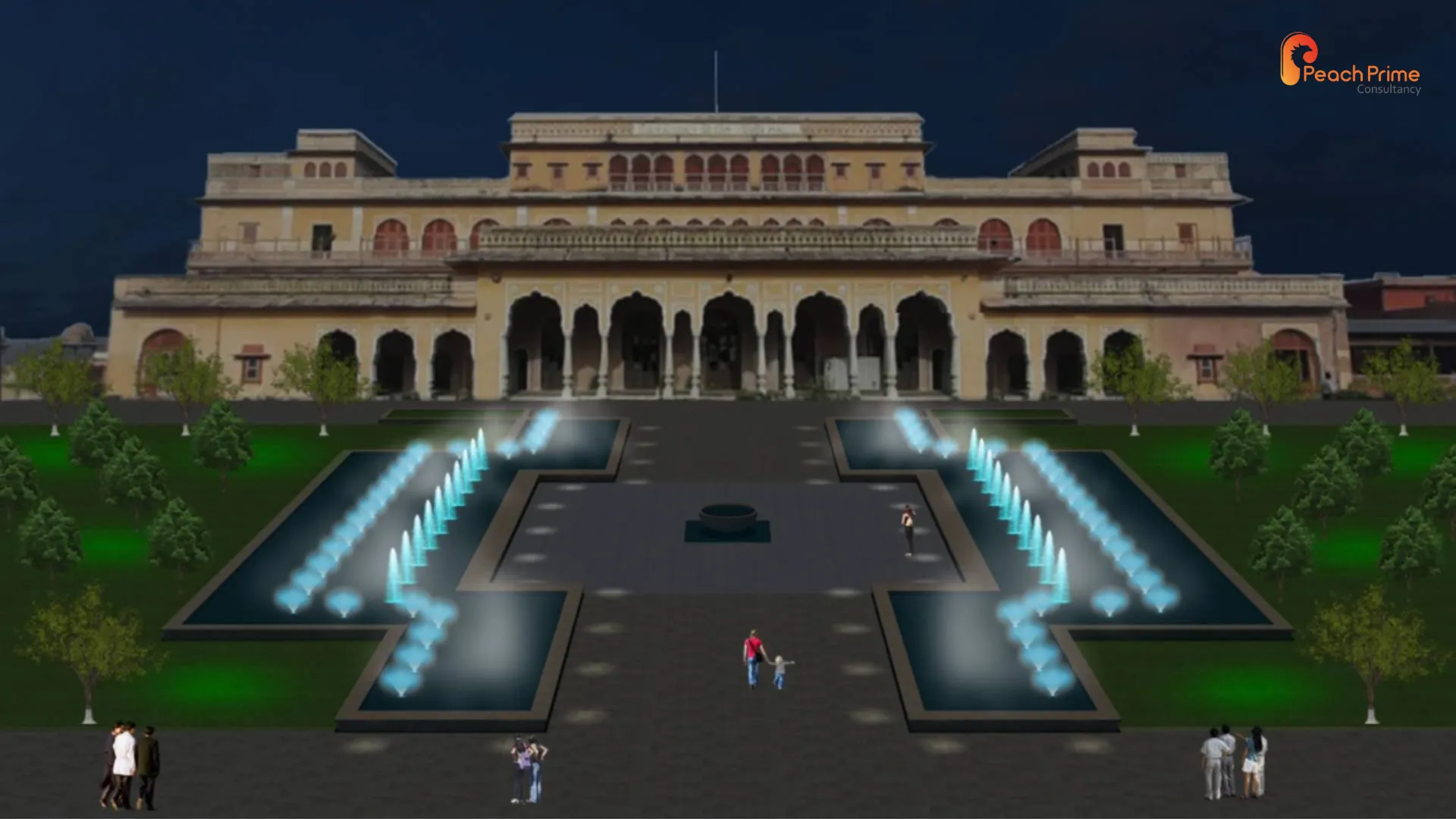
- Musical fountain shows where projection mapping on water screens and surrounding structures creates a multi-sensory spectacle
- Corporate and brand events where projection mapping transforms event venues into branded immersive environments
- Religious and cultural festival events where projection mapping creates spectacular public celebrations of devotional themes
Why Choose Peach Prime Consultancy for Projection Mapping?
Executed show experience at major landmarks: Peach Prime has designed and delivered projection mapping shows at nationally significant public landmarks including the Mahakal Lok Corridor in Ujjain. This executed experience gives us a practical understanding of the specific challenges of projection mapping at heritage sites: managing ambient light competition, working within heritage conservation constraints, coordinating with government and religious authorities, and designing shows that are culturally resonant rather than simply technically impressive.
Narrative before technology: The most common failure mode of a projection mapping commission is a technically competent show that audiences watch once and do not return to see again because the content is visually impressive but emotionally empty. Peach Prime begins every projection mapping project with a narrative content script before a single projector is specified, ensuring the show has a story that creates an emotional experience visitors want to return to and share.
Technical system design that matches the creative intent: Many projection mapping projects suffer from a disconnect between the creative concept and the technical execution because the creative team and the technical team work in sequence rather than simultaneously. Peach Prime develops the creative concept and technical system design in parallel, ensuring projector placement, brightness levels, throw distances, and edge blending zones are designed around the content requirements rather than constraining them after the fact.
Content production coordination across the full production lifecycle: Content production for a projection mapping show involves multiple review and revision cycles between the content studio and the technical team. Without structured coordination, content is delivered that does not map correctly to the projection surface, requiring expensive last-minute revisions. Peach Prime manages the content production coordination process from brief to final delivery, ensuring content meets technical specifications before the installation phase begins.
Frequently Asked Questions: 3D Projection Mapping
Q1. What is 3D projection mapping?
3D projection mapping turns buildings, facades, domes, or objects into animated display surfaces using precisely aligned high-lumen projectors and content mapped to the structure’s geometry – creating spectacular night shows without altering the structure itself.
Q2. How much does projection mapping cost in India?
Permanent facade mapping installations typically cost ₹2–8 crore depending on surface size, projector count, and content length; one-time event mappings cost ₹8–50 lakh. Projector lumens and content production are the main cost drivers.
Q3. What surfaces can be projection mapped?
Heritage facades, temples and monuments, dam and fort walls, domes, museum interiors, stage sets, water screens, and even trees and terrain – any surface with controllable ambient light after dark.
Q4. What equipment is used for projection mapping?
High-lumen laser projectors (10,000–50,000 lumens), media servers, warping/blending software, show control systems, and weatherproof housings for permanent outdoor installations, integrated with synchronized audio and lighting.
Q5. How long does a projection mapping project take?
Event mappings take 4–8 weeks including content creation; permanent installations take 3–6 months covering 3D scanning of the structure, content production, equipment installation, and programming.
Q6. Why is projection mapping popular for tourism destinations?
It creates a ticketed night-time attraction from existing structures – forts, dams, temples, and museums gain an evening revenue stream and social media fame without construction, which is why state tourism boards across India are investing in light-and-sound mapping shows.