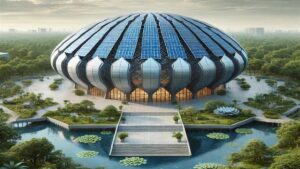

Interactive Science & Discovery Center Design
Science Museum Planning, STEM Lab Development & Experiential Learning Infrastructure
Education today is shifting toward immersive, inquiry-based environments that encourage exploration rather than observation.
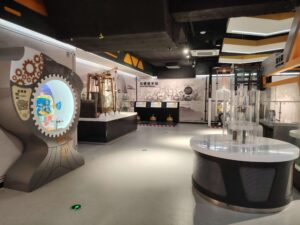
An Interactive Science & Discovery Center is a structured experiential learning destination where physics, biology, engineering, robotics, sustainability, and space science are translated into hands-on installations. These centers function as science museums, STEM innovation hubs, children’s discovery galleries, and educational experience facilities within malls, municipalities, academic campuses, and tourism developments.
Strategic Planning For A Skill-Based Game Zone
Launching a successful Commercial Skill Gaming Arena requires more than installing interactive games. Zoning logic, circulation flow, intensity balancing, spectator integration, and digital leaderboard systems must function cohesively.
Our planning approach ensures:
- Optimized zoning for varied game intensities
- Clear circulation pathways for active gameplay
- Strategic spectator visibility and engagement zones
- Integrated digital scoring and leaderboard systems
- Acoustic control for high-energy environments
- Immersive yet controlled lighting strategy
- Electrical load coordination for interactive installations
- HVAC planning for physically active participation
- RFID, token, or booking system integration
When structured effectively, a Skill-Based Game Zone increases dwell time, competitive participation, corporate bookings, and repeat customer engagement.


What Is an Interactive Science & Discovery Center?
An Interactive Science & Discovery Center is a participation-based science museum environment where visitors engage directly with experiments, models, simulations, and immersive installations.
- Inquiry-based learning environments
- Experiment-driven engagement modules
- Multi-sensory interactive installations
- STEM curriculum-aligned galleries
- Immersive projection and digital interpretation rooms
- Robotics and coding laboratories
- Astronomy and planetarium integration zones
These centers serve school groups, academic institutions, families, teen STEM learners, and educational tourism audiences while ensuring durability and repeat engagement.
Core Zones in an Interactive Science & Discovery Center
A professionally planned Science Discovery Center is structured through thematic galleries that support progressive learning. Strategic zoning enhances visitor flow, learning sequencing, and age-appropriate engagement layering.

Physics & Motion Laboratory
Force tables, gravity experiments, kinetic walls, mechanical advantage modules, and motion simulators.

Energy & Sustainability Pavilion
Solar power models, wind turbine demonstrations, climate awareness displays, and environmental science interactives.

Life Science & Human Biology Studio
Anatomy walls, neurological response systems, sensory experimentation pods, and health science modules.

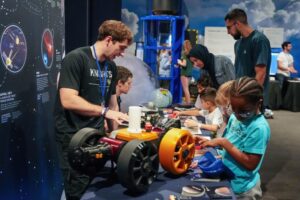
Robotics & Innovation Lab
Introductory robotics platforms, coding terminals, engineering challenges, and STEM skill-building workshops.

Light, Optics & Perception Gallery
Reflection chambers, illusion exhibits, wave theory installations, and laser-based demonstration units.

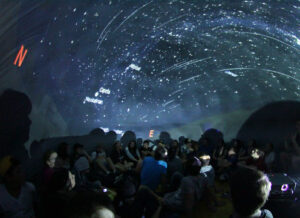
Astronomy & Space Exploration Zone
Mini planetarium dome, digital sky mapping systems, interactive space missions, and astrophysics simulation environments.

Maker Space & Experiment Workshop
Facilitated science sessions, innovation labs, structured STEAM camps, and problem-solving workshops.
Design & Engineering Framework
An effective Interactive Science Museum must integrate educational structuring, structural robustness, high-frequency durability, and modular exhibit planning.
Technical planning considerations include:
- Industrial-grade fabrication detailing
- Exhibit prototyping and testing
- Replaceable modular systems
- Accessible service panels
- Integrated digital interpretation systems
- AV synchronization and projection mapping
- Specialized lighting for science displays
- HVAC planning for electronics-intensive installations
- Safety compliance and structural certification
Complete Planning & Technical Coordination
Developing a Commercial Skill-Based Game Zone requires coordination between architectural planning, AV systems, gaming technology providers, and operational teams.
Our scope includes:We operate as independent consultants, ensuring every Skill-Based Game Zone is commercially aligned and technically robust.
Ideal Development Contexts
They integrate effectively in:
- Municipal cultural districts
- Mall anchor destinations
- Education-focused townships
- Mixed-use developments
- Smart city infrastructure projects
- Tourism knowledge hubs
- University and institutional clusters
Why Peach Prime Consultancy
Our expertise spans science museum design strategy, discovery center spatial planning, STEM lab infrastructure development, immersive exhibit coordination, and multi-system technical planning.
We design Science & Discovery environments that are curriculum-aligned, structurally engineered, high-engagement, adaptable for evolving technologies, and scalable for future expansion.
Build a High-Performance Competitive Gaming Destination
Peach Prime Consultancy provides comprehensive feasibility analysis, structured design planning, and execution support to help you develop a commercially scalable, performance-driven gaming destination.
If you are planning a: Skill-Based Game Zone, Competitive Social Gaming Arena, Interactive Skill Gaming Facility, High-Engagement Game Zone within an FEC.
Explore Our ServicesGet In Touch
FAQs
Q. What is the difference between skill-based gaming and redemption arcade games?
Skill-based gaming rewards measurable player performance such as speed, precision, and coordination, while redemption games often rely on chance-based outcomes.
Q. Is a Skill-Based Game Zone profitable in India?
Yes. Competitive social gaming formats generate strong repeat participation, league engagement, and corporate bookings in urban markets.
Q. How much space is required for a commercial Skill-Based Game Zone?
Space requirements depend on the game mix and zoning plan. Efficient layouts can be developed within mid-sized FEC environments while maintaining safe circulation.
Q. Can Skill-Based Game Zones integrate with esports arenas?
Yes. They complement esports venues by adding physical, performance-driven gaming experiences alongside digital competitions.
Q. Is it suitable for corporate events and team-building activities?
Absolutely. Structured competitive formats and leaderboard-driven challenges make Skill Gaming Arenas highly effective for corporate engagement programs.
Q. What revenue models work best for a Skill-Based Gaming Facility?
Common models include pay-per-play access, time-based entry, tournament entry fees, league memberships, birthday packages, school programs, and brand-sponsored competitions.