

Peach Prime Consultancy

Engineering High-Octane Free-Roam VR Experiences


Launching a commercially successful Free-Roam VR Arena requires synchronized planning across spatial design, hardware integration, and experiential flow. Arena layout, tracking system calibration, and game zoning must collectively support dynamic and safe player movement.

Our planning approach ensures:

  • VR tracking and motion system calibration
  • Mapped free-roam layouts with collision safety zones
  • Multi-player mission design and scenario paths
  • Elevation, cover, and obstacle planning for strategic play
  • Performance-optimized server and hardware infrastructure
  • Safety barriers, staff oversight, and emergency exit planning
  • Throughput planning and peak-hour capacity modeling


When engineered with precision, Free-Roam VR Arenas maximize engagement, encourage social play, and deliver excellent commercial performance in high-traffic entertainment environments.

Engineering High Octane Free Roam VR Experiences
What Defines A Commercial VR Free Roam Arena Setup

What Defines A Commercial VR Free-Roam Arena Setup?


A Commercial Multiplayer Free-Roam VR Arena is an environment where players move freely within a physical space while immersed in a virtual world using VR headsets and motion tracking systems. These facilities provide coordinated multi-user experiences that blur the line between physical movement and digital combat or adventure.

These arenas typically integrate:

  • Free-roam virtual zones with physical obstacle mapping
  • Wireless VR headsets and real-time tracking networks
  • Multi-player mission architecture and co-op modes
  • Real-time scoring, analytics, and digital leaderboards
  • Themed environment overlays (sci-fi, survival, fantasy)


A complete Multiplayer VR Arena Business Model includes timed sessions, competitive leagues, corporate bookings, birthday events, and merchandise cross-selling — making it a high-margin experiential entertainment investment.

High-Demand Multiplayer Free-Roam VR Arena Formats


The configuration and sequencing of free-roam VR formats directly influence immersion depth, player collaboration, and repeat visitation. We design Multiplayer Free-Roam VR Arenas based on gameplay intensity, audience profile, and commercial programming objectives.
Co Op Mission Adventure Arena

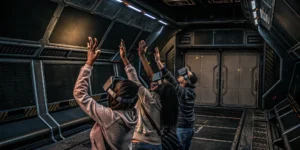
Co-Op Mission & Adventure Arena

Designed for team-based exploration missions where players collaborate to complete objectives within shared virtual environments.
Competitive VR Combat Arena

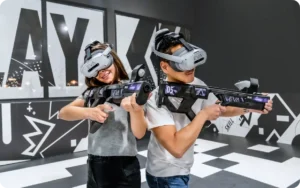
Competitive VR Combat Arena

Optimized for player-versus-player engagements featuring tactical movement, cover-based combat, and real-time scoring systems.
Story Driven Campaign VR Arena

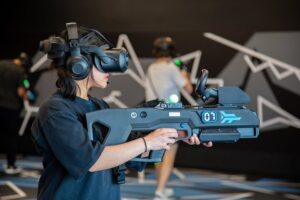
Story-Driven Campaign VR Arena

Configured with narrative progression, multi-chapter missions, and evolving challenges that encourage repeat gameplay.

Corporate League VR Arena

Corporate & League VR Arena

Engineered for tournaments, structured leagues, and corporate team-building formats with measurable performance metrics.

Designing A Revenue-Driven VR Multiplayer Arena

A professionally designed Free-Roam VR Arena must expertly balance immersive gameplay with operational throughput and safety planning. Strategic layout, group batching, and session pacing directly affect revenue performance and customer satisfaction.

Key considerations include:

  • 15–30 minute mission cycles aligned with pricing tiers
  • Tiered ticketing options (solo, team, membership)
  • Durable physical scenery and impact-safe obstacles
  • Backend hardware integration and maintenance workflows
  • Competitive league structures boosting repeat engagement
  • Themed seasons and scenario refreshes
  • Private bookings and corporate team-building monetization

Because free-roam VR gameplay offers unmatched immersion and social play value, these arenas drive high repeat visitation, extended dwell time, and elevated per-session revenue.

Complete Planning & Technical Coordination

Developing a Multiplayer Free-Roam VR Arena in India requires meticulous coordination across architectural planning, VR hardware systems, and commercial modeling.

Our scope includes:
1.
Feasibility study and market positioning analysis
2.
VR hardware ecosystem planning and ROI modeling
3.
Physical layout mapping and safety system design
4.
Game scenario architecture and mission sequencing
5.
Revenue structuring (tickets, leagues, corporate packages)
6.
On-site execution planning and staffing coordination
 

This methodical planning ensures free-roam VR arenas deliver both immersive experiences and measurable commercial returns.

Ideal Locations For Free-Roam VR Arenas

Multiplayer Free-Roam VR arenas thrive in entertainment ecosystems where tech-engaged audiences seek social gaming experiences and high-energy interactive play.

They are ideally suited for:

  • Upper-level mall entertainment courts near gaming zones
  • Urban esports and VR gaming lounges
  • Mixed-use lifestyle districts with youth and family traffic
  • Retail + recreation nodes near universities or cinemas
  • Destination gaming centers in Tier 1 & Tier 2 cities
  • Boutique entertainment parks with adjacent F&B

Locations with strong digital gaming demand and weekend visitation patterns significantly enhance commercial viability and brand differentiation.

Why Peach Prime Consultancy

Peach Prime Consultancy integrates immersive technology strategy, spatial planning, and revenue-focused commercial modeling to design Free-Roam VR Arenas that deliver measurable financial outcomes.

Our approach combines player experience architecture, hardware coordination, and operational strategy frameworks — creating high-visibility VR entertainment assets that captivate audiences and sustain long-term revenue.

FAQs

A Free-Roam VR Arena is an interactive entertainment space where players physically move in a mapped area while immersed in a virtual world via wireless VR headsets.

Yes. Rising demand for social gaming, tech entertainment, and immersive experiences supports strong return on investment potential.

Space needs range from 3,000–10,000+ sq ft based on mission complexity and player capacity goals.

Absolutely. Competitive league structures encourage repeat visits and premium pricing models.

Yes. Spatial tracking, padded obstacles, staff oversight, and emergency exits are essential for safe free-roam play.