

Interactive Science & Discovery Center Design
Science Museum Planning, STEM Lab Development & Experiential Learning Infrastructure
Interactive Science & Discovery Centers are rapidly emerging as high-impact educational destinations within malls, municipalities, academic campuses, and tourism developments. Peach Prime Consultancy designs future-ready science environments that combine hands-on learning, immersive exhibits, and structured STEM infrastructure — delivering engaging visitor experiences with strong operational performance and long-term educational value.
Strategic Planning For An Interactive Science & Discovery Center
Launching a successful Science & Discovery Center requires far more than exhibit procurement. The spatial layout, zone sequencing, structural planning, environmental controls, and digital infrastructure must function as one coordinated educational ecosystem.
Our planning approach ensures:
- Optimized thematic zone positioning and visitor flow
- Proper ceiling heights for immersive installations and domes
- Structural reinforcement for heavy exhibit and equipment loads
- Acoustic treatment for interactive and audio-visual environments
- HVAC design for electronics-intensive science installations
- Electrical load planning and AV integration across all zones
- Efficient visitor circulation and age-appropriate zoning
When designed correctly, an Interactive Science & Discovery Center increases dwell time, school group bookings, repeat family visits, and long-term community engagement.
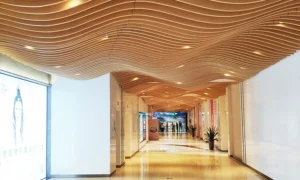
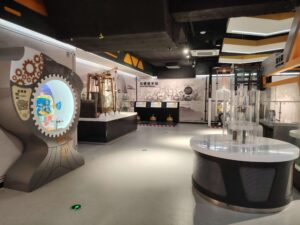
What Is an Interactive Science & Discovery Center?
An Interactive Science & Discovery Center is a professionally planned participation-based learning environment where visitors engage directly with experiments, models, simulations, and immersive installations.
These centers integrate:
- Hands-on science experiment stations
- AI-enabled robotics and coding laboratories
- Real-time digital interpretation and projection systems
- Immersive planetarium and space simulation environments
Unlike conventional science museums, a complete Discovery Center includes multiple thematic galleries, facilitated STEM workshop spaces, structured school programs, and technology-integrated learning environments. The result is a hybrid of a science museum, innovation lab, and immersive educational attraction.
High-Demand Science & STEM Zone Formats
The right mix of exhibit zones directly impacts visitor engagement, school bookings, and overall footfall performance. We curate science center formats based on regional demand, curriculum alignment, and spatial configuration.

Physics & Motion Laboratory
Force tables, gravity experiments, kinetic walls, and motion simulators. Highly engaging for school groups and competitive STEM challenges.
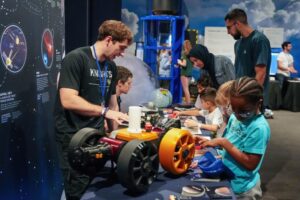
Robotics & Innovation Lab
Introductory robotics platforms, coding terminals, and engineering challenges. Ideal for structured STEM camps and institutional partnerships.
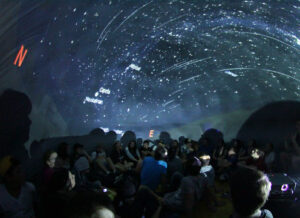
Astronomy & Space Exploration Zone
Mini planetarium dome, digital sky mapping, and astrophysics simulations. Creates strong emotional engagement and repeat visitation.
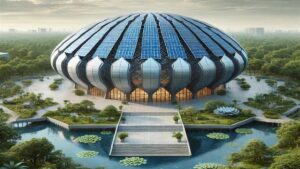
Energy & Sustainability Pavilion
Solar power models, wind turbine demonstrations, and climate science interactives. Supports curriculum-aligned delivery and CSR-funded programs.
A diversified zone mix enhances curriculum alignment, event programming, and family engagement throughout the year.
Designing A High-Impact Science Discovery Environment
Every science museum or STEM center must be designed as a complete educational and commercial ecosystem. Exhibit engineering, operational flow, and structural coordination determine long-term visitor performance.
Key considerations include:
- Child-safe design standards and structural certification
- Industrial-grade fabrication for high-frequency visitor use
- Optimized lighting for science displays and digital interactives
- Efficient facilitator and service circulation pathways
- Integrated civil, MEP, and technology coordination
The difference between a standard exhibit installation and a high-performing science destination lies in strategic spatial planning and engineering discipline.
Complete Planning & Technical Coordination
Setting up an Interactive Science & Discovery Center requires structured coordination between spatial architecture, exhibit engineering, AV systems, and educational content providers.
Our scope includes:Careful coordination reduces operational inefficiencies, exhibit downtime, and safety risks across all phases of development.
Ideal Locations For Interactive Science & Discovery Centers
These centers are ideally suited for:
- Municipal cultural and knowledge districts
- Mall anchor entertainment destinations
- Education-focused townships and smart city developments
- Tourism knowledge hubs and experiential parks
- University and institutional campuses
When positioned strategically, they function as anchor educational attractions that increase footfall, community engagement, and secondary spending across the development.
Why Peach Prime Consultancy
Peach Prime Consultancy brings multidisciplinary expertise in science museum design, immersive exhibit engineering, and educational infrastructure development.
Our experience includes interactive STEM lab planning, digital AV integration, educational attraction design for high-footfall environments, and coordination across civil and MEP teams.
We design Science & Discovery Centers that are:
Build A Future-Ready Science & Discovery Destination
The convergence of STEM learning, immersive exhibits, digital interpretation, and structured educational programming is transforming the science museum landscape.
If you are planning an Interactive Science Museum, STEM Innovation Lab, Discovery Center within a Mall, Science Exhibition Pavilion, or Municipal Educational Attraction, Peach Prime Consultancy provides comprehensive design and planning support to help you create a high-performance Interactive Science & Discovery Center.
Explore Our ServicesGet In Touch
FAQs
Q. What is the difference between skill-based gaming and redemption arcade games?
An Interactive Science & Discovery Center is an immersive, participation-based educational facility where visitors engage directly with science experiments, robotics labs, astronomy zones, and hands-on STEM installations. It combines the depth of a science museum with the engagement of an experiential learning attraction.
Q. Which science zones can be included in a Discovery Center?
A professionally planned center can include physics and motion labs, robotics and coding spaces, astronomy and planetarium zones, energy and sustainability pavilions, life science studios, optics galleries, and maker spaces. The final mix is selected based on space availability, curriculum goals, and local audience demographics.
Q. How much space is required for a science discovery center?
Space requirements vary depending on the number of thematic zones and exhibit types. Key factors include ceiling height for dome installations, structural loads, visitor circulation areas, facilitated workshop spaces, and support infrastructure. Strategic planning ensures maximum educational impact even in compact environments.
Q. What makes an Interactive Science Center commercially successful?
Commercial success depends on more than exhibit procurement. Proper zoning, curriculum alignment, school group programming, digital integration, structured revenue streams, and high-frequency exhibit durability all contribute to sustained visitor engagement, institutional partnerships, and long-term operational performance.
Q. Does Peach Prime Consultancy handle complete planning and execution support?
Yes. Peach Prime Consultancy provides end-to-end planning support including feasibility analysis, content curation, master planning, exhibit design, structural and safety coordination, AV and digital integration, revenue model advisory, and on-site technical supervision to ensure smooth execution.