
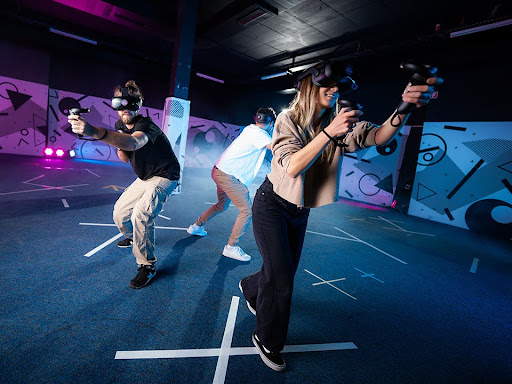
If you are planning to invest in a VR Adventure Park, free-roam virtual reality arena, or immersive VR entertainment center, this guide gives you a clear framework covering capital requirements, technology selection, revenue modelling, and operational structure. The goal is to help you move from concept to a commercially viable, scalable business.
The Market Opportunity Is Real and Still Early
Location-based VR entertainment is one of the few entertainment formats that continues to grow in both search interest and consumer spending. Searches for terms like VR park startup cost, free roam VR business model, location-based VR investment, and immersive VR attraction ROI have grown consistently, driven by an audience that actively seeks out these experiences and plans visits around them.
The core demand demographic is Gen Z and millennials, two generations that have grown up with digital entertainment but increasingly value physical, social, out-of-home experiences that screens at home cannot replicate. Multiplayer VR gaming, VR escape rooms, and interactive VR experiences in malls and mixed-use developments are all performing strongly with this audience.
The market timing is also favourable from an infrastructure perspective. Headset hardware has matured significantly. Tracking systems are more reliable and more affordable than they were five years ago. Content libraries have expanded. The barriers to entry that made early location-based VR venues operationally fragile have come down meaningfully, while consumer awareness and appetite have gone up. For investors entering now, the risk profile is considerably better than it was for first-movers.
Capital Requirements and Technology Planning
VR Adventure Parks are capital-intensive at the front end. Understanding where your capex goes, and where decisions have the largest long-term impact, is essential before you commit to a vendor or a lease.
Free-roam tracking systems are the single most consequential technology decision you will make. The tracking infrastructure defines how accurately and reliably the system maps player movement to the virtual environment. Poor tracking creates motion sickness, session interruptions, and negative reviews. Evaluate vendors on tracking precision, latency specifications, arena coverage reliability, and the quality of their ongoing technical support, not just on upfront hardware price.
High-performance VR headsets are the primary guest-facing hardware. Display resolution, field of view, weight, and hygiene management all affect guest satisfaction directly. For a commercial venue running multiple sessions per day, durability and ease of maintenance are at least as important as raw display quality. Factor in replacement cycles and consumable costs from the beginning.
Backpack PCs are required for untethered free-roam formats. Battery life, heat management, and weight distribution affect guest comfort across session durations. In high-throughput venues, the turnaround time for charging and swapping backpack units between sessions becomes an operational constraint that your floor plan and staffing model must accommodate.
Arena mapping sensors and motion capture systems need to be calibrated to your specific physical space. Ceiling height, arena dimensions, reflective surfaces, and lighting conditions all affect sensor performance. A thorough pre-installation site survey by your technology vendor is non-negotiable.
Content licensing is an ongoing cost that many first-time investors underestimate. Quality content drives repeat visits. Stale or limited content libraries are one of the most common reasons VR venues see declining bookings after the initial novelty period. Budget for content refresh cycles as a recurring operational cost, not a one-time investment.
Poor vendor selection at any of these points reduces uptime, increases maintenance costs, and directly erodes profitability. Taking the time to evaluate vendors rigorously before signing contracts is one of the highest-return activities in the pre-launch phase.
Revenue Streams and Financial Modelling
A profitable VR Adventure Park runs multiple revenue lines rather than depending entirely on walk-in session ticketing. Each stream below contributes differently to your overall financial profile.
Per-session ticketing is your baseline revenue driver. Pricing should reflect your cost per session including technology depreciation, staff time, and content licensing, with margin built in. Dynamic pricing, higher rates on weekends and peak hours, lower rates for off-peak slots, improves overall revenue yield without requiring additional capacity.
Multiplayer VR packages command a premium over solo sessions and drive group bookings, which are operationally efficient because they fill arena capacity in a single transaction. Packages designed around four to eight players simultaneously are both a strong revenue unit and a natural social media content moment for your guests.
Membership models convert high-frequency visitors into predictable monthly revenue. Tiered memberships with session credits, priority booking, and access to new content releases create loyalty while smoothing the revenue volatility that comes from purely transactional booking patterns.
Corporate team-building events represent a high-value, low-churn revenue segment. Companies are actively looking for team experiences that move beyond the standard offsite dinner or escape room format. A well-packaged corporate offering with private arena access, custom game scenarios, and post-session catering partnerships can command significant per-head pricing.
Birthday and group bookings are a consistent revenue driver across demographics, particularly in family and youth segments. Structured packages with reserved time slots, dedicated staff support, and add-on options like food and beverage create a compelling product that justifies advance booking and premium pricing.
Seasonal content upgrades serve two purposes simultaneously. They give existing guests a reason to return and try something new, and they give your marketing team a recurring content calendar to work with. Halloween formats, holiday specials, and competitive seasonal tournaments all drive spikes in bookings that supplement your baseline session revenue.
Three Global Benchmarks Worth Studying
Three operating models in particular offer important lessons for anyone planning a VR Adventure Park investment.
The VOID (USA and Middle East) built its reputation on IP-driven immersive storytelling, partnering with major entertainment franchises to create experiences that guests could not access anywhere else. Their model demonstrates that premium positioning and content exclusivity can justify significantly higher per-session pricing. It also demonstrates the risk concentration that comes with IP dependency, a lesson relevant to any operator considering franchise-based content strategies.
Zero Latency VR (Global) has scaled through an operator franchise model that allows local investors to deploy a proven technology stack and operational playbook rather than building independently. For investors who prioritise lower concept risk and faster time to launch, their franchise model offers a structured entry point with established brand recognition in multiple markets.
Sandbox VR (USA and Asia) has carved out a premium positioning in key urban and tourist markets, demonstrating that guests will pay significantly above average entertainment prices for a genuinely differentiated experience. Their focus on social multiplayer formats and cinematic production quality sets a useful benchmark for what premium VR venue investment looks like at its best.
Each model reflects a different approach to technology, content, and market positioning. Knowing which one aligns with your specific capital budget, target market, and operational capacity is part of the strategic clarity that needs to precede any investment commitment.
Risk Management and Scalability Planning
VR Adventure Parks carry specific operational risks that must be planned for from the outset.
Technology obsolescence is the most structurally unique risk in this category. VR hardware evolves rapidly. The headsets and tracking systems that represent the state of the art today will be superseded within a three to five year horizon. Your financial model needs to include hardware refresh cycles, and your vendor agreements should address upgrade pathways explicitly rather than leaving you locked into outdated equipment.
Content refresh cycles are a close second in terms of long-term impact on venue performance. Consumer appetite for new experiences is high in this audience segment. A venue running the same content library eighteen months after opening will see measurable booking decline. Budgeting for regular content updates is not a discretionary expense. It is a core cost of maintaining your revenue base.
Space optimisation has a direct effect on ROI. The revenue potential of a VR adventure park is partly a function of how efficiently your physical space is used. Dead zones, inefficient player flow between zones, and oversized staging areas all reduce the revenue-generating footprint of your facility. Modular arena design, where zones can be reconfigured to accommodate different game formats or group sizes, significantly improves adaptability and long-term space utilisation.
Throughput modelling is the analytical discipline that ties all of these elements together. Understanding your maximum daily session capacity, average revenue per session, peak versus off-peak booking distribution, and staff-to-guest ratios allows you to build a financial model that reflects operational reality rather than optimistic assumptions.
How Peach Prime Consultancy Supports Investors
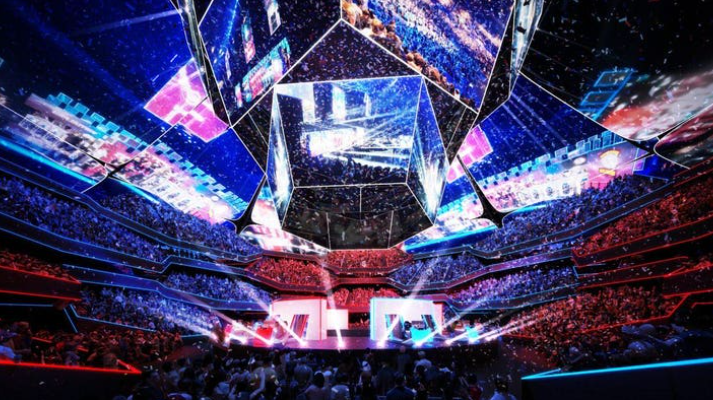
Launching a profitable VR Adventure Park requires getting a large number of interdependent decisions right simultaneously. Technology selection affects layout planning. Layout planning affects throughput modelling. Throughput modelling affects financial projections. Financial projections affect your financing structure. An error at any point in this chain has consequences that compound.
Peach Prime provides end-to-end advisory support for investors entering the immersive entertainment space. Our services cover feasibility analysis, vendor evaluation, spatial planning, throughput modelling, and financial projections, structured to give you the confidence that your investment is built on rigorous, market-tested foundations rather than assumptions.
We work with investors at concept stage through to launch and beyond, ensuring that the venue you build is not just experientially compelling but commercially sustainable and designed to scale.
Contact Peach Prime today to begin your VR Adventure Park feasibility assessment.
Peach Prime is a specialist consultancy helping investors and operators build and scale immersive entertainment venues across emerging markets. Visit peachprime.in to learn more.