
A comprehensive infrastructure planning and investment guide for developers building tournament-ready esports arenas that deliver structured leagues, ticketed live events, sponsorship revenue, and strong long-term community engagement.
Introduction: Why Professional Esports Arenas Are an Emerging Asset Class
Esports has crossed the threshold from cultural phenomenon to mainstream entertainment industry. Global esports revenues have consistently exceeded one billion US dollars annually and continue to grow, driven by a combination of increasing viewership, expanding corporate sponsorship, game publisher investment in official leagues and competitions, and the rapid maturation of the esports content creation economy. In key markets including South Korea, China, the United States, and increasingly India, competitive gaming viewership regularly rivals or exceeds that of conventional sports broadcasts for the 18 to 34 demographic that advertisers value most.
For real estate developers and entertainment investors, this maturation of the esports industry has created a genuine and largely underserved infrastructure opportunity. Professional esports competition requires physical venues that most conventional entertainment or sports facilities cannot adequately provide: low-latency network infrastructure, production-grade broadcast capabilities, acoustic environments optimised for both player concentration and spectator energy, and the specialised spatial requirements of simultaneous competition, team preparation, spectator engagement, and media operations. The venues that have been built to this standard command strong event hosting fees, build loyal community followings, and generate the sponsorship revenues that transform an entertainment venue into a media platform.
This playbook provides a complete strategic and technical framework for developing a professional esports arena: from infrastructure requirements and technology investment to revenue architecture, risk management, and the operational disciplines that sustain commercial performance over a multi-year lifecycle.
MARKET SIGNAL | Search demand for esports arena design, competitive gaming venue, gaming tournament facility, and esports event hosting centre continues to grow globally. Unlike casual gaming lounges, professional esports arenas support structured leagues, ticketed live audiences, streaming monetisation, and brand sponsorships that generate recurring engagement rather than one-time visits. |
Why E-Sports Arenas Are a Long-Term Asset Class
The commercial durability of a professional esports arena as an investment asset rests on a set of structural characteristics that distinguish it from most other entertainment venue categories. The most commercially significant of these is the recurring engagement model that structured leagues and competitive programming create. Where a cinema, a bowling alley, or a conventional gaming lounge depends on continuous new customer acquisition to sustain attendance, a professional esports arena that runs a successful competitive league generates a committed, recurring visitor base whose engagement is sustained by competitive motivation and community belonging rather than the novelty of a new experience.
This recurring engagement dynamic has direct financial implications: advance booking revenue from league participants is more predictable than general admission revenue, per-visit spending from engaged community members is higher than from casual visitors, and the brand loyalty of a community that identifies strongly with a venue as the home of their competitive sport is more resilient to competitive entry than the casual preference of entertainment consumers choosing between comparable options.
The Broadcast and Media Dimension
A professional esports arena that invests in broadcast-quality streaming infrastructure unlocks a revenue dimension unavailable to most physical entertainment venues: the ability to monetise the content of its events to a global digital audience in addition to the physical audience in the venue. Streaming partnerships with esports content platforms, revenue share arrangements with game publishers for official competition rights, and the brand sponsorship value generated by high-visibility online broadcasts create a media business layer that compounds the venue’s commercial performance beyond what its physical footfall alone can generate. This media dimension also creates a marketing asset of extraordinary efficiency: every broadcast featuring the venue’s visual identity and branding reaches an audience of competitive gaming enthusiasts that paid advertising could not target at comparable cost.
Core Infrastructure Requirements
A tournament-grade esports arena requires a level of technical infrastructure specification that differs fundamentally from conventional entertainment venues and that must be planned from the earliest stages of the design process rather than added as a technical overlay to a standard commercial fit-out. The following table maps the eight critical infrastructure elements to their specification requirements and priority levels.
Infrastructure Element | Specification Requirement | Priority |
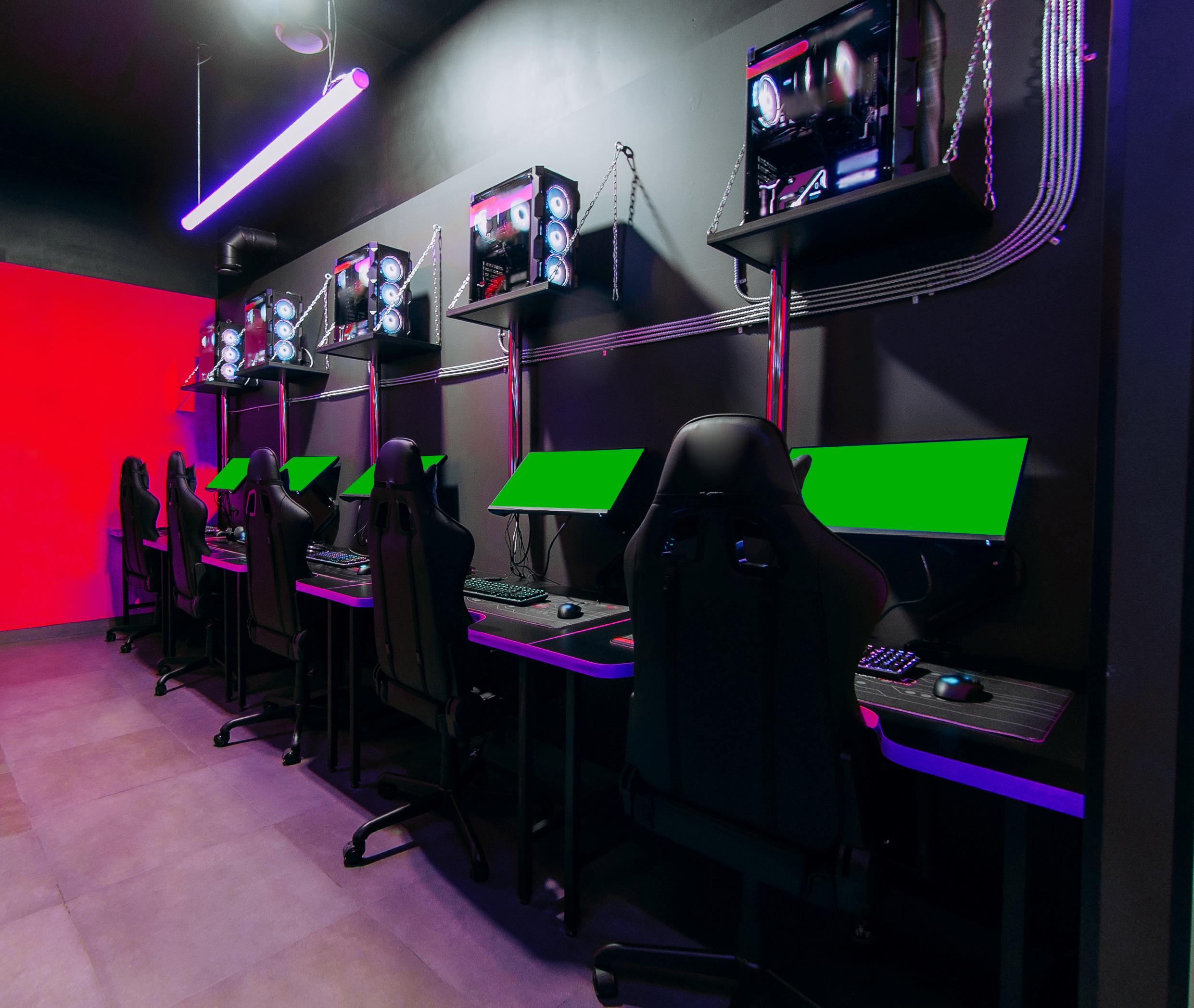
Gaming Stations | Tournament-grade PCs or consoles, high-refresh monitors, mechanical keyboards | Critical |
Network Infrastructure | Dedicated low-latency fiber, redundant ISP connection, esports VLAN | Critical |
Broadcast and Streaming Studio | Professional cameras, capture cards, streaming encoders, dedicated bandwidth | Critical |
LED Video Walls | High-resolution P2 or P3 pixel pitch display for spectator viewing | High |
Acoustic Treatment | Sound absorption panels, commentary booth isolation, spectator zone separation | High |
Player Practice Rooms | Separate bootcamp rooms with team communication infrastructure | High |
Power and Backup Systems | UPS for all gaming and broadcast equipment, dedicated server room cooling | Critical |
Network Infrastructure as the Foundation
The network infrastructure of a professional esports arena is its most critical and most uncompromising technical requirement. Tournament-grade competitive gaming demands end-to-end network latency that is imperceptible to players during competition, which requires dedicated low-latency fiber connectivity to the internet backbone, a redundant secondary ISP connection that activates automatically in the event of a primary connection failure, and a purpose-designed local area network architecture that isolates competitive gaming traffic from spectator, administrative, and broadcast data streams on separate VLANs. The specification of this infrastructure requires networking expertise that goes significantly beyond standard commercial IT design, and engaging a specialist esports network consultant in the design phase is a non-optional investment for any developer serious about tournament-grade operation.
Broadcast Studio and Streaming Infrastructure
The broadcast studio is the component that transforms a gaming venue into a media platform, and its specification must meet professional production standards rather than amateur streaming quality. Professional cameras for player and audience capture, hardware capture cards for clean game feed acquisition, professional-grade streaming encoders, redundant internet uplinks dedicated exclusively to streaming data, and a commentary booth with appropriate acoustic isolation are the baseline components of a tournament broadcast setup. The spatial planning of the broadcast infrastructure within the arena must also ensure that camera positions have unobstructed sight lines to all player stations and to the main spectator display, and that the production team can operate without interfering with the competitive play environment.
Revenue Architecture and Monetisation
The revenue architecture of a professional esports arena is broader and more scalable than that of most comparable entertainment venue types, because the media and sponsorship dimensions of the format create revenue channels that extend well beyond the physical venue’s footfall. The following table maps the primary revenue streams and their commercial profiles.
Revenue Stream | Format | Commercial Profile |
Tournament Hosting Fees | Entry fees and venue hire for competitive tournaments | Primary, event-driven |
Ticketed Live Events | Spectator admission to live tournament events | Demand surge, broadcast-aligned |
Team Practice Subscriptions | Monthly access for competitive teams and bootcamp programmes | Recurring, community-building |
Corporate Esports Leagues | Inter-company competitive leagues with facilitated programming | High-yield B2B |
Sponsorship and Naming Rights | Brand presence on equipment, displays, broadcasts, and apparel | Incremental, brand-aligned |
Streaming and Media Partnerships | Content licensing and streaming platform revenue share | Scalable, brand-building |
F&B and Merchandise | Gaming-themed food and beverage and branded merchandise | Ancillary, high-margin |
Sponsorship as a Primary Revenue Driver
Brand sponsorship is among the most commercially significant revenue streams for a professional esports arena and one that is unavailable to most other entertainment venue types at the same scale. Technology brands, gaming peripheral companies, energy drink and beverage brands, telecommunications companies, and financial services firms targeting the 18 to 35 demographic all invest substantially in esports sponsorship, and a venue with a credible competitive programme and demonstrable audience reach is a viable sponsorship partner for brands in each of these categories. Sponsorship packages should be structured to offer brand partners a combination of physical presence within the venue, integration within broadcast content, social media reach, and the activated brand association that comes from connecting the brand to the competitive intensity and community passion of a well-run tournament event.
Recurring Revenue Through Structured Leagues
Structured competitive leagues are the commercial engine that stabilises the revenue base of a professional esports arena across the variability of major tournament and event scheduling. A weekly amateur competitive league across three to five game titles, a monthly corporate esports league targeting the young professional demographic that represents the highest-value B2B client segment, and a seasonal ranked ladder system that tracks player performance across the full calendar year create the recurring engagement and advance booking revenue that provides the financial predictability the venue needs to plan its programming and staffing costs confidently.
Global Benchmarks in Esports Infrastructure
01 | Esports Stadium Arlington Texas, USA Esports Stadium Arlington is one of the largest dedicated esports facilities in North America and represents the purpose-built, large-scale end of the esports arena development spectrum. Purpose-built for competitive esports rather than adapted from a conventional sports or entertainment venue, the stadium has full broadcast infrastructure, seating for several thousand live spectators, dedicated production facilities, and the technical specifications required to host the largest professional esports tournaments across multiple game titles simultaneously. What makes Arlington instructive for new developers is the clarity of its design brief: every spatial, acoustic, and technical decision is made in service of the tournament and broadcast experience rather than the general entertainment audience. The result is a venue that attracts the most prestigious competitive events precisely because it can deliver the operational standard that professional publishers and tournament organisers require. For developers planning a professional-grade arena with tournament hosting ambitions, the Arlington model provides the infrastructure benchmark against which their own specification should be assessed. |
02 | HyperX Esports Arena Las Vegas, USA HyperX Esports Arena at the Luxor Hotel in Las Vegas represents the hybrid entertainment-esports model, combining live tournament hosting with an accessible daily gaming experience that serves both dedicated competitive players and casual visitors exploring the broader Las Vegas entertainment ecosystem. Its location within a major casino-resort property provides extraordinary footfall exposure that a standalone esports venue could never achieve independently, while its naming rights partnership with HyperX illustrates the brand sponsorship value that a high-visibility esports venue in a premium tourism market can generate. For developers considering esports arena integration within a larger hospitality or mixed-use development, HyperX demonstrates the compounding commercial benefits of positioning the esports venue as an anchor attraction within a broader entertainment ecosystem rather than as a standalone destination. |
03 | Seoul OGN eStadium Seoul, South Korea Seoul’s OGN eStadium operates in the world’s most mature and commercially sophisticated esports market and reflects the highest standard of integrated competitive gaming infrastructure available anywhere globally. South Korea’s esports culture, which has produced professional gaming leagues, nationally broadcast tournaments, and celebrity-level competitive players for over two decades, provides the OGN eStadium with a market context that delivers built-in audience depth and competitive talent density that new markets must work to develop. For developers in emerging esports markets including India, the OGN model illustrates what a mature esports arena ecosystem looks like after years of community and infrastructure investment, providing a directional template for the long-term trajectory of venues that commit to building genuine competitive communities rather than simply providing gaming facilities. |
Execution Risks and Mitigation
The specific risk profile of a professional esports arena is dominated by technology reliability, programming quality, and the speed of community development. Understanding these risks and building mitigation into the planning and operational design of the venue is as important as the quality of the infrastructure investment itself.
Technology Downtime and Redundancy
Technology failure during a competitive event is the most immediately damaging operational risk for an esports arena. A network outage, server failure, or hardware malfunction during a tournament undermines the venue’s reputation with game publishers, team organisers, and competitive players simultaneously. Redundant systems for all critical infrastructure, including internet connectivity, server hardware, and broadcast equipment, with automatic failover that activates within seconds of a primary system failure, are the minimum standard for tournament-grade reliability. Regular hardware testing and replacement schedules, calibrated to the expected lifecycle of gaming-grade equipment under intensive daily use, prevent the gradual performance degradation that creates competitive fairness issues before it produces outright hardware failure.
Programming Quality and Event Calendar Development
An esports arena without a strong competitive programming calendar is a collection of equipment without an audience or a revenue model. Developing a credible and consistently executed event calendar requires relationships with game publishers for official competitive rights, partnerships with team organisations and tournament operators, and the internal programming expertise to design and manage competitive events that meet the standards that serious players and viewers expect. Investing in a dedicated programming team from the earliest stage of venue operation, rather than treating event development as a secondary activity managed by the general operations team, is the discipline that determines whether the arena becomes a genuine hub of competitive activity or a venue that hosts occasional events without building a community.
Frequently Asked Questions
The following questions address the most important planning and investment considerations for developers entering the professional esports arena market.
What is the minimum viable scale for a commercially viable professional esports arena? |
A commercially viable professional esports arena requires a minimum of 50 to 80 high-performance gaming stations, a dedicated broadcast and streaming setup, at least 200 to 300 seats of spectator capacity, and the network and acoustic infrastructure that tournament-grade competition requires. Below this scale, the venue cannot host the events that generate the highest-value revenue streams or build the audience depth that sustains a competitive community. A mid-scale arena of 150 to 200 stations with 500 to 800 spectator seats represents the optimal size for a new-market entry that can support serious tournament hosting while remaining commercially viable on recurring league and community programme revenue during the periods between major events. |
How does an esports arena generate revenue during periods without major tournaments? |
Revenue during non-tournament periods is generated through the recurring programme structures that should form the commercial backbone of the venue’s operating model alongside major events. Weekly competitive leagues across multiple game titles fill daily session capacity with advance-booked players. Team subscription programmes provide consistent revenue from competitive teams using the venue for practice and preparation. Corporate esports league packages fill weekday evening capacity with the B2B demographic that generates the highest per-head yield. Casual public gaming sessions with hourly station rental pricing serve the broader gaming community during off-peak hours. And streaming content creation partnerships, where content creators use the venue’s broadcast infrastructure to produce their own streaming content, generate both revenue and marketing reach. |
What game titles should an esports arena prioritise for competitive programming? |
Game title selection for competitive programming should be driven by the specific competitive gaming culture of the target market rather than global popularity rankings alone. In the Indian market context, titles with the largest active competitive communities include BGMI (Battlegrounds Mobile India), Valorant, CS2, FIFA, and Free Fire, with significant and growing competitive communities around each. Partnering with the Indian organisations that manage competitive circuits for these titles, and working with game publishers to secure official competitive rights where available, provides the credibility and audience pre-qualification that drives strong early event attendance. The portfolio of titles should include at least one mobile gaming title, given the dominance of mobile as the primary gaming platform in the Indian market, alongside PC and console titles. |
What are the acoustic design requirements specific to a professional esports arena? |
Acoustic design for a professional esports arena must address two competing requirements simultaneously: the player environment must be quiet enough to allow concentration and in-team communication without interference from spectator noise or adjacent station audio, while the spectator environment must be energetic and immersive enough to create the live event atmosphere that drives ticket sales and broadcast appeal. These requirements are managed through spatial separation of player and spectator zones, acoustic treatment of the player area to absorb external sound while maintaining clean in-game audio monitoring, and the use of directional speaker arrays in the spectator area that concentrate crowd audio away from the competition floor. Dedicated commentary booths require full acoustic isolation from both the player zone and the spectator area to ensure broadcast audio quality is maintained regardless of in-venue noise levels. |
How should an esports arena approach naming rights and sponsorship development? |
Naming rights and sponsorship development for an esports arena should be approached as a structured business development function rather than a passive waiting for brands to make contact. The most commercially successful naming rights and sponsorship agreements are built on a combination of demonstrable audience quality data, a clear and credible competitive programming calendar that gives brand partners confidence in the venue’s long-term relevance, and a sponsorship product structure that offers genuine brand activation value rather than simply logo placement. The target sponsor categories for an esports arena, technology, gaming peripherals, telecoms, energy drinks, and financial services, all have active esports sponsorship programmes with defined criteria for partnership evaluation. Developing relationships with the sponsorship and marketing teams at these brands well before the venue opens, and presenting a compelling pitch that quantifies the brand’s exposure and activation opportunity, is the commercial approach that generates sponsorship agreements rather than expressions of interest. |
What is the expected payback period for a professional esports arena investment? |
Payback periods for professional esports arenas vary based significantly on scale, market, and the quality of programming development, but well-executed mid-scale arenas in strong urban markets typically achieve payback within 48 to 72 months when the full revenue model including sponsorship, league programming, and streaming partnerships is developed alongside general admission. Venues that secure naming rights and major tournament hosting agreements early in their lifecycle benefit from large advance revenue receipts that substantially accelerate payback. The Indian market, with its rapidly expanding competitive gaming community and still-limited supply of professional-grade tournament venues, presents a particularly favourable timing opportunity for developers willing to invest in the infrastructure standard that the emerging professional market requires. |
Why Partner with Peach Prime Consultancy
Peach Prime Consultancy supports esports arena development with feasibility analysis, infrastructure planning, technology coordination, and revenue modelling. We bring specialist expertise in digital sports venue development and the structured planning methodology that ensures your esports arena is built as a scalable, high-performance digital sports asset rather than simply a collection of gaming equipment in a commercial space.
From the initial feasibility conversation through to technology vendor evaluation, spatial master planning, and investor-ready financial modelling, Peach Prime Consultancy provides the expert guidance that reduces execution risk and positions your venue for long-term commercial performance. Visit www.peachprime.in to explore our services or contact our team to arrange a strategic consultation.
WHAT PEACH PRIME DELIVERS | Feasibility analysis and market positioning, infrastructure planning and technology specification, broadcast studio and network design briefing, revenue architecture and financial modelling, community programming strategy, and full investor presentation support. |