

A business development and investment guide for developers building RC and off-road racing attractions that combine skill-based competition, community loyalty, and scalable multi-stream revenue.
Introduction: The Commercial Case for RC Racing Attractions
Radio-controlled and off-road racing experience tracks occupy a unique and underexploited position in the family and competitive leisure market. They combine the accessibility and visual appeal of a motorsport experience with the community loyalty of a hobby-based club, and they do so at a capital cost that is dramatically lower than full-scale ride attractions or even electric go-kart facilities. The format appeals simultaneously to multiple demographic segments that are difficult to serve together in a single attraction: families with children who are drawn by the novelty and spectacle of miniature racing, teenagers and young adults who engage with the competitive and technical dimensions of the hobby, hobbyist communities who are motivated by the ongoing improvement and customisation of their own vehicles, and corporate groups seeking an unusual, competitive, and genuinely engaging team experience.
The commercial appeal of RC racing for operators is shaped by the repeat engagement dynamic that the hobby format creates. Unlike passive entertainment attractions where visitors consume a fixed experience once or twice before satiation reduces their visit frequency, RC racing venues generate the kind of skill-improvement motivation, community competition, and equipment customisation investment that brings participants back week after week. A hobbyist who is working to improve their lap time, upgrading their vehicle to compete in a higher performance class, or competing in a seasonal league has an intrinsic motivation to return that no marketing budget can replicate.
MARKET SIGNAL | Growing search demand for RC car racing arena, indoor off-road RC track, drift racing experience centre, and hobby racing club reflects a consumer appetite for skill-based competitive recreation that combines physical engagement, technical challenge, and community belonging in a format accessible from the age of six to sixty. |
Why RC Racing Is a Scalable Entertainment Format
The scalability of an RC racing venue as a commercial entertainment asset rests on several structural characteristics that distinguish it from both higher-capital attractions and simpler recreational formats. The moderate capital investment required to establish a quality RC racing facility, particularly for indoor carpet or turf track formats, provides a lower barrier to commercial entry than karting, bowling, or laser tag while delivering the competitive engagement and community loyalty that those formats achieve.
The modular character of RC track design allows a venue to scale its footprint incrementally: beginning with a single track for one racing class and adding additional tracks, surface types, and racing categories as the community grows and revenue supports investment. This incremental scalability reduces financial risk during the early development phase and allows the operator to respond to actual demand patterns rather than speculative projections.
Indoor versus Outdoor Track Models
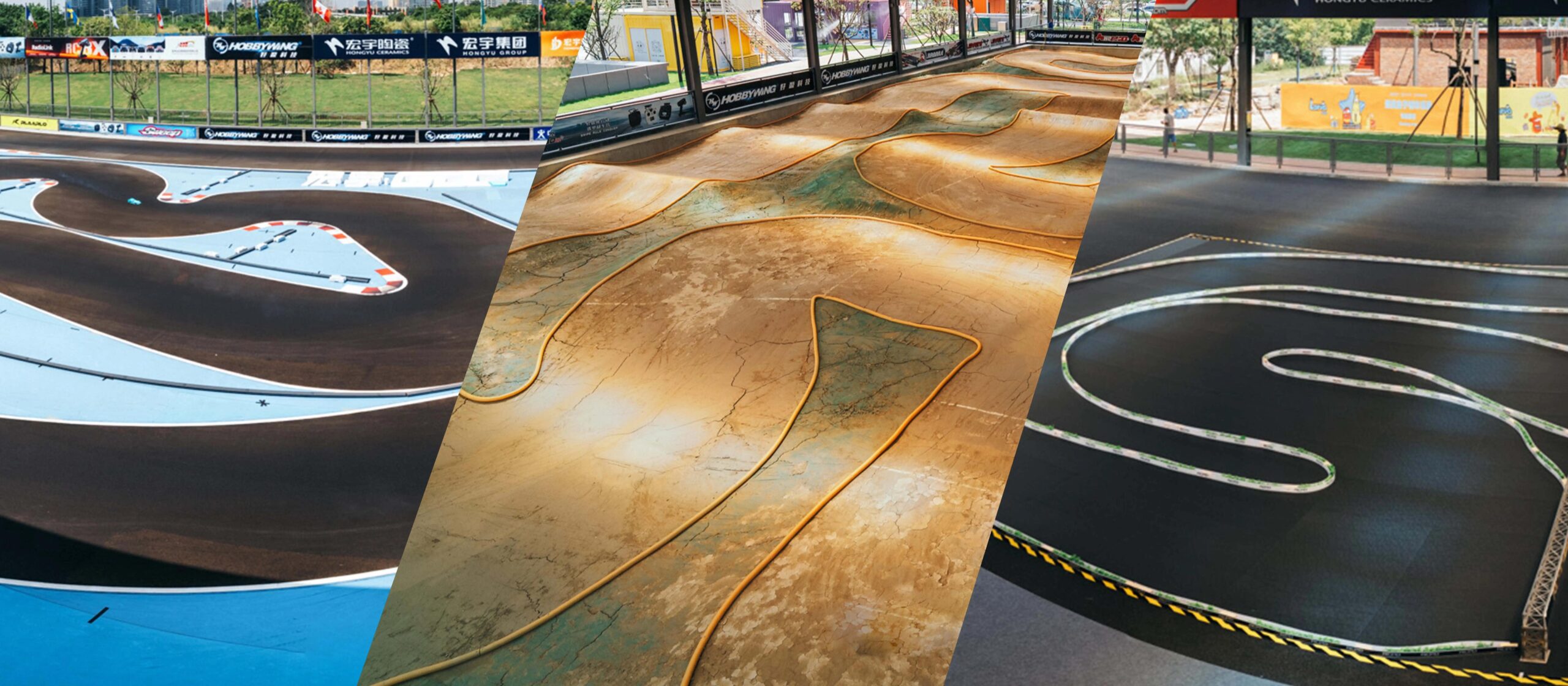
Indoor RC tracks operate within a climate-controlled environment using carpet, turf, or smooth epoxy surfaces that are appropriate for different racing classes. The indoor format eliminates weather dependency, allows year-round operation, and is compatible with mall and mixed-use entertainment venue integration where outdoor space is unavailable or impractical. Outdoor off-road tracks use dirt, clay, compacted soil, artificial turf, or modular ramp systems to create more technically demanding terrain with jumps, berms, elevation changes, and rugged surface simulation that delivers a more authentic motorsport feel. A hybrid model, offering an indoor circuit for precision and drift racing and an outdoor course for off-road and off-track formats, delivers the broadest possible vehicle category and audience coverage.
Vehicle Categories That Drive Participation
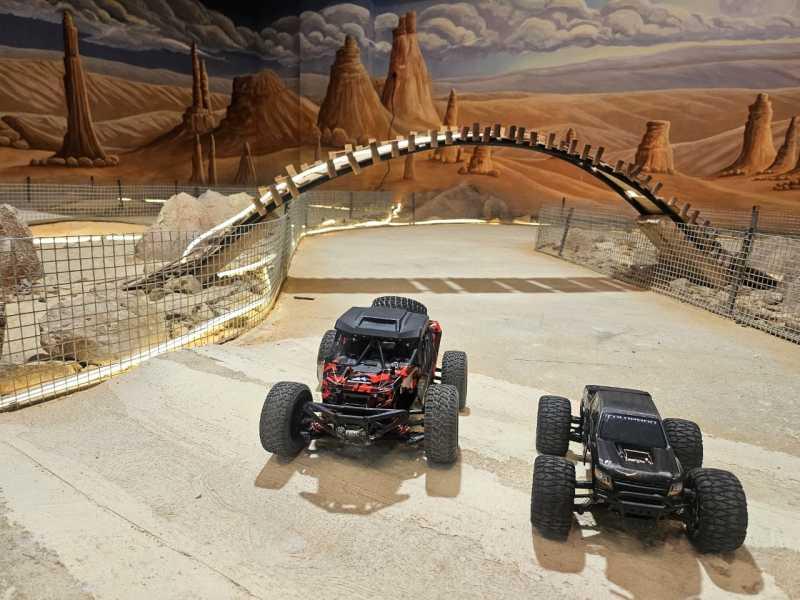
The range of vehicle categories that an RC racing venue supports determines its addressable audience width and the long-term depth of its community engagement. Each vehicle category attracts a distinct participant profile with different skill levels, investment capacity, and participation frequency.
- 1/10 and 1/8 scale electric buggies: the most accessible and widely popular class, with a large existing hobbyist community and strong entry-level participation from younger visitors
- Nitro-powered RC cars: attracting the more serious hobbyist segment seeking performance authenticity and the sensory experience of combustion engine sound and smell
- Short course trucks: offering a visually spectacular racing format with strong youth appeal and accessibility for beginners
- Drift cars for smooth indoor circuits: drawing the automotive and style-focused audience segment and generating strong social media content through the visual drama of controlled drift
- Rock crawlers for technical obstacle tracks: serving the precision-oriented hobbyist who values technical challenge over speed
- RC monster trucks for youth engagement: providing the most accessible and visually exciting format for family audiences and younger visitors
Offering a rental fleet across the two or three most accessible vehicle categories alongside hobbyist practice sessions expands the total addressable audience significantly, converting the curiosity of first-time visitors into participation without requiring the capital commitment of personal vehicle ownership.
Revenue and Monetisation Strategy
A well-structured revenue model for an RC racing venue captures value across multiple channels that serve different visitor types and engagement levels.
- Timed race session bookings for hobbyist practice and casual visitor participation
- Membership programmes offering unlimited or discounted weekly access to competitive players
- Hobby workshop sessions covering vehicle maintenance, tuning, and performance optimisation
- Vehicle and equipment rental packages for first-time and casual visitors
- Tournament entry fees for structured competitive events across vehicle classes
- Hobby retail integration selling spare parts, accessories, and upgrade components
- Café and spectator lounge food and beverage revenue
- Corporate team event packages with facilitated race programming and catering
Global Benchmark RC Racing Projects
01 | Silver Dollar RC Raceway Nevada, USA Silver Dollar RC Raceway is a professionally designed outdoor dirt track that has built a strong competitive community through consistent event programming and high-quality track maintenance. Its success in a market characterised by warm climate and strong hobbyist culture demonstrates the commercial viability of the outdoor RC racing format when the track design quality and event calendar are managed with the discipline of a genuine motorsport venue rather than a casual recreation facility. The raceway’s competitive programming, which includes national-level events that attract participants from across the region, illustrates the marketing and community value that high-profile competitive events generate for a venue beyond their direct revenue contribution. |
02 | RC Excitement Massachusetts, USA RC Excitement’s indoor carpet track, integrated with a full hobby retail store, represents one of the most commercially complete models for an indoor RC racing venue. The retail integration is commercially essential: hobbyists who race at the track are also natural customers for the spare parts, accessories, and upgrade components that the store sells, creating a self-reinforcing commercial ecosystem where participation at the track drives retail spending and retail relationships drive continued track participation. The consistent community engagement that RC Excitement has maintained through its combined racing and retail model demonstrates the commercial durability of the hybrid venue format for the hobbyist audience segment. |
03 | RC Land 23 Tokyo, Japan RC Land 23’s multi-level indoor format in Tokyo demonstrates how a premium, dense-urban-market RC racing venue can deliver a sophisticated and commercially successful product within the spatial constraints of a city-centre location. The venue’s league programming, which creates a structured competitive ladder across multiple vehicle classes and skill levels, is the commercial engine that drives the consistent weekly attendance and advance booking revenue that underpins its financial performance. For developers planning RC racing venues in high-density urban markets where outdoor space is limited and the hobbyist community is large but fragmented across multiple disciplines, RC Land 23 provides a directly applicable model of how indoor premium positioning and competitive programming depth can compensate for spatial constraints. |
Operational Planning and Risk Mitigation
Structured track maintenance, battery charging station management, ventilation planning for nitro vehicle operation, noise control design for urban or shared building environments, and clear spectator separation from the active racing area are the operational disciplines that determine the safety, quality, and regulatory compliance of an RC racing venue. A preventive maintenance schedule that addresses track surface conditions, safety barrier integrity, and timing system calibration on a defined weekly cycle is the operational foundation that sustains the experience quality and competitive credibility of the venue over time.
Frequently Asked Questions
The following questions address the most common planning and investment considerations for RC racing venue developers.
What is the minimum floor area required for a commercially viable indoor RC racing track? |
A compact but commercially viable indoor RC track can be developed from as little as 3,000 to 4,500 square feet of net racing floor area for a single 1/10 scale electric class track, sufficient to support eight to twelve simultaneous racing participants with basic spectator provision. A mid-scale venue offering tracks for two or three vehicle classes requires 6,000 to 10,000 square feet. The track layout within this area must achieve the minimum meaningful lap length of 60 to 80 metres for electric buggy classes, which constrains the minimum floor plate dimension in at least one direction to approximately 20 metres. |
How important is hobby retail integration to the RC racing venue business model? |
Hobby retail integration is commercially significant for venues targeting the serious hobbyist segment and strongly recommended as a component of any RC racing venue that plans to build long-term community loyalty rather than primarily serving casual and family visitors. The retail dimension creates a second commercial relationship between the venue and its most engaged participants: hobbyists who race at the venue are natural customers for the spare parts, accessories, tyres, and upgrade components that the store sells, and the store relationship strengthens their connection to the venue community beyond their racing participation. The retail integration also provides a revenue stream during periods when the track is not being actively used and reduces the overall customer acquisition cost by making the venue a multi-purpose destination for hobbyists. |
What is the most effective format for corporate group events at an RC racing venue? |
The most commercially successful corporate event format for an RC racing venue is a structured team relay race, where corporate groups are divided into teams of three to five participants who compete in a relay format over a defined race duration, with cumulative team scoring and a post-race prize ceremony. This format creates genuine competitive engagement across skill levels because the relay structure means that every team member contributes to the outcome regardless of individual driving ability. Combining this structured race format with a pre-race skills session that introduces participants to vehicle operation, and a post-race debrief with lap time analysis, creates a professional event experience that commands premium pricing and generates the enthusiastic post-event advocacy that drives subsequent bookings from the same organisation. |
What safety standards apply to a commercial RC racing venue? |
The primary safety requirements for a commercial RC racing venue relate to spectator separation, vehicle containment, and operational supervision. All spectator and participant seating areas must be separated from the active racing surface by barrier systems that prevent errant vehicles from reaching spectators at any credible speed and trajectory. Track boundaries must be clearly defined by foam barrier systems that contain vehicles within the racing area and absorb impact energy without creating secondary projectile hazards. Nitro-powered vehicle operation requires adequate ventilation to manage exhaust fume accumulation in enclosed indoor environments. Battery management for electric vehicles requires appropriate storage and charging protocols to prevent thermal runaway incidents. All of these requirements should be reviewed against the specific regulations of the relevant jurisdiction before the venue design is finalised. |
How does a RC racing venue build a sustainable competitive community? |
Building a sustainable competitive community requires consistent investment in three dimensions simultaneously. The first is programming quality: a regular, well-structured competitive calendar that includes both accessible beginner classes and genuinely challenging expert formats gives participants at every skill level a meaningful competitive context and a progression pathway that motivates ongoing participation. The second is community infrastructure: a clubhouse space, an online community platform, and the social culture that comes from a venue team that knows its regulars by name and treats the competitive community as the most important asset of the business. The third is inclusivity across skill levels: a venue that is welcoming and rewarding for beginners while remaining genuinely challenging for experts will grow its community across multiple demographics simultaneously rather than serving only one end of the skill spectrum. |
What is the typical payback period for an indoor RC racing venue? |
A well-designed and well-operated indoor RC racing venue in a market with a meaningful existing hobbyist community typically achieves payback within 24 to 42 months. Venues that develop strong membership programmes from the outset, creating a predictable recurring revenue base from committed regular participants, achieve payback at the faster end of this range. The integration of a hobby retail store adds capital requirement but typically improves the overall financial performance of the venue by creating an additional high-margin revenue stream that is directly correlated with the health of the racing community. |
Why Partner with Peach Prime Consultancy
Peach Prime Consultancy supports RC racing experience development with track layout planning, material selection guidance, feasibility studies, and revenue modelling. If you are developing an RC or off-road racing attraction, we ensure operational efficiency and commercial scalability from concept through to opening. Visit www.peachprime.in to arrange a planning consultation.
WHAT PEACH PRIME DELIVERS | Track layout and surface material planning, vehicle category and community strategy, revenue architecture and financial modelling, operational playbook development, and full investor presentation support. |