
Blogs
Entertainment District Planning for India’s Mixed-Use Townships
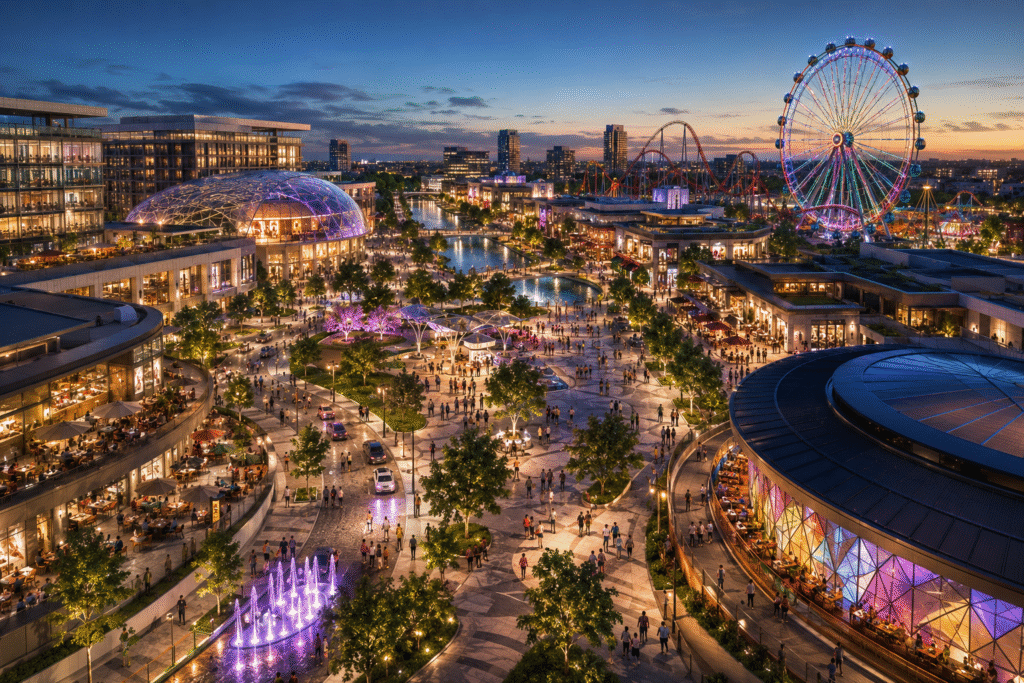
India’s large integrated townships have moved well beyond the residential-plus-mall formula that defined the first generation of projects. Developers now compete on lifestyle differentiation, and entertainment programming, from family entertainment centres to musical fountains and immersive public spaces, has become one of the clearest ways to do that. This guide looks at why entertainment districts matter to township economics, and what developers need to plan for when integrating one into a large-scale mixed-use project.
The Township Boom Behind the Opportunity
Integrated townships have been a recognised development category in India since the government’s 2005 Integrated Township Policy, and the model has since produced landmark projects such as Magarpatta City in Pune, Brigade Gateway and Bhartiya City in Bengaluru, Adani Shantigram in Ahmedabad, and DLF Cybercity in Gurgaon. These projects combine residential, commercial, retail, and social infrastructure inside a single master planned boundary, and the trend has continued into greenfield smart city scale developments such as GIFT City and Dholera Smart Investment Region in Gujarat. Township style development is now expanding rapidly beyond the traditional metro hotspots of Pune, Mumbai, and Bengaluru into Tier 2 cities, driven by land scarcity in city centres, a lifestyle shift toward experience-led living, and hybrid work patterns that make self-contained communities more attractive.
Why Entertainment Programming Moves the Numbers
Research into completed integrated township projects has found that mixed-use developments with strong amenity and social infrastructure programming see price appreciation between 15 and 30 percent higher than comparable single-use developments, and that particularly successful integrated townships have driven price appreciation of 20 to 40 percent in their surrounding micro-markets. Brigade Gateway in Bengaluru is frequently cited as an example where a well-executed mixed-use project measurably repositioned an entire location as a premium residential address. Entertainment and leisure infrastructure, distinct from generic retail, plays an outsized role in that repositioning because it is what differentiates one large township from another when the basic offering, homes, schools, hospitals, and a mall, has become table stakes.
The shift developers are making: from treating entertainment as a mall-anchored amenity to treating it as a designed district in its own right, with its own identity, footfall strategy, and revenue model, similar to how retail and hospitality are already planned as distinct components of a township master plan.
What an Entertainment District Actually Includes
- Family entertainment centre: an indoor anchor drawing repeat family visits year round, independent of weather or season.
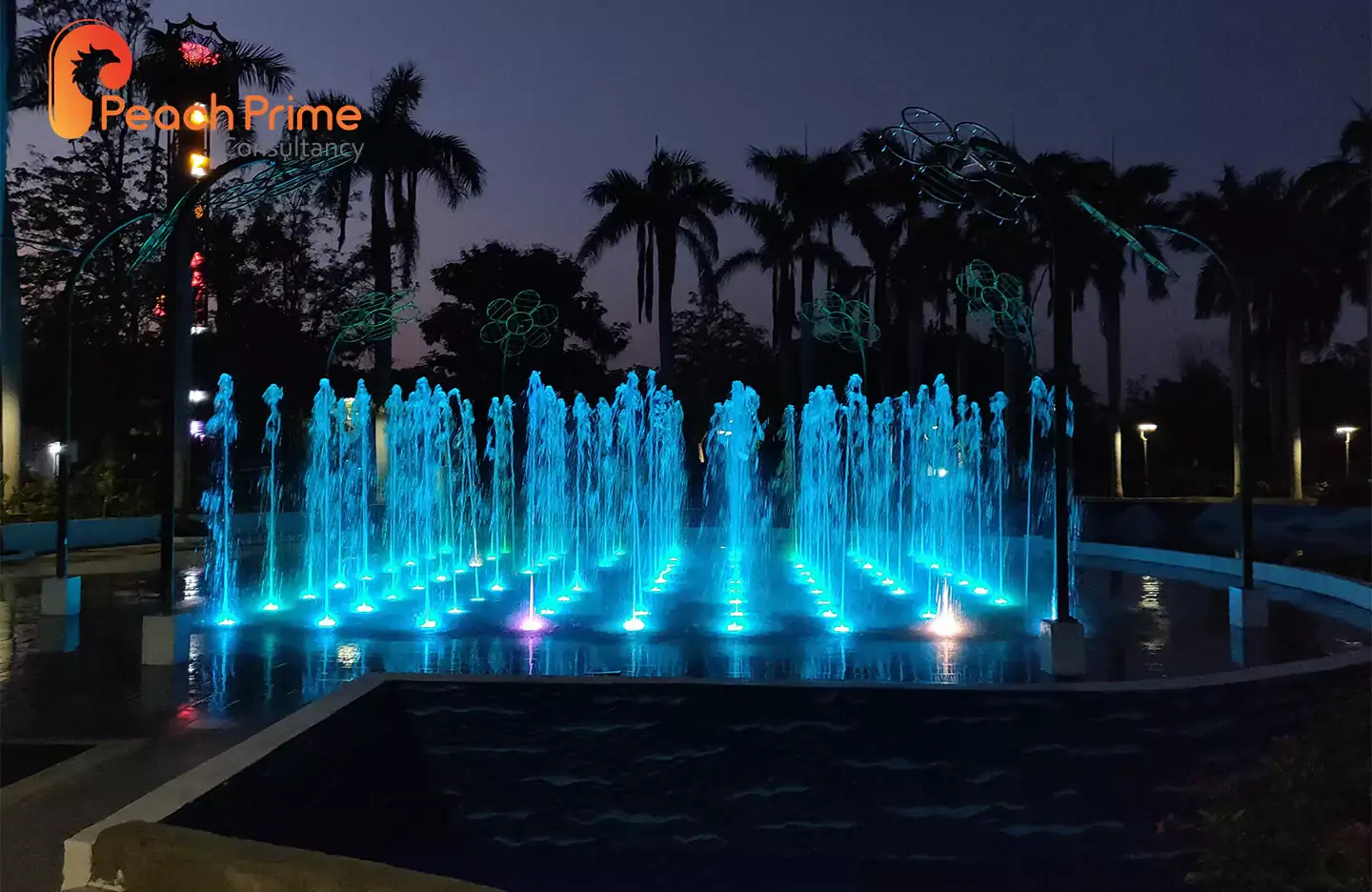
- Water and light features: musical fountains, light and sound shows, and glow gardens that function as low-maintenance, high-visibility landmarks for the township.
- Public realm and event space: plazas and amphitheatre-style spaces that can host markets, festivals, and community events, extending the district’s use beyond a single attraction.
- Food and beverage cluster: a dedicated dining precinct that extends dwell time and captures spend beyond ticketed attractions.
- Cultural or edutainment component: in larger townships, a small museum, science centre, or immersive experience venue that broadens the audience beyond families with young children.
Design and Planning Considerations for Developers
Consideration | Why It Matters |
Phasing against residential rollout | An entertainment anchor delivered too late misses the window to influence early sales momentum and pricing. |
Operator model | Developers must decide between operating the entertainment district in-house, leasing to a specialist operator, or a hybrid model, each with different capital and management implications. |
Zoning and land use mix | Entertainment components need to be zoned and licensed correctly from the outset, since retrofitting entertainment use into a purely commercial or retail zoned parcel is far more difficult. |
Catchment beyond residents | The strongest entertainment districts draw visitors from well beyond the township’s own resident base, which changes the scale and design brief significantly. |
Maintenance and lifecycle cost | Water features, ride equipment, and technology installations carry ongoing maintenance obligations that need to be budgeted into the township’s long-term facility management plan. |
Where Peach Prime Consultancy Fits
Peach Prime Consultancy provides master planning, FEC design, musical fountain design, and immersive experience design for large-scale entertainment, cultural, and hospitality components within bigger developments, including riverfront, lakefront, and waterfront master planning that is often central to a township’s public realm strategy. For a township developer, bringing this kind of specialist entertainment planning into the broader master planning process early ensures the entertainment district is designed as an integrated part of the township’s identity and phasing plan, rather than bolted on after the residential and commercial components are already locked in.
Frequently Asked Questions
Q. How much of a township’s land parcel should be allocated to entertainment and leisure use?
This depends heavily on the township’s scale and positioning, but successful mixed-use projects typically treat entertainment and public realm space as a core component of the master plan from the outset rather than an afterthought, with allocation decided alongside residential density and commercial floor space rather than after those are finalised.
Q. Should a township developer operate the entertainment district directly or bring in a specialist operator?
Many large townships use a hybrid approach, developing the infrastructure themselves while leasing operations to specialist FEC or attraction operators, which reduces the developer’s exposure to day-to-day operating risk while still capturing the land value uplift the entertainment district creates.
Q. Does an entertainment district only benefit residential sales, or does it generate its own revenue?
Well-designed entertainment districts typically do both: they support residential and commercial pricing through differentiation and placemaking, while also generating direct revenue through ticketing, food and beverage, and retail that operates largely independently of the residential sales cycle.
PLANNING AN ENTERTAINMENT DISTRICT FOR A TOWNSHIP?
Peach Prime Consultancy provides master planning, FEC design, and immersive experience design for large-scale mixed-use and township developments across India.
Market and township data referenced from Meraqi Advisors, Gensler, and published industry analysis of integrated township developments in India. Price appreciation figures are estimates from third-party research and should be validated against project-specific market studies.