

Blogs
What Topgolf, Flight Club, Puttshack and CAMP Teach Operators About Social Gaming
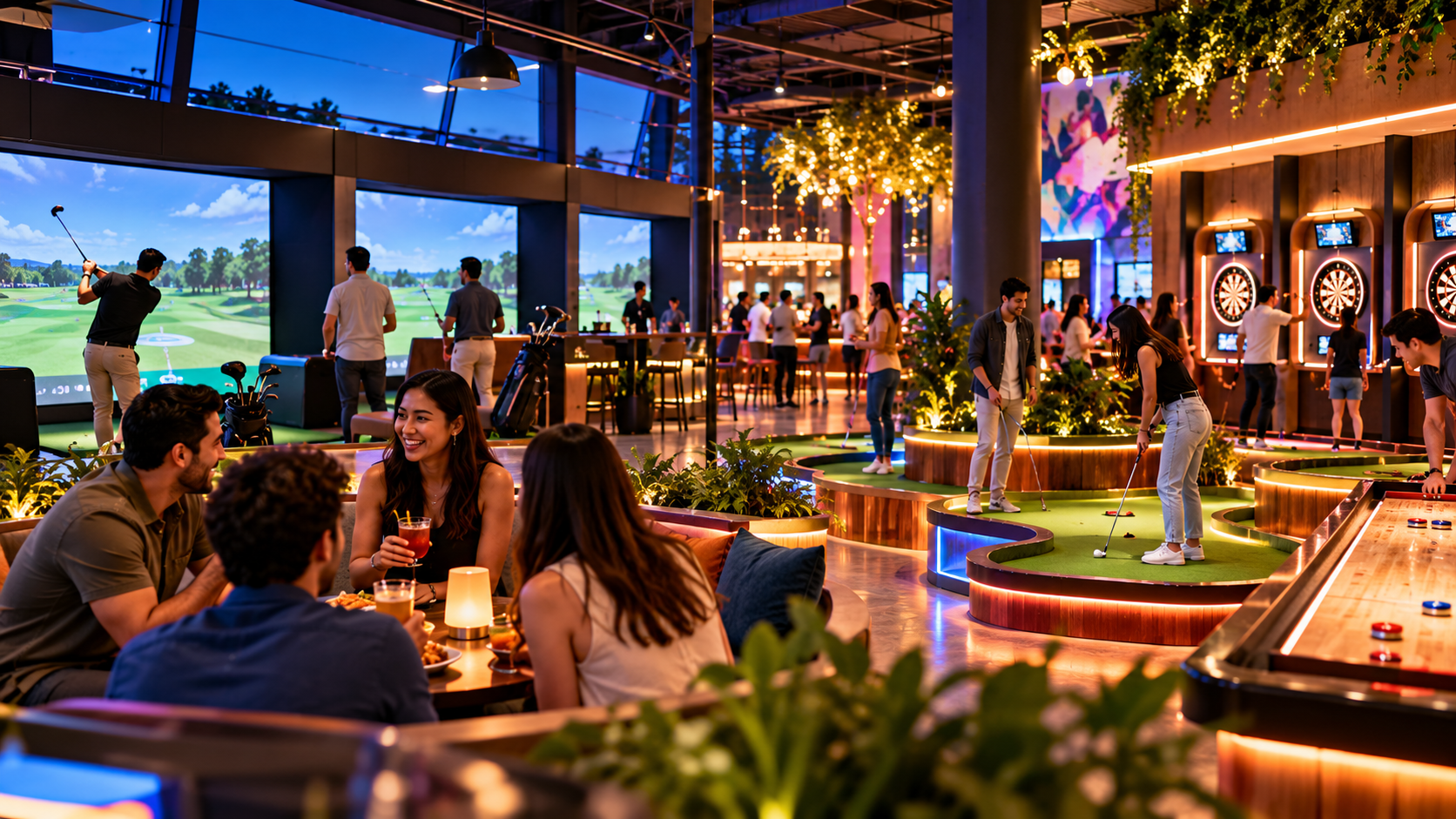
The last decade has seen a new category of entertainment venue take shape. Competitive socialising, as the UK trade press calls it. Eatertainment, as the US calls it. Social gaming, as most of the rest of the world now says.
Four brands sit at the front of the conversation. Topgolf. Flight Club. Puttshack. CAMP. They play different games in different formats, but they have made a similar bet about what a group of adults, or a family with teenagers, really wants from an evening out.
The bet is this. People do not go out to play a game. They go out to be together. The game is the excuse. The venue has to make being together easy, comfortable and worth staying for.
Here is what each brand does, and the common thread that connects them.
Topgolf: game bays plus food plus lessons
Topgolf started as a driving range with sensors on the balls. It has grown into one of the most recognisable social gaming formats in the world. The bay is the unit. A group of four to six books a bay for an hour or two. The group hits balls, scores through a screen, orders food and drinks to the bay, and watches each other play between turns.
What Topgolf gets right is the bay as a social space. Every seat has a view of the game. Food comes to the bay. The scoring is visible and simple enough for a first timer to join within one shot. Golf lessons sit alongside the social offer, so the venue serves people who care about skill as well as people who are only there for the evening.
A beginner, a casual player and a serious golfer can share one bay without any of them feeling out of place. That is the test the format passes.
Flight Club: darts plus table service plus replay
Flight Club took the pub game of darts and rebuilt it as a social format. Short turns. A visible digital score. A system that handles rules and scoring so the group does not have to. Table service so food and drinks come to the oche while the game continues.
The format works because darts was already an easy game to pick up visually. Flight Club removed the two blockers. Scoring is handled by the screens, so a first timer never has to do mental arithmetic. Replay rounds are easy to buy without leaving the group.
The result is a format where a confident thrower and a complete beginner can play the same round and both feel like they contributed.
Puttshack: mini golf plus dining plus events
Puttshack took the other easy social game, mini golf, and did a similar rebuild. Trackball technology scores the game automatically. Food and drink service runs throughout the course, not only at the end. Private spaces at the venue host corporate events, team days, parties and large group bookings.
Puttshack earns its dwell time two ways. The game itself is longer than a Topgolf bay or a Flight Club oche. And the venue is designed to carry a group from the game into dining and events afterwards without the group ever leaving the building.
CAMP: play plus making plus a shop
CAMP sits in a different corner of the category. Its focus is families with young children. The venue combines interactive play, a making or workshop component and a retail shop under one roof.
The structure matters. Play draws the family in. The workshop gives the child something to make. The shop gives the family something to take home. Each element reinforces the next, and the memory of the visit sits in the house afterwards in the form of the thing the child made or chose.
CAMP shows that the social gaming lesson is not only for adult venues. The same thinking applies to families, with the age appropriate equivalents of a game, a bay, food at the seat and a reason to come back.
The connection, not the brand
Four very different brands. Golf, darts, mini golf, family play. Different ticket sizes, different audiences, different hours of trading. And yet one connection runs through all of them.
Each brand joins a game to the social and commercial supports that keep a group inside the venue.
- Food at the game, not in a separate court
- Scoring handled by the venue, not the group
- Clear sightlines so spectators are part of the moment
- A clear next choice from where the group is already sitting
- A reason to come back, through a league, a workshop, a seasonal update or an event
The lesson for an FEC operator is not to copy any one of these brands. A regional venue is unlikely to beat Topgolf at Topgolf’s own game, and probably should not try. The lesson is to copy the connection.
That means asking, for your own venue, how the game connects to food, to seating, to scoring, to spectating and to the next visit. The strongest venues answer those questions in a single bay or a single space. The weakest venues answer them in five different zones with queues between each one.
How to apply the lesson
Three small moves bring the lesson into an existing venue.
Pick your strongest game. Not the newest, but the one guests already queue for. Build a bay around it. One game, one table, one group. Food to the seat. Service behind the seat. Scoring on a visible screen.
Add one event rhythm. A weekly league night, a monthly tournament or a quarterly challenge. Something that gives the game a social calendar and a reason to come back.
Make the next choice visible. From the bay, a guest should be able to see food, another activity and a party booking option without getting up. Signage, screens and staff pitches all help.
None of this requires a Topgolf scale budget. All of it uses the connections that Topgolf, Flight Club, Puttshack and CAMP have already proved work. The connection is the lesson. The brand is just one way of expressing it.