
A technical and commercial planning framework for developers designing professional RC racing arenas with precise surface engineering, RFID-based race control systems, and structured community programming that maximises throughput and long-term profitability.
Introduction: From Concept to Commercial Raceway
The development of a professional RC and off-road racing arena is a multidisciplinary planning challenge that spans structural engineering, surface material science, timing and race control technology, visitor circulation design, and community programme development. Each of these disciplines has its own internal logic and its own body of specialist knowledge, and the quality of the final venue is determined by how well they are integrated rather than by excellence in any single dimension.
This framework addresses each planning discipline in sequence, from the initial track surface engineering decision through to the capacity and community building strategies that determine long-term commercial performance. It is designed to give developers a complete and integrated planning architecture for an RC racing arena project that delivers both the technical precision that serious competitors demand and the commercial structure that investors require.
PLANNING PRINCIPLE | A professional RC racing arena that is designed purely for competitive quality without regard to throughput, community building, and revenue diversification will serve enthusiasts well but struggle commercially. One designed purely for throughput and revenue without regard to competitive credibility will generate early visits but fail to build the community loyalty that sustains long-term performance. The planning challenge is integrating both. |
Step 1: Track Surface Engineering
The track surface is the most foundational and the most technically demanding specification decision in RC arena development, because the grip, consistency, and durability of the surface directly determine the quality of the racing experience for every participant on every visit. A surface that is correct for the primary vehicle class served by the venue will deliver competitive racing quality. A surface that is a compromise between incompatible vehicle classes, or a cost-driven approximation of the appropriate specification, will consistently frustrate competitors and undermine the venue’s credibility with the serious hobbyist community.
Indoor Surface Options and Specifications
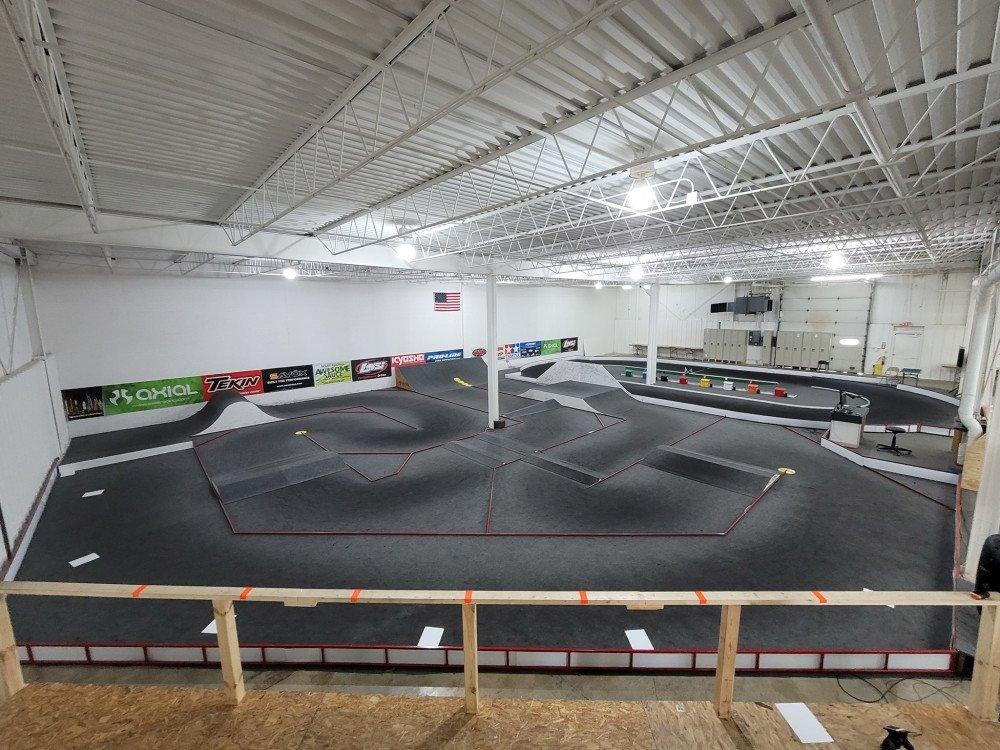
Carpet tracks, using a low-pile commercial carpet bonded to a flat rigid sub-base, are the standard surface for 1/10 and 1/12 scale electric on-road and touring car racing. The specific carpet specification, pile height, fibre type, and backing density, must be matched to the tyre compound of the vehicle class the track is designed to serve. Artificial turf in short-pile specifications provides an appropriate surface for smaller off-road classes and provides the terrain variation that carpet cannot deliver. Polished epoxy or commercial-grade smooth vinyl flooring provides the low-friction surface required for RC drift disciplines. Indoor surface maintenance requires daily cleaning to prevent rubber deposit accumulation and debris contamination that reduce grip consistency, and periodic deep cleaning or surface renewal when wear degradation affects competitive quality.
Outdoor Surface Options
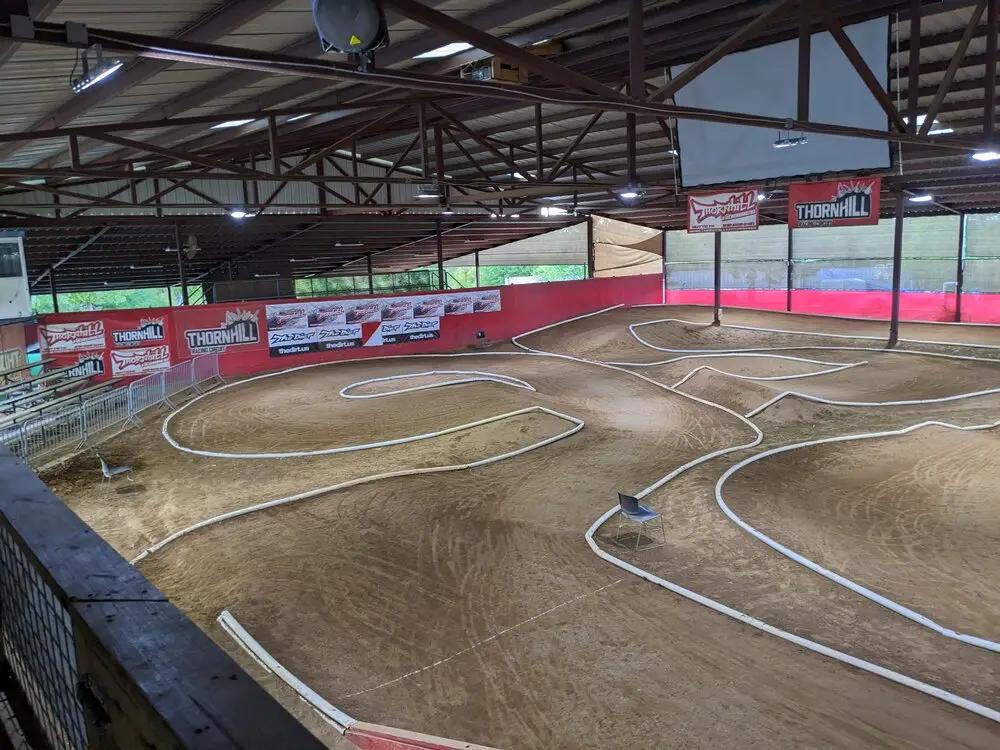
Outdoor off-road tracks use natural or processed clay and dirt as their primary surface, typically treated with a binding agent and compacted to provide a consistent, dust-controlled racing surface. The specific soil composition, moisture content management, and compaction specification determine the grip characteristics and durability of the surface under competitive use. Clay-based surfaces require regular watering and compaction maintenance to sustain their grip and texture characteristics. Artificial turf in longer-pile specifications provides a more weather-consistent alternative that requires less maintenance than natural dirt surfaces while delivering acceptable off-road terrain feel. Proper drainage engineering is the most critical infrastructure requirement for outdoor tracks, as poor drainage creates surface damage during and after rainfall that can render the track unusable for extended periods.
Step 2: Timing and Race Control Systems
The race control infrastructure of a professional RC racing arena is the technology layer that transforms a high-quality track into a genuine competitive venue. Without accurate timing, structured race management, and transparent scoring communication, the competitive quality of the racing is undermined regardless of the physical quality of the track.
RFID Lap Counting and Timing
RFID-based lap timing systems, using transponders mounted on each competing vehicle and detection loops embedded in the track surface at the start/finish line, provide the millisecond-accurate lap time data that competitive RC racing requires. The timing system must capture clean transponder reads for every vehicle on every lap without missed reads caused by transponder positioning, detection loop sensitivity settings, or vehicle speed variations. Multiple transponder loops, placed at the start/finish line and at one or more intermediate positions around the circuit, allow split-time data collection that provides competitors with the detailed performance feedback that motivates improvement and return visits.
LED Race Leaderboards and Digital Scheduling
Real-time race leaderboards displayed on large-format LED screens visible from both the pit zone and the spectator area transform the competitive energy of a race session from a technical exercise into a shared spectacle. Live position updates, current lap times, gap-to-leader data, and fastest lap records create the context that makes racing meaningful for spectators as well as competitors. Digital scheduling platforms that manage heat assignments, qualifying result processing, and final race staging automatically reduce the administrative burden on race control staff and ensure that the competitive programme runs on schedule, which is the operational standard that serious hobbyists expect from professional venues.
Step 3: Capacity and Community Building
The long-term commercial viability of an RC racing arena depends on its ability to build and sustain a community of regular participants whose engagement with the venue goes beyond occasional casual sessions into the weekly practice, competitive participation, and social belonging that define the hobbyist club model.
Structured Community Programming
A beginner workshop programme that introduces new participants to vehicle operation, track rules, and competitive etiquette converts the curious first-time visitor into a community member. Hobby repair clinics staffed by experienced participants or professional technicians provide the technical support that helps beginners progress beyond the initial frustration of mechanical issues, and creates a social occasion that strengthens the community bonds of the venue. Youth leagues that run on a term-based school-year calendar build the next generation of the venue’s core community while generating family attendance that extends per-visit spending to the parent demographic.
Championship Tournament Programming
Sponsored championship events that attract participants from across the region elevate the competitive status of the venue within the national hobbyist community and generate media coverage, social media content, and community excitement that reinforces the venue’s identity as a serious competitive destination. Championship events should be structured with multiple vehicle class competitions running simultaneously to maximise participant numbers and spectator appeal, with appropriate recognition and prize structures for each class that reflect the competitive seriousness of the hobbyist participants.
International Case Studies
01 | AMSCI RC Raceway Arizona, USA AMSCI RC Raceway is a dedicated indoor racing community venue that has built one of the strongest competitive memberships of any RC facility in the American Southwest through consistent tournament programming and a strong emphasis on accessibility for participants at all skill levels. The venue’s success in maintaining high attendance across multiple race classes simultaneously reflects the quality of its scheduling and race management infrastructure, which allows complex multi-class competitive events to run efficiently and fairly. For developers planning the competitive programming infrastructure of a new professional venue, AMSCI’s race management approach provides a practical and proven template for managing the operational complexity of multi-class competition. |
02 | Robin Hood Raceway UK Robin Hood Raceway represents the outdoor off-road club racing model at its most commercially sustainable, having maintained strong community engagement over many years through a combination of high-quality track maintenance, consistent competitive programming, and the strong social culture that outdoor club racing venues create among their participant communities. The venue’s outdoor format, with its natural terrain variation and seasonal racing calendar, delivers an authenticity of off-road racing experience that indoor venues cannot match, and its community of regular participants demonstrates the loyalty that authentic competitive experience builds when it is delivered with consistent quality. |
03 | Tamiya Circuit Shizuoka, Japan The Tamiya Circuit demonstrates the commercial power of integrating product retail with competitive venue operation. Every participant racing at the circuit is a potential customer for the Tamiya product range available in the adjacent store, and the competitive environment creates the most compelling possible demonstration of product performance. The circuit’s focus on Tamiya product compatibility creates a tightly integrated commercial ecosystem that serves both the competitive community and the company’s commercial objectives, making it a model for any manufacturer or distributor considering venue investment as a customer engagement strategy. |
Future-Proofing the Investment
The RC racing arena sector is evolving toward greater sustainability and digital integration on two fronts simultaneously. The emergence of competitive electric-only racing categories, aligned with the broader shift in the automotive industry toward electric propulsion, creates a sustainability positioning opportunity that resonates with the values of younger participants and corporate clients. Digital broadcasting of competitive events through social media and esports content platforms extends audience reach beyond physical attendance, creating the media content that builds the venue’s competitive reputation and brand visibility far beyond the local hobbyist community.
Frequently Asked Questions
The following questions address the technical and commercial planning priorities for professional RC arena developers.
What is the most important investment priority when developing a first professional RC racing arena? |
The single most important investment priority for a first professional RC racing arena is the track surface engineering quality. Every other element of the venue, the timing systems, the community programming, the retail integration, depends on the track being good enough to attract and retain serious competitive participants. A timing system installed on a mediocre track will accurately measure mediocre racing. A premium track with adequate timing and basic facilities will attract the serious hobbyist community whose participation generates the revenue and community energy that justifies every subsequent investment. Invest in the track first and allow the community its facilities generate to inform the prioritisation and timing of every subsequent development decision. |
How should an RC arena balance walk-in casual visitors with serious competitive hobbyists? |
Balancing casual and serious participant segments requires deliberate spatial and temporal separation of their respective experiences rather than attempting to serve both simultaneously in the same physical space. Designating specific session windows for casual rental participants and separate sessions for competitive practice and races allows each segment to use the track in an environment calibrated to their needs: casual participants on a managed track with supervision support, competitive hobbyists in sessions with the rules and race management standards they expect. A beginner pathway programme, with structured introductory sessions that progress new participants toward competitive participation, creates the pipeline from casual to community member that sustains long-term growth of the competitive segment. |
What are the most common planning failures in RC racing venue development? |
The three most common and commercially consequential planning failures are undersized pit zones that create the social and operational congestion that drives community members to competing venues, insufficient power infrastructure for battery charging at peak session loads, and a competitive programme that is too narrowly focused on a single vehicle class to attract the breadth of participants needed to sustain viable race entry numbers. Pit zone sizing is consistently the dimension most underestimated in early planning, as the social function of the pit area, where the community congregates between races, requires significantly more space per regular participant than the functional minimum for vehicle preparation. Power infrastructure that cannot support simultaneous charging of the full participant fleet at peak session loads creates the battery management frustrations that reduce competitive session quality and generate participant dissatisfaction. |
How does the RFID timing system affect the competitive experience? |
A high-quality RFID timing system transforms the competitive experience from a sequence of heats and finals where participants know only the finishing order to a data-rich performance environment where every participant has access to their own lap time progression, sector time comparisons, and historical performance records that allow them to measure their improvement over time. This performance data dimension is one of the most powerful engagement drivers in the competitive RC racing format: participants who can see their lap times improving return more frequently and invest more in their vehicles to continue improving, creating a virtuous cycle of performance motivation and commercial engagement that sustains community participation across the competitive skill development arc from beginner to expert. |
What sponsorship categories are most relevant for a professional RC racing arena? |
The most commercially aligned sponsorship categories for a professional RC racing arena are RC vehicle and component manufacturers seeking competitive exposure for their products, automotive accessory and performance brands targeting enthusiast demographics, battery and electronics brands relevant to the electric vehicle segment, and broader consumer brands targeting the young adult male demographic that forms the core of most competitive RC communities. Title sponsorship of championship events is the most commercially significant individual sponsorship package, combining brand naming rights for the event with competition floor presence and social media integration across the event’s coverage. Equipment partnership agreements, where a specific brand’s products are used as standard equipment at the venue in exchange for product supply and financial support, create ongoing brand exposure across every race session rather than only during sponsored events. |
How should an RC arena approach the development of an electric-only racing category? |
Developing a dedicated electric-only racing category is both a competitive development opportunity and a sustainability positioning strategy that is increasingly relevant to corporate clients and family audiences. Electric-only categories eliminate the noise, exhaust, and fuel handling requirements of nitro classes, making them more compatible with indoor and urban venue environments, more accessible for younger participants, and more appealing to corporate clients with sustainability mandates. The competitive appeal of electric-only racing is strong: modern LiPo battery technology and brushless motor systems deliver performance that matches or exceeds comparable nitro-powered vehicles in most racing applications, and the lower ongoing running cost of electric operation makes the format more accessible to entry-level participants. Establishing an electric-only class alongside existing petrol categories, rather than replacing them, allows the venue to serve both segments while positioning itself at the forefront of the format’s evolution toward full electrification. |
Develop with Experienced Entertainment Planners
Peach Prime Consultancy provides detailed master planning, technical coordination, and financial modelling for motorsports-themed entertainment venues. From track surface engineering through to competitive programming strategy and investor financial modelling, we ensure your RC racing arena delivers both competitive credibility and commercial sustainability. Visit www.peachprime.in to arrange your planning consultation.
WHAT PEACH PRIME DELIVERS | Track engineering and surface specification, RFID timing and race control system planning, community programming strategy, capacity and throughput optimisation, and full financial modelling for investor presentations. |