
A technical design and operational planning guide for developers engineering professional RC racing arenas with precision track layouts, spectator integration, and competitive community programming that drives sustainable commercial performance.
Introduction: Engineering as the Foundation of RC Racing Excellence
The quality of an RC racing arena as a competitive venue is inseparable from the quality of its engineering. A track that looks visually impressive but delivers inconsistent grip, unpredictable corner behaviour, or dangerous contact zones between competitors will fail to attract or retain the serious hobbyist community that is the commercial foundation of any sustainable RC racing operation. Conversely, a track that is engineered with precision, built to the dimensional standards that enable genuinely competitive racing at all skill levels, and maintained to a consistent quality standard over time, builds the competitive credibility that drives the community formation and repeat participation that sustain long-term commercial performance.
This guide approaches RC racing arena design from the perspective of the engineer and the operator simultaneously, addressing the technical disciplines of track layout, surface specification, and infrastructure installation alongside the operational and commercial decisions about flow management, community programming, and revenue optimisation.
DESIGN PRINCIPLE | Precision engineering in RC racing track design is not a luxury reserved for professional-grade facilities. It is the baseline requirement for any venue that aims to build a competitive community rather than serve only casual visitors, because serious hobbyists immediately and correctly evaluate track quality against established racing standards. |
Designing the Racing Flow
The flow architecture of an RC racing venue, the sequence of spaces through which participants and spectators move from arrival through to active racing and departure, determines both the quality of the experience and the operational efficiency of the venue. A well-planned flow architecture separates the functions of preparation, practice, competition, and spectating spatially and temporally, creating a coherent experience for each participant type while maintaining the safety separation between active vehicles and non-participant visitors that is the primary operational safety requirement.
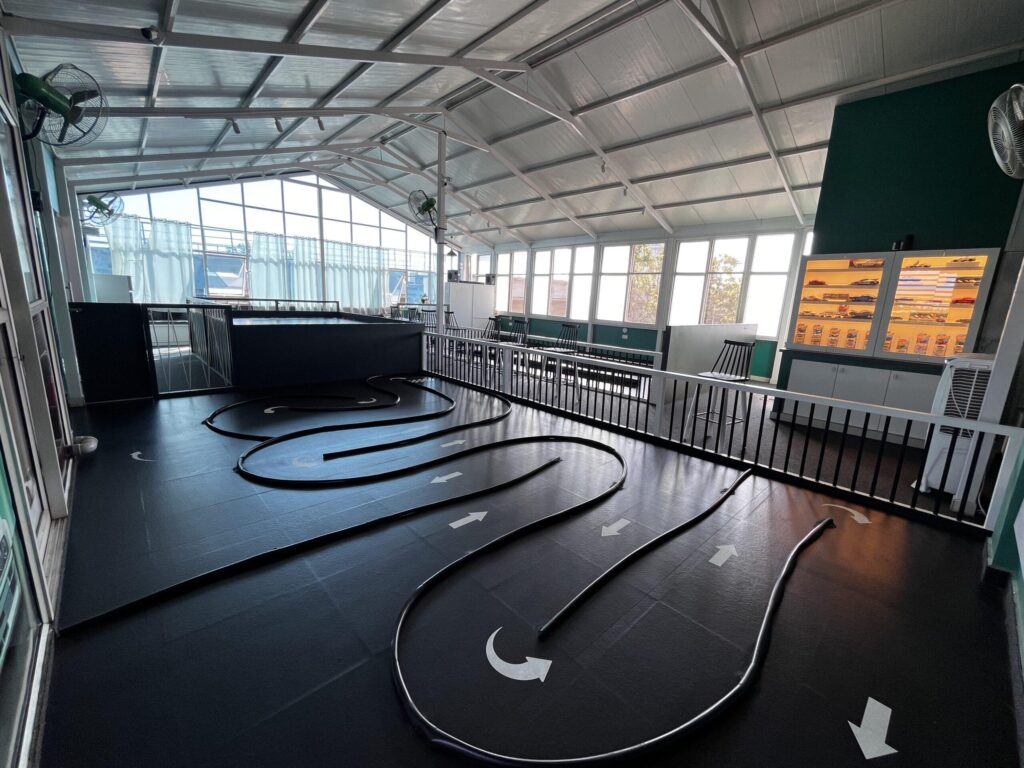
The optimal flow sequence begins with a structured pit zone where participants prepare and maintain their vehicles, adjacent to a practice lane where new participants and returning drivers can develop their skills without the pressure of formal competition. The competitive circuit itself is accessed from the pit lane through a designated marshalling area where race control can stage and release vehicles for each race. Spectator seating is positioned for maximum sightlines to the most visually engaging sections of the track, particularly the main straight and the most technically demanding corner complexes, without creating conflict with participant circulation areas.
Pit Zone Design
The pit zone is the social and operational heart of the RC racing venue and its design quality has a direct and significant impact on the sense of community that the venue creates. Individual pit spaces with adequate width for vehicle preparation, tool storage, and battery charging should be provided for regular participants through membership arrangements. A shared preparation bench with adequate lighting for close assembly work, accessible power points at appropriate intervals, and a battery charging station with sufficient simultaneous charging capacity for peak day session loads are the infrastructure essentials of a functional pit zone. The pit zone should be positioned adjacent to the race control area to allow marshals and race officials to communicate directly with participants, and its orientation relative to the track should provide direct access to the practice lane and race circuit entry.
Commercial Optimisation Through Programming
The commercial performance of an RC racing arena is determined as much by the quality of its competitive programming as by the quality of its physical facilities. A well-designed track that runs only casual open practice sessions will consistently underperform commercially relative to a comparable facility that runs structured beginner training, competitive leagues, and sponsored championship events.
- Beginner training programmes: structured introductory courses for first-time participants, including vehicle operation basics, racing etiquette, and track navigation, that convert casual visitors into regular members
- Youth hobby leagues: term-based competitive programmes for younger participants that build the next generation of the venue’s core community while creating strong family group attendance
- Corporate racing nights: exclusive venue hire with facilitated team relay racing, scoring, and catering that serves the premium B2B market and fills weekday evening capacity
- Sponsored championship events: multi-class competitive championships with external title sponsorship that generate media coverage, community excitement, and prestige that reinforces the venue’s competitive identity
Infrastructure Essentials
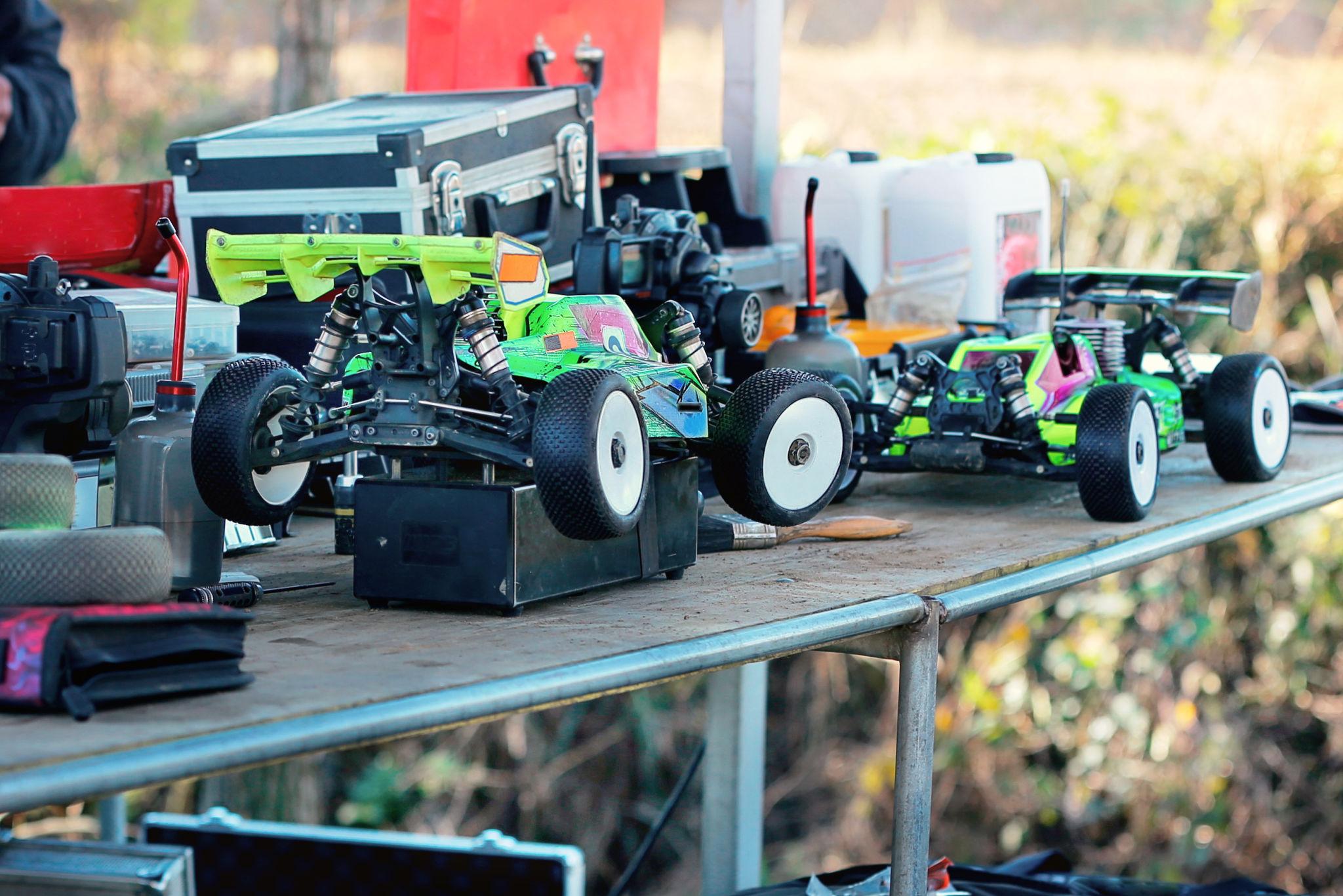
The technical infrastructure of a professional RC racing arena must address power management, timing precision, visual communication, environmental management, and security simultaneously.
- Power charging stations: commercial-grade LiPo battery charging infrastructure with appropriate amperage per bay, thermal monitoring, and fire-safe storage for charged and discharged batteries
- Timing systems: RFID transponder-based lap timing with millisecond accuracy, integrated scoring display for race control, and live leaderboard screens visible from spectator and pit areas
- Track lighting: consistent, shadow-free illumination across the full track surface, with lighting specification that eliminates the reflective glare that can disorient drivers and spectators
- Dust control systems for outdoor dirt tracks: regular watering schedules, dust suppressant applications, and sealed pit zone surfaces to maintain safe air quality and consistent surface conditions
- CCTV monitoring: comprehensive camera coverage of the full track perimeter and pit zone for safety monitoring, incident review, and community content generation
International Case Studies
01 | Hudy Racing Arena Slovakia Hudy Racing Arena in Slovakia represents the premium European indoor RC racing venue model and is widely regarded as one of the best-designed competitive RC facilities in the world. The venue’s track layout, which combines high-speed sections with technically demanding obstacle sequences and wide run-off areas at all critical impact zones, delivers racing conditions that are simultaneously accessible for hobbyist participants and genuinely challenging for expert competitors. Its RFID timing infrastructure, real-time leaderboard displays, and professional race control setup provide the competitive infrastructure standard that attracts serious hobbyists from across the region. For developers seeking a technical benchmark for premium indoor track design, Hudy Racing Arena is the most directly applicable reference available. |
02 | Tamiya Circuit Shizuoka, Japan The Tamiya Circuit, operated by one of the world’s most respected RC vehicle manufacturers at their headquarters in Shizuoka, represents the brand-backed track model that integrates competitive racing with product showcase and retail. Every vehicle competing on the circuit is a living advertisement for the Tamiya product range, and the retail store adjacent to the track allows participants to immediately access the parts and vehicles they have seen used by competitive drivers. The circuit’s focus on the Tamiya product ecosystem creates a tightly integrated commercial model that serves the company’s brand and commercial objectives simultaneously, providing a template for any RC manufacturer or distributor considering venue investment as a community-building and brand-activation strategy. |
03 | SDRC Raceway USA SDRC Raceway represents the dedicated competitive community model of American indoor RC racing, with a programming calendar structured around the specific needs and preferences of its established hobbyist membership base. The venue’s success in sustaining strong community engagement over time reflects the quality of its competitive programming, specifically the depth and variety of its race class structure, which provides meaningful competition for participants across a wide range of vehicle types and skill levels simultaneously. For developers designing the competitive programming infrastructure of a new venue, SDRC’s class structure and race scheduling approach provides a practical and proven template. |
Future Trends in RC Racing Arenas
The RC racing arena sector is approaching a set of technology-driven changes that will reshape the competitive and commercial landscape of the format over the coming decade. Hybrid AR-enhanced RC racing experiences, where physical vehicles are combined with augmented reality overlays visible through smartphone screens or trackside displays that add digital game elements to the physical racing, are beginning to emerge as a commercially viable format that extends the appeal of RC racing to the digital gaming audience segment. Live-streamed tournament broadcasting, where competitive events are produced and distributed to online audiences through dedicated esports content platforms, expands the audience reach of venue events beyond physical attendance and creates the media content that builds the venue’s brand and competitive reputation globally.
Frequently Asked Questions
The following questions address the technical and operational planning priorities for RC racing venue developers.
What are the critical dimensional requirements for a competitive RC circuit? |
A competitive RC circuit for 1/10 scale electric touring car or buggy classes requires a minimum lap length of 60 to 80 metres, with lane widths of at least 1.5 metres on straights and 2 metres or more through corner sequences to allow multiple-vehicle simultaneous racing without forced contact. Corner radii must be sufficient for the maximum speed of the vehicle class to allow safe and competitive overtaking without requiring extreme defensive blocking. Straight lengths should provide meaningful top speed attainment without exceeding the circuit boundary, and the ratio of technical corner sections to flowing higher-speed sections should reflect the competitive balance the venue aims to achieve between precision driving and outright speed. These dimensional requirements should be validated against the specific performance characteristics of the vehicle classes the venue plans to support before the track layout is finalised. |
How should track surface selection be matched to vehicle category? |
Track surface selection must be matched precisely to the tyre compound and suspension characteristics of the vehicle classes the track is designed to serve. 1/10 electric touring cars perform optimally on tight-pile carpet or smooth polished epoxy surfaces that provide high, consistent grip. Off-road buggy and truck classes perform optimally on loose dirt, clay, or artificial turf surfaces that provide the traction variation and terrain challenge appropriate to their suspension and drive system design. Drift vehicles require smooth, low-friction surfaces that allow controlled rear tyre slip. Mixing incompatible vehicle classes on a surface optimised for a different category creates safety risks and competitive unfairness that damage both the competitive programme and the venue’s reputation. Venues planning multi-class operation should either design separate track sections for each class or select a surface compromise that is acceptable across multiple classes at the cost of optimal performance for any single class. |
What race control systems are required for a professional RC racing programme? |
A professional RC racing programme requires at minimum a transponder-based lap timing system with millisecond accuracy, a race management software platform that handles heat scheduling, qualifying results, and final race staging automatically, and a live display system that shows current race standings and lap times to drivers, their pit crews, and spectators simultaneously. More advanced venues add automated race marshalling protocols, false start detection, and penalty management systems that reduce the dependence on manual race official intervention during competitive sessions. The race control infrastructure should be housed in a dedicated booth with unobstructed sightlines to the full track surface and direct communication capability with marshals at all critical track sections. |
How much maintenance does an RC racing track require? |
Maintenance requirements vary significantly by surface type and venue format. Indoor carpet tracks require vacuuming and debris removal after each operating day, periodic deep cleaning to maintain surface consistency, and replacement of worn or damaged sections when grip levels fall below the standard established at installation. Outdoor dirt and clay tracks require regular watering and compaction to maintain surface consistency, post-event grading and repair of ruts and surface damage, and periodic full surface replacement when wear or weather damage has degraded the racing quality beyond what surface treatment can restore. All track types require regular inspection and maintenance of safety barriers, timing system transponder loops, and spectator separation infrastructure to ensure they meet the safety standards required for public operation. |
How can an RC racing venue attract first-time visitors effectively? |
Attracting first-time visitors to an RC racing venue requires addressing the knowledge and accessibility barriers that prevent curious potential participants from making their first visit. A dedicated beginner experience package that provides everything a first-time visitor needs, vehicle rental, basic training, track access, and a structured introductory race, removes the intimidation of arriving at an established hobbyist venue without knowledge or equipment. Corporate and family event packages that present RC racing as a complete facilitated experience rather than a self-directed hobby activity reach audience segments that would never self-identify as RC enthusiasts but find the format genuinely engaging when introduced through a structured and supported event context. Social media content that showcases the accessibility and fun of the beginner experience specifically, rather than only the technical sophistication of advanced competitive racing, addresses the intimidation barrier that prevents many potential visitors from taking their first step. |
What is the most important operational discipline for sustaining long-term RC community engagement? |
The single most important operational discipline for sustaining long-term RC community engagement is the consistent quality and regularity of the competitive programming calendar. A competitive community forms around reliable, well-organised competitive events that give participants genuine reasons to prepare, improve, and return. When the competitive calendar is inconsistent, events are cancelled or poorly organised, or racing classes are not managed with fairness and professionalism, the community fragments and participants migrate to other venues or disciplines that offer the competitive environment they value. Investing in a dedicated programming manager who is responsible for the competitive calendar, the race management systems, and the community communication channels, and treating this role with the same commercial priority as the venue’s physical maintenance and financial management, is the operational commitment that distinguishes venues with enduring competitive communities from those that generate early enthusiasm without sustaining it. |
Partner with Peach Prime Consultancy
Our advisory model ensures technical precision in track design, spectator engagement architecture, and long-term financial sustainability for RC racing and motorsports entertainment venues. Peach Prime Consultancy provides expert planning support from initial concept through to operational launch. Visit www.peachprime.in to arrange your strategic planning consultation.
WHAT PEACH PRIME DELIVERS | Track layout and flow engineering, surface material specification, infrastructure planning, competitive programming strategy, revenue architecture and financial modelling. |