
Blogs
Government Museum Consultant in India: DPR Preparation, Tenders, and PPP Capability
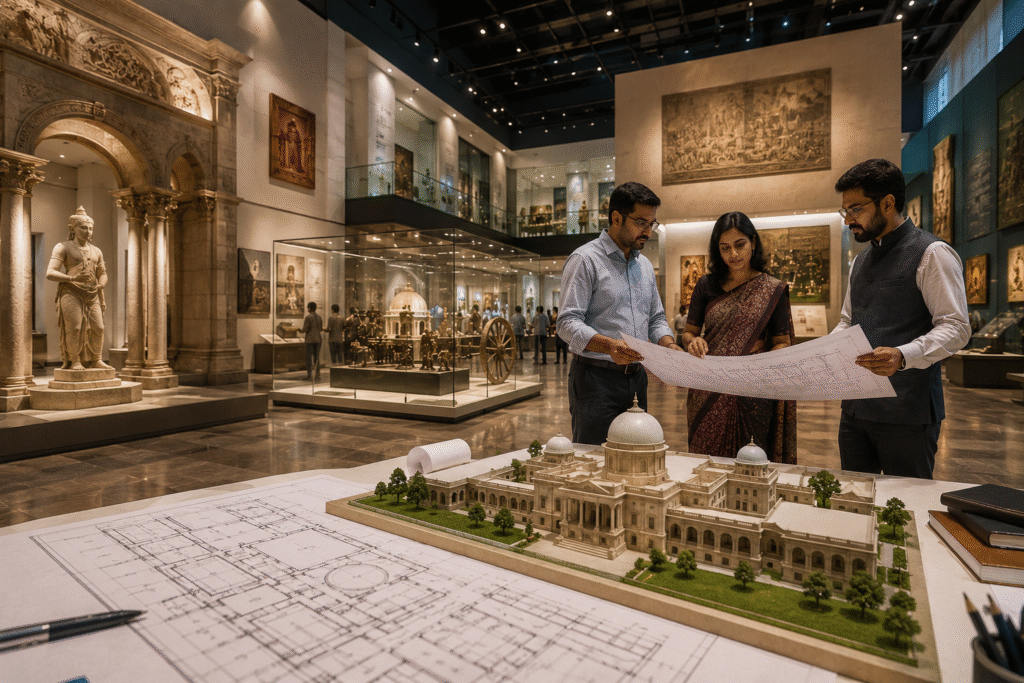
Government museum, planetarium, and cultural infrastructure projects in India follow a very different path to private sector attractions. They move through detailed project reports, formal tender processes, and often public private partnership structures, each with its own documentation and approval requirements. For state cultural departments, tourism boards, and municipal bodies evaluating a design consultant for a public museum project, understanding this process, and what to look for in a partner who can operate within it, is the first step toward a project that survives procurement and reaches completion.
How Government Museum Projects Reach the Market
Museum, planetarium, and cultural infrastructure projects typically originate from a state tourism, culture, or heritage department, and move through several stages before construction begins: a conceptual proposal, a detailed project report, a tender or request for proposal to select a design and execution consultant, and in some cases a further procurement round to select construction and PPP operating partners. A recent example is the Gujarat government’s tender for the preparation of a DPR and full project consultancy for the Bharatiya Kaal Avadharana Museum, a planetarium, and an iconic sculpture at Veraval in Gir Somnath district, which illustrates the typical scope: DPR preparation bundled with ongoing project execution consultancy rather than a one-off report.
What Goes Into a Museum DPR
- Market and demand assessment, including projected visitor numbers and catchment analysis.
- Site analysis, master plan, and architectural concept with supporting drawings.
- A detailed cost estimate and bill of quantities.
- A financial model covering both capital cost and, where relevant, operations and maintenance economics.
- A phasing and implementation schedule.
- Statutory and regulatory compliance notes, including environmental and heritage clearances where applicable.
- Recommended procurement route, including whether the project should proceed as EPC, PPP, or a hybrid structure.
DPRs above certain cost thresholds, generally in the range of INR 100 crore or more, are often required to include an economic internal rate of return analysis and a formal societal benefit assessment, since public funds are being committed against a documented public value case rather than a purely commercial one.
Procurement Routes: EPC vs PPP for Museums
Route | How It Works | Typical Fit |
EPC (Engineering, Procurement, Construction) | Government funds and owns the project outright; contractor delivers to specification | Fully public funded museums with no private revenue share |
PPP (Public Private Partnership) | Private partner co-invests and takes a share of project revenue; government shares initial risk | Museums with strong footfall and ticketing or F&B revenue potential |
Hybrid / Design-Build with VGF | Government provides Viability Gap Funding support through schemes such as IIPDF, private partner builds and may operate | Large cultural infrastructure where full private funding is not commercially viable alone |
Note on PPP support: the Department of Economic Affairs’ Private Investment Unit maintains India Infrastructure Project Development Fund and Viability Gap Funding schemes specifically to help structure PPP projects, including cultural and tourism infrastructure, where a government agency wants private participation but the project is not fully self-funding on its own.
What Public Sector Clients Should Look For in a Consultant
- DPR track record: demonstrated ability to produce authority-ready documentation that clears government review on first submission, since resubmissions cost months of delay.
- Multi-disciplinary capability: architecture, exhibit design, cost estimation, and financial modelling under one roof, rather than a consultant who subcontracts each discipline separately.
- Understanding of statutory processes: familiarity with the specific approval chain for the relevant state or municipal authority, since these vary significantly across India.
- Experience across procurement routes: comfort structuring a project for EPC, PPP, or hybrid VGF funding, since the right route is not always decided before the DPR is written.
- Post-tender delivery capability: the ability to carry a project through construction supervision and commissioning, not just win the DPR mandate and step back.
Where Peach Prime Consultancy Fits
Peach Prime Consultancy offers project feasibility studies, market research, and detailed project reports for museums, theme parks, water parks, and family entertainment centres across India, positioning these reports as the roadmap that helps clients make informed investment decisions from concept through to completion. For government clients, this means a single consultancy relationship covering the DPR, master planning, exhibit and architectural design, and construction supervision phases of a public museum or cultural infrastructure project, reducing the coordination burden that typically falls on the commissioning department.
Frequently Asked Questions
Q. How long does DPR preparation typically take for a government museum project?
Depending on project scale and the depth of survey work required, DPR preparation for a museum or cultural infrastructure project typically takes three to six months, though larger projects with heritage or environmental clearance requirements can take longer.
Q. Can a private consultancy be involved in both DPR preparation and later project execution?
Yes, and government tenders increasingly bundle DPR preparation with ongoing project execution consultancy, as seen in recent state government tenders, since continuity between the planning and delivery phases reduces the risk of design intent being lost during construction.
Q. What is Viability Gap Funding and when does it apply to museum projects?
Viability Gap Funding is government financial support provided to make an otherwise commercially unviable but socially valuable infrastructure project attractive to private investment, and it can apply to museum and cultural PPP projects where ticketing and ancillary revenue alone would not justify private capital investment.
PLANNING A GOVERNMENT MUSEUM OR CULTURAL INFRASTRUCTURE PROJECT?
Peach Prime Consultancy prepares feasibility studies and detailed project reports and delivers end-to-end design for public sector museum, planetarium, and cultural projects across India.
Procurement and DPR process information referenced from published government tender documentation and the Department of Economic Affairs’ Public Private Partnerships in India resource. Specific tender examples cited are as publicly listed at the time of writing and should be verified against current government tender portals.