Blogs
Practical Guide to Investing in Futuristic Immersive Experience Centers
The most financially resilient entertainment venues are not the ones with the most advanced technology. They are the ones with the broadest audience and the most reasons to return. Futuristic Immersive Experience Centers have a structural advantage that most entertainment formats do not: they can position simultaneously as entertainment, education, and cultural destination, reaching audience segments that a pure gaming venue or a pure museum never touches.
This practical guide gives investors a framework for designing a futuristic attraction around that hybrid positioning, structuring the revenue model to capture its full commercial potential, and planning the operational systems that sustain performance over time.
Why the Hybrid Edutainment Model Outperforms Pure Entertainment
Most immersive entertainment venues face a ceiling on their addressable audience. A laser tag arena attracts competitive gaming audiences. A horror walkthrough attracts thrill-seekers. A VR park attracts technology enthusiasts. Each of these is a strong format within its segment, but the segment itself limits the venue’s revenue potential.
Futuristic Immersive Experience Centers break through that ceiling by occupying a positioning that is simultaneously credible to multiple distinct audiences:
Consumer entertainment audiences seeking novel, shareable experiences they cannot access at home
Families and school groups looking for educational experiences that feel genuinely engaging rather than didactic
Corporate buyers seeking venues that reflect their brand’s innovation credentials
Technology and creative industry communities drawn to spaces that showcase the frontier of digital art and interactive technology
Tourism visitors for whom a futuristic experience center is a destination attraction rather than a local amenity
Each of these segments generates revenue through different channels, visits at different times of the week and year, and responds to different marketing narratives. A venue that serves all five effectively has a demand base that is far more stable and far less seasonal than one designed for a single audience.
The financial insight is straightforward: hybrid edutainment positioning broadens the audience base, and a broader audience base means higher asset utilisation, more consistent cash flow, and a stronger long-term valuation.
Experience Architecture and Zone Design
The physical journey through a futuristic immersive center should be engineered as a narrative progression that builds from orientation through immersion to interaction and finally to reflection. Each zone serves a distinct function in both the experiential and the commercial architecture of the venue.
Digital Portal Entry is the threshold moment that signals to guests they have left the ordinary world and entered something genuinely different. The entry experience sets the experiential register for everything that follows. Design considerations include:
A visual and sonic environment that creates immediate disorientation from everyday experience
Digital check-in or ticketing integration that feels consistent with the futuristic aesthetic rather than contrasting with it
Staff presentation and costuming aligned with the venue’s visual identity
A physical transition, a corridor, a sensory environment, or a staging area, that creates a psychological boundary between the outside world and the experience
The portal entry is also a photography moment. Guests who photograph the entry before they have even begun the experience are already generating the organic social content that is among the most valuable and lowest-cost marketing assets a venue can have.
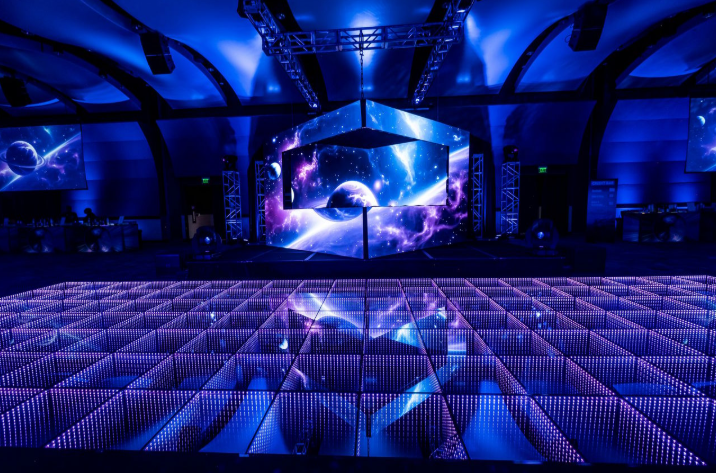
Immersive Core Chamber is the centrepiece experience that anchors the entire attraction. This is the zone that appears in every review, every social media post, and every media feature about the venue. Investment priorities for the core chamber include:
Maximum visual impact through projection scale, LED density, or holographic display that exceeds what guests have seen elsewhere
Multi-sensory integration combining visual, audio, and where possible haptic or scent elements
Content that is thematically coherent and emotionally resonant rather than simply technologically impressive
Session formats that accommodate both individual exploration and structured group experiences
The core chamber needs to be extraordinary enough to justify the venue’s price positioning and compelling enough to sustain repeat visitation when content is refreshed around it.
Interactive Tech Labs are where the experience transitions from observation to participation. Guests who can interact with technology, who can create something, influence something, or compete through something, develop a relationship with the venue that passive observation never generates. Tech lab formats that have performed well across comparable venues include:
AI-powered portrait or artwork generation stations that produce personalised outputs guests can save and share
Gesture-controlled visual environments that respond to body movement in real time
Collaborative digital creation tables where groups build shared visual or sonic outputs
Future technology demonstration stations that allow guests to interact with emerging technologies in a guided context
Competitive challenges or puzzle formats that introduce a light gaming element into the broader experience
Interactive labs also generate the longest dwell time of any zone in the venue, which translates directly into higher secondary spend on merchandise and food and beverage.
Innovation Lounge is the experiential destination zone that most venues underinvest in and most guests appreciate disproportionately. A well-designed innovation lounge is not a waiting area or an exit corridor. It is a social, intellectual, and commercial space that extends the guest visit and converts engagement into revenue. Functions it should serve include:
Comfortable seating and atmospheric design that encourages groups to remain and debrief
Curated content displays, rotating showcases of emerging technology, art, or scientific concepts, that provide fresh material for repeat visitors
Merchandise and retail integration positioned as an extension of the experience rather than a gift shop afterthought
Food and beverage offerings with a futuristic or innovation-themed identity that extends the venue’s world into the hospitality experience
Event hosting capability for innovation workshops, corporate presentations, and influencer preview sessions
Revenue Optimisation Framework
The commercial model of a Futuristic Immersive Experience Center benefits from intentional structuring across multiple revenue channels from the outset. Each channel below targets a different audience segment and demand timing, collectively creating a revenue profile that is more stable and higher-yielding than single-channel ticketing models.
Rotational Themes address the repeat visitation challenge that all immersive experience venues face over time. A content rotation strategy built around quarterly or seasonal theme updates gives the venue a continuous marketing narrative and returning guests a genuine reason to revisit. Practical implementation considerations include:
Modular zone design that allows individual chambers to be rethemed without full infrastructure replacement
Annual content production budget allocated before the venue opens rather than drawn reactively from operating cash flow
Partnerships with digital artists, technology studios, and content developers who can deliver new material on planned schedules
Marketing calendar built around theme launch events that generate press coverage and advance booking spikes
Innovation Workshops unlock the educational revenue channel that most entertainment venues leave entirely untapped. Structured workshop formats hosted in the Innovation Lounge or Tech Labs, covering topics like digital art creation, AI interaction design, future technology literacy, or creative technology for business, attract school groups, corporate training buyers, and general public audiences who would not book a standard immersive session. Benefits of the workshop channel include:
Higher per-head revenue than standard ticketing for equivalent floor time
Advance institutional booking that fills off-peak weekday capacity predictably
Eligibility for educational funding streams and institutional partnerships in many markets
Reputation building in the educational and innovation communities that support broader venue positioning
Corporate Sponsorship Activations monetise the venue’s visual environment and audience profile in ways that standard ticketing revenue cannot. The futuristic aesthetic and technology-forward positioning of an immersive experience center makes it a natural fit for brand sponsorship from companies in technology, automotive, financial services, and consumer electronics sectors. Sponsorship products that have performed well in comparable venues include:
Named zone or installation sponsorships tied to annual or multi-year agreements
Branded technology demonstrations integrated into the interactive lab environment
Co-branded corporate event programming that combines the sponsor’s product narrative with the venue’s experiential platform
Sponsored innovation workshop series aligned with a corporate partner’s industry focus
Influencer Tech Previews generate outsized organic marketing reach relative to their operational cost. A well-structured influencer programme, with reserved early-access sessions for creators in the technology, travel, and lifestyle verticals, produces content that reaches audiences the venue cannot access through paid channels at comparable cost. Programme structure considerations include:
Curated invitations to creators whose audience demographic matches the venue’s target market
Guided experience formats that ensure creators encounter the most visually compelling and shareable moments
Exclusive access to behind-the-scenes technology or installation creation content that provides creators with unique material
Ongoing relationship management that converts one-time preview participants into regular venue advocates
Three Global Case Studies
AYA Universe (UAE) has created one of the most commercially successful digital art and immersive experience destinations in the Middle East, combining large-scale projection environments, interactive installations, and a food and beverage concept that extends the experiential world into hospitality. Their model demonstrates that the futuristic immersive experience format performs strongly in tourism-heavy markets where the combination of visual spectacle and social shareability drives destination-level demand from international visitors. For investors in markets with significant tourism footfall, AYA Universe’s integration of immersive experience with premium hospitality offers a compelling revenue model template.
Nxt Museum (Netherlands) operates as a dedicated new media art institution that presents large-scale digital and immersive artworks in a museum context. Their curatorial approach, positioning technology-driven art as culturally significant rather than purely entertaining, has allowed them to attract audiences, press coverage, and institutional funding that standard entertainment venues do not access. For investors considering a more culturally positioned attraction, Nxt Museum demonstrates that the futuristic immersive format can occupy a credible institutional position that broadens audience reach and opens funding streams not available to commercial entertainment venues.
Mori Building Digital Art Museum (teamLab Borderless, Japan) is perhaps the most referenced global benchmark in the immersive digital art and experience category. Operating without fixed room boundaries or predetermined guest routes, the museum creates a genuinely exploratory experience where digital artworks flow between spaces and guests navigate the environment freely. Their extraordinary social media reach, with organic content generated by visitors reaching global audiences continuously, demonstrates the commercial power of designing for shareability as a primary objective rather than a secondary benefit. The lesson for investors is that a futuristic experience center that generates content guests are compelled to share does not need a conventional marketing budget to sustain awareness and demand.
Financial Structuring for Sustainable Returns
The financial structure of a Futuristic Immersive Experience Center rewards two strategic decisions above others.
The first is the hybrid edutainment positioning described throughout this guide. A venue that generates revenue from consumer ticketing, corporate events, educational programmes, sponsorship, and workshop formats simultaneously has a demand base that no single channel disruption can destabilise. When corporate event bookings soften, educational programmes fill capacity. When weekend consumer demand fluctuates seasonally, advance institutional bookings provide baseline revenue.
The second is front-loaded investment in modular content infrastructure. Venues that invest in flexible digital architecture, with systems that accept new content without hardware replacement, and physical zones designed for reconfiguration, sustain their guest experience quality and repeat visitation rates at a fraction of the ongoing capital cost of venues that require full rebuilds to remain fresh. The content refresh investment should be budgeted as a recurring operational line from the beginning, not treated as an exceptional capital event that disrupts cash flow when it becomes unavoidable.
Together, these two structural decisions create the conditions for a futuristic immersive experience center that generates strong, predictable returns across a long operating horizon rather than a high-intensity initial period followed by declining performance.
Partner with Peach Prime Consultancy
A Futuristic Immersive Experience Center that performs commercially across multiple audience segments and revenue channels requires planning discipline that spans creative concept development, technology selection, financial modelling, and operational structuring. Peach Prime provides structured advisory support that ensures your immersive concept is matched by the commercial rigour and scalability planning required to sustain it.
Our work covers concept curation, experience architecture planning, AV and technology vendor coordination, financial feasibility modelling, and operational design, structured to give investors the analytical foundation and practical expertise needed to build venues that perform from day one and continue to grow.
Contact Peach Prime today to begin your Futuristic Immersive Experience Center feasibility assessment.
Peach Prime is a specialist consultancy helping investors and operators build and scale immersive entertainment venues across emerging markets. Visit peachprime.in to learn more.