

Blogs
Science Museum Design in India: Lessons from Science City Ahmedabad
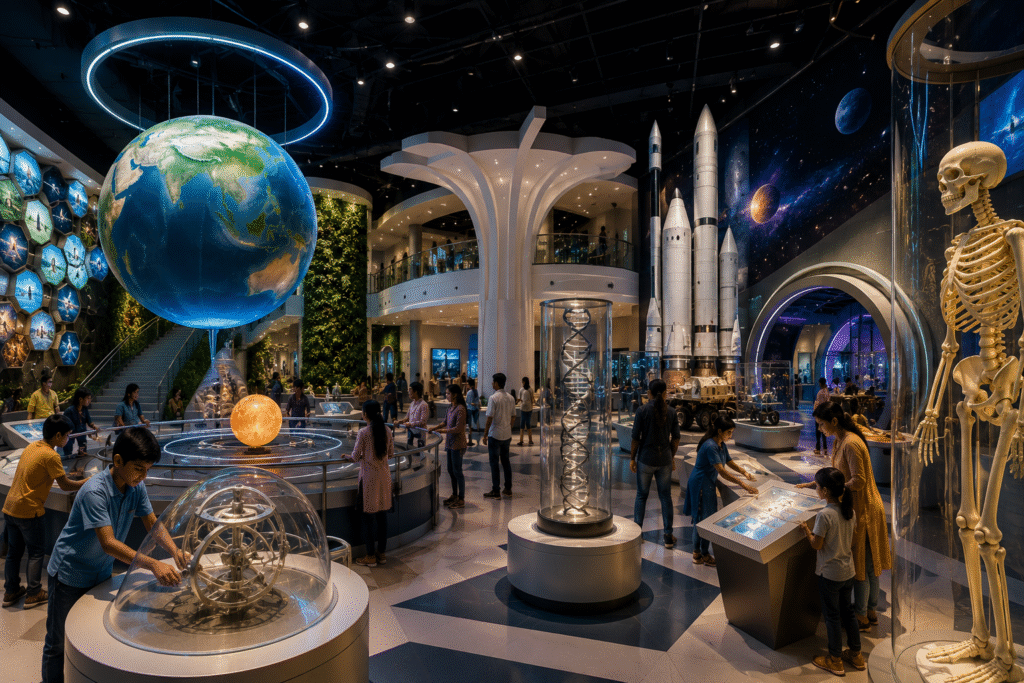
Science museums occupy a different design brief to entertainment venues. They need to hold a visitor’s attention as effectively as a theme park attraction, while delivering genuine STEM learning outcomes that satisfy government funders, education boards, and school groups. Few Indian projects illustrate that balance better than the Robotics Museum at Gujarat Science City in Ahmedabad, one of Peach Prime Consultancy’s flagship exhibit design projects, and a useful case study for anyone planning a science museum or science centre in India.
Inside the Robotics Museum at Science City, Ahmedabad
The Robotics Museum forms part of the second phase of development at Gujarat Science City, a 155 acre public science education campus in Ahmedabad developed under a Gujarat government initiative. The wider Phase 2 expansion, inaugurated in 2021, added a robotics gallery, an aquatic gallery housing one of India’s largest aquariums, and a 20 acre nature park to a campus that already included an IMAX 3D theatre, a Hall of Science, and an energy education park. The robotics building itself spans roughly 11,000 square metres across three levels and displays more than 80 to 170 robots depending on how static and functional exhibits are counted, spanning entertainment robots, industrial and space robots, medical and surgical robotics, and a dedicated virtual reality gallery.
Peach Prime Consultancy led the museum and exhibit design for the Robotics Museum, working in collaboration with construction partner CCEL and exhibit systems partner ESI to translate a highly technical subject, robotics across healthcare, entertainment, industry, and space exploration, into an experience that works for school groups, families, and casual visitors alike. The result is India’s first museum dedicated specifically to functional robots, combining interactive robots that play sport or perform choreographed routines with static displays that walk visitors through the history and application of robotics technology.
What Makes Science Museum Design Different
- Curriculum alignment: exhibits need to map to STEM learning objectives that school groups and education departments recognise, not just look impressive.
- Durability under heavy public use: interactive exhibits in a government science museum see far higher and rougher daily footfall than a typical corporate showcase, so materials and mechanisms need industrial grade durability.
- Layered engagement: the same exhibit needs to work for a five year old on a school trip and an engineering student, which usually means multiple depths of information within a single display.
- Storytelling structure: the strongest science museums, including the Robotics Museum’s own layout, use a narrative arc, in this case tracing the evolution of robots from historical automatons to space and medical robotics, rather than presenting exhibits as an unordered list of facts.
- Safety and accessibility: government funded museums typically require compliance with public building safety and accessibility norms well beyond what a private attraction needs.
Funding Models Behind India’s Science Museums
Most large scale science museums and science cities in India are developed as fully government funded public infrastructure, often under state science and technology departments or in coordination with the National Council of Science Museums under the Ministry of Culture. Gujarat Science City’s robotics gallery, for example, was constructed at a reported cost of around INR 127 crore as part of the state government’s broader push to draw students toward science education and position the campus as a global standard fun and learn destination. Increasingly, however, states are also exploring public private partnership structures for museum expansion and operations, particularly where ongoing maintenance and visitor experience upgrades benefit from private sector operational discipline.
What this means for planners: a science museum brief in India needs a design partner who can work within government procurement, statutory approval, and public funding processes, not just one who can design a compelling exhibit.
Applying These Lessons to a New Science Museum or Science Centre
Whether the project is a full science city on the scale of Gujarat’s, a district level science centre, or a university affiliated STEM museum, the design process benefits from the same sequence: a feasibility and content strategy phase that defines the STEM narrative and audience segments, a master plan that organises galleries around that narrative, detailed exhibit design that balances durability with interactivity, and close coordination with construction and technology partners through fit out and commissioning. Peach Prime Consultancy’s work on the Robotics Museum followed exactly this sequence, and the same approach applies to science museum, science centre, and STEM gallery projects for state governments, municipal bodies, and private developers across India.
Frequently Asked Questions
Q. How long does it take to design and build a science museum gallery in India?
For a large scale gallery comparable to the Robotics Museum, the process from concept design through construction and commissioning typically spans two to three years, depending on the complexity of interactive exhibits and government approval timelines.
Q. Who typically funds science museum projects in India?
The majority are funded by state governments through science and technology departments, sometimes with central government support through bodies such as the National Council of Science Museums, though private and PPP funded science centres are becoming more common.
Q. What separates a science museum exhibit designer from a general museum designer?
Science museum design requires close collaboration with subject matter experts and curriculum bodies to ensure exhibits are scientifically accurate and pedagogically sound, in addition to the spatial storytelling and interactive design skills that any museum project needs.
PLANNING A SCIENCE MUSEUM OR SCIENCE CENTRE?
Peach Prime Consultancy designs science museums, STEM galleries, and interactive exhibits for government and private clients across India, building on flagship projects including the Robotics Museum at Science City, Ahmedabad.
Project details referenced from Peach Prime Consultancy’s own project documentation and public reporting on Gujarat Science City by the Gujarat Council of Science City and regional news coverage. Cost and scale figures are as publicly reported at the time of the Phase 2 inauguration.