

A comprehensive technical planning and commercial strategy guide for developers, venue operators, and entertainment investors designing electric go-kart arenas that deliver sustained competitive excitement and optimised financial performance.
Introduction: Electric Karting as a Premium Entertainment Investment
Few entertainment formats combine the visceral excitement of competitive motorsport with the operational accessibility of a family leisure activity as effectively as indoor electric go-karting. The format has moved decisively from its origins as a budget-friendly rainy-day activity into the premium leisure sector, driven by the arrival of high-performance electric kart technology, the sophistication of modern race management systems, and the appetite of a growing affluent leisure demographic for experiences that deliver genuine physical excitement, competitive social engagement, and the distinctive identity of motorsport culture.
Electric karting, specifically, has transformed the commercial landscape of the category. The shift from petrol to electric kart technology eliminates the noise, fumes, and ventilation infrastructure requirements that constrained the indoor deployment of petrol karting to large, expensive, purpose-built facilities. Electric karts can operate in standard commercial building environments with manageable infrastructure modification, reducing the capital cost of market entry while delivering a performance experience that in many respects exceeds the petrol alternative. The instant torque delivery of electric motors creates acceleration characteristics that drivers find genuinely thrilling. The absence of engine noise allows on-track commentary, music programming, and race atmosphere enhancement that petrol venues cannot achieve. And the sustainability credentials of electric operation provide a positioning advantage that resonates with the values of the premium leisure consumer in a way that matters commercially.
For investors and developers, the electric karting arena represents a compelling combination of proven format commercial viability, meaningful technology-driven differentiation from the existing market, and the operational predictability of a throughput-optimised attraction with multiple revenue expansion pathways. This framework provides the complete technical and commercial planning architecture for developing an electric go-kart arena that captures the full potential of this opportunity.
MARKET POSITION | Modern electric karting arenas are not updated versions of the conventional indoor karting model. They are premium competitive entertainment destinations that combine the excitement of motorsport with the hospitality standards, technology sophistication, and multi-stream revenue architecture of the best social entertainment venues in the market. |
STEP 1 | Track Engineering and Layout Planning |
The track is the primary asset of an electric go-kart arena and every commercial and experiential outcome the venue delivers flows from the quality of its design and engineering. A well-designed track creates genuinely exciting racing, manages driver safety through its geometry rather than through restrictive speed limiting, and supports the throughput optimisation that is the foundation of commercial performance. A poorly designed track generates the congestion, incident risk, and visitor frustration that no quality of technology or hospitality can compensate for.
Track Format and Scale
The first planning decision is the choice of track format and scale, which determines the visitor experience profile, the infrastructure investment required, and the operating cost structure of the venue. The following table summarises the four primary track format options and their key commercial and operational characteristics.
Track Format | Min. Track Length | Ideal Kart Count | Primary Audience |
Compact Indoor | 350 to 500 metres | 10 to 16 karts | Mixed, FEC integration |
Full Indoor | 500 to 800 metres | 16 to 24 karts | Adults, competitive |
Multi-Level Indoor | 600 to 1,000 metres | 20 to 30 karts | Premium, enthusiast |
Outdoor Circuit | 800 to 1,500 metres | 24 to 40 karts | All ages, tourism |
Flowing Layout Design and Overtaking Zones
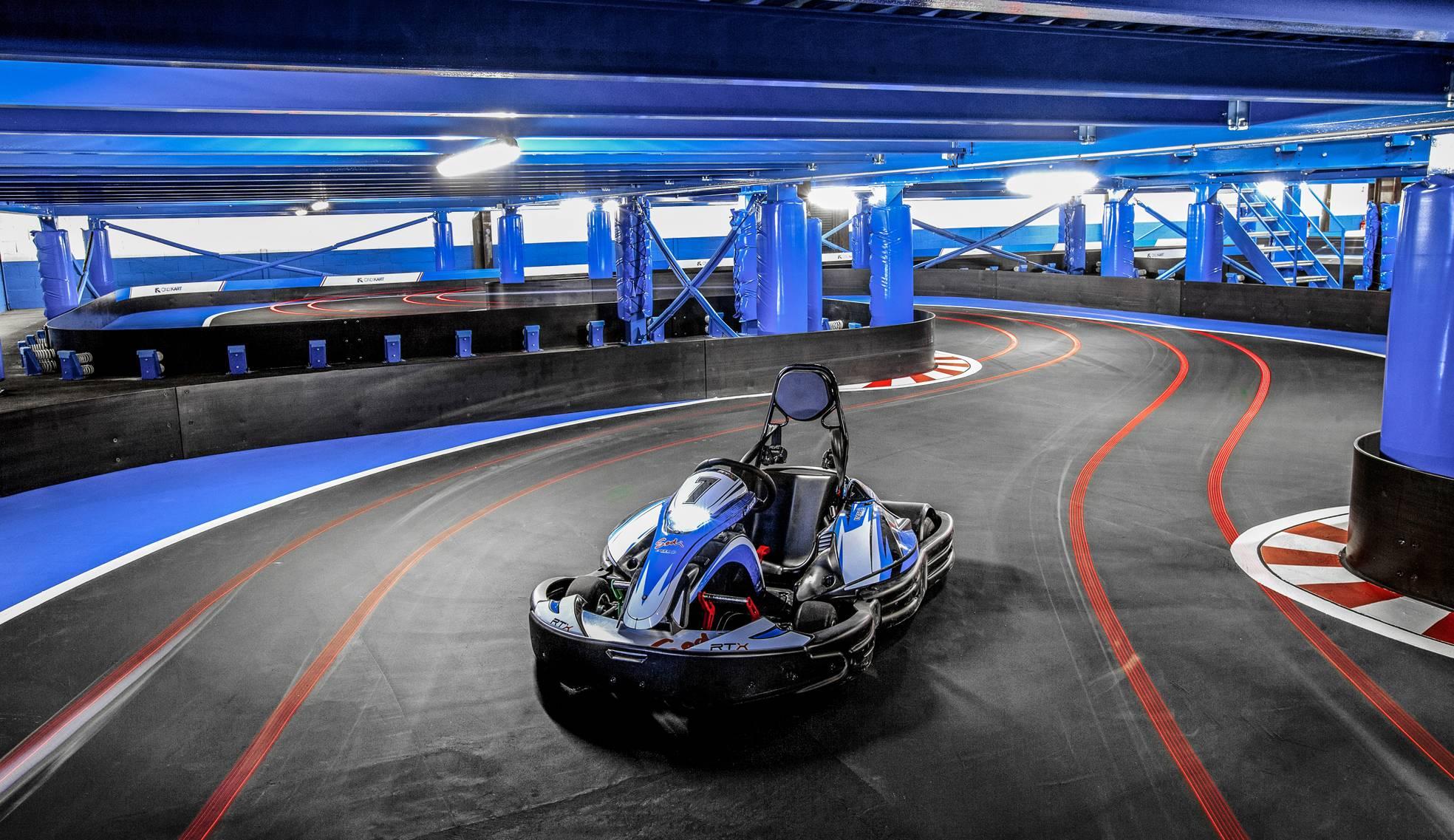
The layout of the track is the single most important determinant of racing quality and visitor satisfaction. Great karting tracks are designed around a principle of flowing geometry: sequences of corners that connect naturally and reward smooth, progressive driving rather than a series of disconnected technical challenges that break the rhythm of a lap. A flowing layout builds driver confidence progressively across a session, creating the improvement arc that motivates repeat visits from drivers who want to refine their technique. Within this flowing geometry, deliberate overtaking zones, typically created through long straights leading into late-braking corners with a defined racing line and an alternative wider approach, are essential for enabling the competitive racing that generates the memorable moments visitors talk about afterward.
Corner variety is equally important to the experiential quality of the layout. A track with a balanced mix of tight hairpins, medium-speed sweeping bends, and faster flowing sections creates the tactical complexity that separates experienced drivers from novices and sustains interest across multiple visits. Every corner should have a defined racing line that is rewarded by faster exit speed, a consequence of going wide or braking too early that is educationally instructive rather than simply punitive, and sufficient runoff space to accommodate the inevitable excursions of less experienced drivers without causing extended interruptions to the race session.
Safety Runoff Areas and Barrier Systems
Safety runoff areas and barrier systems are the physical infrastructure through which the competitive energy of an electric kart race is contained within acceptable risk parameters for a public entertainment venue. Tyre barriers at all significant impact risk points, combining a compressible primary impact layer with a rigid secondary containment structure, are the industry standard for indoor karting and must be specified to absorb the maximum credible impact energy of the heaviest kart and driver combination at the maximum permitted speed for each section of the track. Armco barriers along straight sections provide continuous containment with minimal impact absorption and must be supplemented with tyre barrier sections at any point where a driver could approach at an angle that generates a significant lateral component to the impact force. All barriers must be regularly inspected and restored to their specified condition after any significant impact, with a pre-session safety check as a mandatory operational standard.
Multi-Level Indoor Track Engineering
Multi-level indoor tracks represent the highest-complexity and highest-appeal variant of the indoor electric karting format and command the premium positioning that justifies the additional capital investment they require. The structural engineering challenge of a multi-level track, where karts travel up or down a ramp between levels at racing speeds, requires significant reinforcement of the floor structure at the transition points, precision geometry for the ramp gradient and approach/exit corner design, and careful analysis of the dynamic loads imposed by simultaneous multiple-kart use of the elevated sections. Building structure assessment by a qualified structural engineer must be completed before the track design is finalised, and the track design engineer must work in close coordination with the structural engineer to ensure that the track layout is fully compatible with the structural reinforcement solution.
Outdoor Circuit Drainage and Weather Resilience
Outdoor electric kart circuits require a drainage engineering standard that goes well beyond conventional commercial external paving. The track surface must drain completely within a defined time threshold after rainfall to allow safe resumption of racing, which requires a cross-fall specification across the full track width, perimeter drainage channels capable of handling peak rainfall intensity, and a surface material with sufficient porosity or macro-texture to prevent standing water accumulation during light rain. Weather-resistant barrier systems must maintain their containment performance in wet conditions, which excludes some barrier types that are adequate for dry conditions but lose significant energy absorption capacity when saturated. The kart fleet must be specified with sealed electrical systems rated for wet-weather operation, and the race control system must include reliable wet-weather detection and automatic speed limit protocols.
STEP 2 | Technology and Race Control Systems |
The technology layer of a modern electric go-kart arena is the operational infrastructure through which the physical excitement of the racing is measured, managed, communicated, and enhanced. A well-specified and well-integrated technology suite transforms a functional karting venue into a high-engagement competitive entertainment destination, creating the data-rich racing environment that drives the repeat visitation, competitive league participation, and premium upgrade purchasing that optimise long-term commercial performance.
Digital Lap Timing Systems
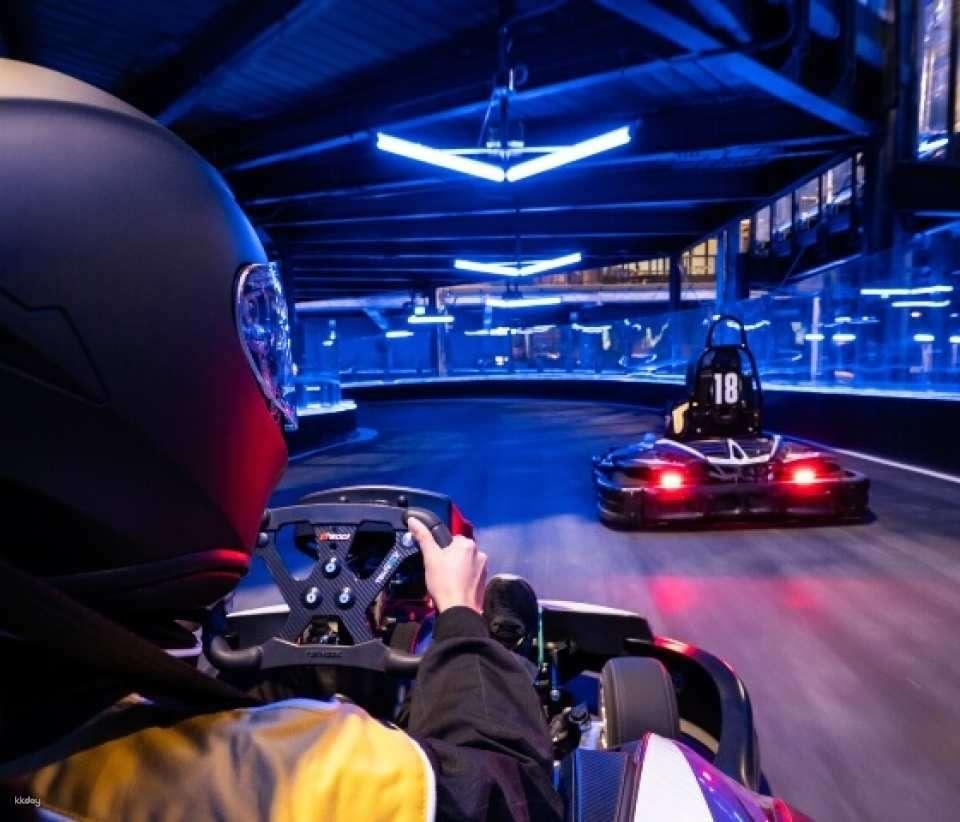
Precision lap timing is the foundational technology requirement of any competitive karting venue and the data infrastructure on which all other race control and engagement features depend. Transponder-based timing systems, using either RFID or optical transponders mounted on each kart and fixed detection loops embedded in the track surface, provide lap time accuracy to the millisecond level that drivers expect from a premium racing experience. The timing system must record and display split times at multiple points around the circuit, not just full lap times, to provide the granular performance feedback that allows drivers to understand specifically where they are gaining or losing time on each lap. Post-session lap time records, accessible through the venue’s digital platform and printable as a race report, are among the highest-value tangible takeaways a karting venue can provide and are a significant driver of both social sharing and return visit motivation.
RFID Driver Identification
RFID-based driver identification systems link individual driver profiles to the kart’s transponder data throughout a session, enabling per-driver lap time recording, personal best tracking across multiple visits, cumulative race statistics, and the competitive ranking data that powers league and championship programming. For venues with a membership or loyalty programme, RFID identification is the technology that makes the member’s competitive record portable across all their visits, creating the accumulated performance history that builds the identity investment and community belonging that drives long-term loyalty. RFID registration at the kart check-in point integrates naturally into the driver briefing process and adds minimal time to the pre-session operational cycle.
LED Race Boards and Spectator Displays
Large-format LED race display boards, positioned at strategic points around the circuit and in the spectator and waiting areas, are the technology that creates the atmosphere of a genuine racing event rather than a commercial recreation activity. Live race position displays, updated in real time from the timing system, give drivers the competitive context of their current race standing while they are on track. Sector time comparisons, displayed at the exit of key track sections, provide the performance feedback that engages technically motivated drivers and differentiates the venue’s data offering from basic competitors. Spectator displays in the waiting and hospitality areas showing live race feeds and real-time leaderboards convert the waiting period before a race session into a high-engagement spectator experience that builds pre-session excitement and supports F&B spend.
Centralised Control Room and Race Management
The centralised control room is the operational command centre of the electric karting arena, housing the race director and technical operator functions and providing real-time monitoring and management of every system in the venue. Race management software integrates the timing system, kart fleet management, driver booking and check-in, race scheduling, and safety flag system into a single operational interface that allows the race director to monitor the full circuit status and respond to incidents, mechanical issues, or scheduling changes from a single workstation. Remote kart speed control, accessed through the race management software, allows the race director to reduce the speed of any individual kart or the entire fleet instantly via the kart’s electronic control unit, providing the critical safety intervention capability that allows racing to continue safely when a slower or disabled kart is on track.
Battery Monitoring and Fleet Management
Battery management is the operational dimension of electric karting that most distinguishes it from petrol karting and that most directly determines the throughput and revenue performance of the venue. Every electric kart in the fleet must enter each race session with sufficient charge to complete the full session duration at racing speeds without performance degradation, and must complete post-session charging within the time available between sessions. A battery monitoring system that tracks state of charge, state of health, temperature, and charging cycle count for every battery in the fleet in real time allows the operations team to schedule charging and rotation intelligently, identify batteries approaching end-of-life before they cause in-session performance failures, and manage the fleet size and session frequency to maintain consistent performance across the operating day. Adequate spare battery inventory, allowing a full charge rotation between sessions without compressing the available race time, is an operational planning requirement that must be factored into the fleet procurement budget.
STEP 3 | Capacity and Revenue Optimisation |
The commercial performance of an electric go-kart arena is determined by the precision with which its capacity management and revenue architecture are designed and executed. A track that generates extraordinary racing excitement but manages its session scheduling and revenue streams inefficiently will consistently underperform its potential. The most commercially successful karting venues treat throughput and revenue optimisation with the same engineering rigour they apply to the track and kart systems.
Timed Race Batch Architecture
The timed race batch is the fundamental unit of the karting venue’s commercial model: a defined duration race session accommodating a fixed number of drivers, priced at a set rate, and scheduled to follow the previous batch with the minimum operationally achievable interval. The commercial mathematics of the batch architecture are straightforward: maximising the number of batches per operating hour, while maintaining the experience quality and safety standards that justify the pricing and drive the repeat visitation, is the primary operational objective. A 10 to 15 minute race session, with a pre-session driver briefing of five to eight minutes and a post-session kart recovery and reset of four to six minutes, allows a well-managed venue to complete four to five complete session cycles per hour per track. The revenue implications of this throughput rate, multiplied by the per-head pricing and the number of karts per session, define the maximum theoretical revenue capacity of the venue and provide the basis for the financial model that supports investment decisions.
Structured Driver Briefings
The driver briefing is an operational necessity that simultaneously serves a commercial function if it is designed with that function in mind. A briefing that covers safety protocols, track rules, flag signals, and kart operation clearly and efficiently fulfils its safety and regulatory obligations while building driver confidence and anticipation. A well-delivered briefing by an enthusiastic and knowledgeable staff member also creates the first impression of the venue’s brand quality and sets the emotional tone for the race session that follows. Briefing duration must be managed as a precise operational parameter: every minute of briefing time adds directly to the total session cycle time and reduces the number of sessions per hour, so the briefing must achieve its safety and engagement objectives within the tightest achievable time frame. Digital briefing systems, which deliver the core safety content via touchscreen kiosk before the driver reaches the track, can significantly reduce the live briefing time required while maintaining compliance with safety training requirements.
Revenue Architecture
A fully developed revenue architecture for an electric go-kart arena captures value across nine distinct commercial channels, each serving a different visitor type and spending motivation. The following table maps the primary revenue streams and their commercial profiles.
Revenue Stream | Format | Commercial Profile |
Timed Race Batches | Standard and peak session pricing, 10 to 15 minute races | Primary, high-frequency |
Premium Kart Tier Upgrades | Faster or exclusive kart access at an additional per-session fee | Upsell, margin-positive |
Championship Leagues | Structured seasonal competition with weekly rounds and final event | High-yield, repeat-driving |
Endurance Race Events | Extended team relay format for dedicated enthusiast groups | Premium, pre-booked |
Corporate Group Hire | Exclusive circuit sessions with facilitated race programme and F&B | High-yield B2B |
Birthday and Celebration Packages | Private group racing with party room and F&B inclusion | Premium, pre-booked |
Junior Racing Programmes | Age-tiered racing with coaching, progression tracking, and badges | Recurring, loyalty-building |
F&B and Merchandise | Track-side food and beverage lounge and racing-branded retail | Ancillary, high-margin |
Premium Kart Tiers and Upgrade Programmes
A tiered kart fleet, offering differentiated performance levels at differentiated price points, is one of the most commercially effective upsell mechanisms available to a karting venue operator. The psychological dynamic of a performance upgrade is deeply aligned with the competitive motivation that brings drivers to a karting venue in the first place: the opportunity to access a faster, more capable kart than the standard fleet is intrinsically compelling to the competitive driver who believes their skills deserve better equipment. Premium tier karts, specified with higher peak speeds, sharper throttle response, or enhanced weight-to-power ratios, should be present in sufficient numbers to create meaningful scarcity, enough that the upgrade is genuinely available to motivated purchasers, but scarce enough that it retains the exclusivity quality that justifies the premium price.
Championship Leagues and Endurance Events
Championship league racing is the highest-return repeat visitation programme available to a karting venue and the primary mechanism through which a transactional visitor relationship is converted into a committed community membership. A well-structured championship league, running across eight to twelve weeks with weekly qualifying rounds, cumulative point scoring, a mid-season standings broadcast, and a season finale race event with podium ceremony and prize presentation, creates the narrative arc of a genuine motorsport championship within the venue’s commercial framework. Endurance racing events, where teams of two to six drivers compete in relay format over extended race periods of 30 minutes to two hours, serve a different but complementary commercial function: they attract the most committed and highest-spending enthusiast drivers, generate premium revenue from a relatively small number of participants, and create the kind of intense shared experience that generates the strongest loyalty and word-of-mouth in the venue’s core driver community.
International Case Studies: Three Venues Setting the Commercial Standard
The electric go-kart arena sector has produced a compelling body of international precedent across diverse market contexts and venue positioning strategies. The following three venues represent distinct approaches to the commercial and experiential optimisation of the format.
01 | SpeedPark USA SpeedPark represents the multi-attraction FEC integration model for electric karting in the United States, demonstrating how a high-quality karting facility positioned as the anchor attraction within a broader entertainment portfolio can generate compounding commercial benefits that exceed the standalone karting venue model. By integrating electric karting with complementary attractions including bowling, arcade gaming, mini golf, and a full-service restaurant within a single destination venue, SpeedPark creates the visit occasion economics of a full leisure day out rather than a single-format activity, driving significantly higher total per-visit spend and longer average dwell times than a standalone karting venue can achieve. The anchor relationship works in both directions: the karting facility draws the high-energy sports entertainment demographic to the venue, where complementary attractions capture their spending before and after their race session, while the broader entertainment portfolio gives families and groups with mixed interests a reason to choose SpeedPark even when not all members of the group are primarily motivated by karting. For developers planning electric karting within a multi-attraction FEC context, the SpeedPark model provides direct evidence of the compounding commercial benefits of this integration approach and the importance of positioning the karting facility as the premium experiential anchor that justifies the venue’s overall destination appeal. |
02 | Daytona Milton Keynes (E-Karting) United Kingdom Daytona Milton Keynes is one of the United Kingdom’s most operationally disciplined electric karting venues and stands as a benchmark reference point for how consistent throughput management, rigorous safety standards, and a strong corporate event product can sustain high commercial performance across a multi-year operating lifecycle. Daytona’s operational discipline, which encompasses precise session timing, systematic driver briefing protocols, structured kart maintenance schedules, and a race control team trained to motorsport professional standards, creates a racing experience that consistently delivers on its quality promise across every session and every visitor group. This consistency is the commercial foundation of Daytona’s strong corporate event business, where the ability to promise and reliably deliver a premium, professionally managed racing experience to demanding corporate clients is the differentiator that commands premium pricing and generates the repeat bookings that provide revenue stability. The venue’s approach to its championship league programme, which runs across multiple seasons and attracts committed regular participants from across the region, illustrates the long-term community and revenue value that structured competitive programming delivers when it is managed with the same operational rigour as the racing itself. |
03 | Yas Marina Circuit Kartzone Abu Dhabi, UAE Yas Marina Circuit Kartzone in Abu Dhabi represents the aspirational ceiling of premium karting brand positioning and provides a powerful illustration of how association with a world-class motorsport venue can command price points and generate demand that no standalone karting facility can achieve independently. Operating within the precinct of the Yas Marina Circuit, which hosts the Abu Dhabi Formula One Grand Prix, the Kartzone facility benefits from one of the most powerful motorsport brand associations in the world, positioning its visitors as racing drivers at a genuine Formula One venue rather than simply participants in a recreational activity. This positioning allows premium pricing that substantially exceeds the market average for comparable karting facilities in the region and attracts the high-spending tourism and corporate event market that the Yas Marina precinct is positioned to serve. For developers evaluating the commercial impact of venue positioning and brand association on the pricing power and market reach of an electric karting facility, the Kartzone model provides compelling evidence that the physical and brand context of a karting venue can be as commercially significant as the quality of the track and kart technology themselves. |
Future-Proofing the Karting Investment
The long-term commercial performance of an electric go-kart arena depends on the operator’s ability to sustain visitor motivation to return beyond the initial experience, to retain the competitive drivers who become the core of the venue’s community, and to maintain the performance and appeal of the kart fleet and technology infrastructure as the market’s expectations evolve. Future-proofing is not a single investment decision but a structured programme of asset management, content development, and community building that must be planned before the venue opens and managed as a core operational discipline throughout its operating life.
Battery and Kart Fleet Upgrades
Electric kart technology is advancing rapidly, and the performance characteristics of the kart fleet that opens a venue in the current generation may be meaningfully inferior to what is available at equivalent cost three to five years later. Negotiating modular upgrade pathways with kart and battery suppliers at the point of initial procurement, including the right to upgrade the battery system within the existing kart chassis as improved cell technology becomes available, is the most cost-effective approach to maintaining fleet performance competitiveness over time. A structured battery replacement schedule, based on cycle count and capacity retention data from the battery monitoring system, prevents the gradual performance degradation that is the most common cause of declining visitor satisfaction in mature electric karting venues.
Junior Racing Programmes
Junior racing programmes are among the most strategically valuable investments an electric karting operator can make for long-term commercial sustainability. By introducing younger drivers to the format through age-appropriate kart specifications, structured coaching, progressive achievement systems, and a competitive pathway that connects junior racing to the main adult programme, the venue builds a pipeline of future drivers who enter adulthood with an established relationship with the venue and the competitive identity of a racer. Well-designed junior programmes also generate strong family group attendance that extends per-visit spend to the adult lounge and F&B areas, and create the parent community engagement that drives the word-of-mouth recommendation most effective for family leisure decisions.
Digital Leaderboards and Gamification
Persistent digital leaderboards, accessible through the venue’s app and website as well as on in-venue displays, transform the competitive experience from a series of isolated sessions into an ongoing performance narrative that connects every visit to a driver’s cumulative racing identity. The psychological investment that comes from a visible position on a track record board, a personal best time that demands improvement, or a league standing that motivates the next visit, is one of the most powerful repeat visitation drivers available to a karting venue operator. Gamified achievement systems that award driver-level badges, recognise milestone lap counts, and create visible progression pathways from novice to expert extend this psychological investment across a longer relationship arc and generate the social sharing that introduces the venue to new drivers through the authentic advocacy of existing regulars.
Sustainability Positioning
The electric propulsion of the kart fleet is not simply a technology choice with operational implications. It is a sustainability credential that carries genuine commercial value with the premium leisure consumer demographic and that becomes more commercially significant with each passing year as environmental performance expectations in the leisure sector continue to rise. Communicating the zero-emissions operation of the venue actively and credibly, through energy consumption data, renewable power sourcing, and sustainability reporting that goes beyond generic claims to specific and verifiable performance metrics, builds a brand differentiation that competitors operating petrol fleets cannot match and that resonates with the values of the corporate event clients and premium family demographics that represent the highest-value segments of the market.
Frequently Asked Questions
The following questions address the most important technical and commercial planning considerations for developers and investors approaching an electric go-kart arena project.
What is the minimum track length and floor area required for a commercially viable indoor electric karting venue? |
A commercially viable indoor electric karting venue requires a minimum track length of approximately 350 to 400 metres to provide a racing experience with sufficient lap time, corner variety, and overtaking opportunity to justify premium pricing. At this track length, the total floor area required for the track surface, barrier systems, pit lane, and essential operational areas typically ranges from 2,500 to 4,000 square metres for a single-level layout. Multi-level tracks can achieve longer track lengths within a smaller footprint by stacking levels vertically, but require the additional height clearance and structural reinforcement that increases both construction complexity and capital cost. Developers should plan for a total venue footprint of 3,500 to 6,000 square metres to accommodate the track, spectator areas, briefing rooms, control room, kart storage and charging infrastructure, changing facilities, and the F&B and hospitality spaces that are essential to the multi-stream revenue model. |
What are the primary advantages of electric karts over petrol karts for an indoor venue? |
Electric karts offer four primary advantages over petrol alternatives for an indoor venue context. First, the absence of combustion exhaust eliminates the ventilation infrastructure requirement that made large-scale indoor petrol karting economically viable only in very large purpose-built facilities, dramatically reducing the civil engineering cost and expanding the range of suitable commercial premises. Second, electric motors deliver instant torque that creates a different and in many respects more exciting acceleration profile than petrol engines, generating the responsive, immediate power delivery that drivers find thrilling. Third, the significantly lower noise output of electric karts makes the indoor acoustic environment far more manageable, enabling race commentary, music programming, and spectator conversation at levels that enhance the atmosphere without requiring hearing protection. Fourth, the zero-emissions operation of the electric fleet provides a sustainability credential that commands commercial value with premium demographic segments and corporate clients. |
How does the race batch architecture affect the financial performance of a karting venue? |
The race batch architecture is the primary determinant of the venue’s revenue capacity and its achievement requires precise operational management across every element of the session cycle. A venue that achieves four complete session cycles per hour at an average of 12 drivers per session, priced at a market-rate per-head fee, generates a revenue rate per operating hour that is directly comparable to a premium hospitality concept of equivalent floor area. Every minute added to the session cycle through inefficient briefing, slow kart recovery, or extended changeover reduces the number of sessions per operating day and compounds across the full year into a material revenue reduction. Conversely, every minute saved through operational efficiency, automated digital briefing systems, streamlined kart recovery protocols, and intelligent scheduling software, directly improves the financial performance of the venue without any additional capital expenditure. |
What safety certifications and compliance requirements apply to an electric karting venue in India? |
Electric karting venues in India are subject to a combination of building regulations, fire safety requirements, electrical installation standards, and general public entertainment venue licensing obligations that vary by state and municipal jurisdiction. At the national level, the venue must comply with the National Building Code provisions relevant to public assembly spaces, the Bureau of Indian Standards electrical installation requirements, and the relevant fire safety regulations for the building category and occupancy load. At the state and municipal level, entertainment venue licensing, local building approval for the specific track structure and any elevated elements, and periodic safety inspection requirements apply and must be researched specifically for the planned location before the design is finalised. Engaging a specialist safety compliance consultant with experience in motorsport venue development early in the design process is strongly recommended, as safety requirements have direct implications for the track geometry, barrier specification, and emergency egress design that are most efficiently addressed before construction begins. |
How should corporate events be developed as a revenue stream for an electric karting venue? |
Corporate events represent one of the highest-yield revenue streams for a karting venue and should be developed as a distinct commercial product with its own dedicated sales approach, operational format, and pricing structure rather than simply offered as a group ticket option. A strong corporate event product includes exclusive circuit hire during off-peak hours, a structured race programme with qualifying, final races, and podium ceremony, facilitated team competition formats that align with team-building objectives, a pre and post-race hospitality area with food and beverage service, personalised race data reports for all participants, and an optional video and photography package that extends the brand presence of the event for the corporate client. Pricing corporate packages on a total event basis rather than per-head rate captures the full value of the exclusive circuit hire and the operational investment in the facilitated programme, and is the structure that most effectively positions the venue as a premium corporate entertainment destination rather than a discounted bulk-booking option. |
What is the typical payback period for an electric go-kart arena investment? |
Payback periods for electric go-kart arenas vary based on scale, location, capital investment level, and the quality of operational execution, but well-designed and operationally disciplined venues in strong urban markets typically achieve payback within 36 to 54 months for mid-scale indoor facilities. Venues that develop strong corporate event and championship league revenue streams from the outset, and that maintain high capacity utilisation across weekday as well as weekend operating periods, tend to achieve payback at the faster end of this range. The multi-level indoor format, which commands premium pricing but requires higher capital investment, typically has a longer payback period of 48 to 72 months but delivers stronger long-term competitive defensibility and margin performance once the initial investment is recovered. |
Why Choose Peach Prime Consultancy
Developing a commercially optimised electric go-kart arena requires a depth of specialist expertise that spans track design coordination, technology vendor evaluation, safety compliance review, and long-term revenue modelling simultaneously. The technical decisions made at the planning stage, about track geometry, kart fleet specification, race control technology, and revenue architecture, determine the competitive quality, operational efficiency, and financial performance of the venue for its entire operating life.
Peach Prime Consultancy delivers end-to-end planning for electric karting arena projects across the full development lifecycle. Our services cover track design coordination and layout optimisation, technology vendor evaluation and procurement support, safety compliance planning and regulatory engagement, throughput and capacity management design, revenue architecture and financial modelling for investor and lender presentations, and operational playbook development for launch and beyond. We bring deep specialist expertise in high-energy entertainment venue development, with a planning methodology that consistently ensures our clients’ venues are commercially optimised, operationally robust, and positioned to sustain strong performance over the long term.
Whether you are at the earliest stage of feasibility assessment or ready to move into detailed design and procurement planning, Peach Prime Consultancy provides the expert guidance that reduces your execution risk and maximises the return on your investment. Visit www.peachprime.in to explore our full services or contact our team directly to arrange a strategic planning consultation.
WHAT PEACH PRIME DELIVERS | Track design coordination and layout optimisation, technology vendor evaluation and procurement support, safety compliance planning, throughput and capacity management design, revenue architecture and financial modelling, and full operational playbook development for launch and beyond. |