

A comprehensive planning guide for developers, sports entertainment investors, and venue operators designing multi-sport simulation clubs that deliver predictable hourly revenue, strong community loyalty, and premium positioning across amateur, professional, and corporate audiences.
Introduction: The Multi-Sport Simulation Club as a New Entertainment Asset Class
Sport is one of the most powerful drivers of human engagement, community formation, and repeated discretionary spending available to the entertainment sector. People watch sport obsessively, follow it passionately, and invest in it personally at every level from casual recreation to serious competitive aspiration. But the physical and logistical constraints of conventional sport have always imposed sharp limits on when, where, and how people can participate actively: the availability of outdoor facilities, the dependency on weather, the requirement for a full team or court partner, the cost of professional coaching, and the impracticality of accessing world-class training environments for anyone outside a professional programme.
Multi-sport simulation technology has systematically removed each of these constraints, one by one, over the past decade. A golfer can now play Augusta National on a rainy Tuesday evening in a climate-controlled bay. A cricketer can face deliveries calibrated to replicate the pace and movement of an international fast bowler. A footballer can train precision shooting against reactive digital targets that adapt to their skill level in real time. And all of these experiences can be delivered in a single compact venue, with performance data captured, analysed, and delivered back to the player in a format that makes every session genuinely developmental as well as genuinely enjoyable.
For investors and developers, this convergence of technology capability and sporting aspiration has created a compelling new entertainment asset category: the multi-sport simulation club. This guide provides a complete strategic and technical framework for developing one, from the zoning and acoustic design of the physical space to the technology and calibration systems that power each simulation bay, the monetisation architecture that maximises commercial performance, and the community and content strategies that sustain engagement and loyalty over the long term.
INVESTMENT APPEAL | Multi-sport simulation clubs combine the predictable hourly revenue of a bay-booking model with the community loyalty of a sports club, the coaching margin of a training academy, and the corporate event potential of a premium hospitality venue. Few entertainment asset classes offer this breadth of revenue channel from a single compact footprint. |
STEP 1 | Zoning and Experience Flow |
The spatial planning of a multi-sport simulation club is a multidimensional design challenge that must balance the distinct technical requirements of each simulation zone, the acoustic isolation needed to maintain immersive experience quality across adjacent bays, the operational flexibility required to support diverse programming formats from individual bookings to league tournaments, and the hospitality character of the lounge and social spaces that transform a functional training facility into a destination club environment.
Simulation Zone Portfolio and Bay Specifications
The selection and sizing of simulation zones is the foundational design decision that determines the venue’s audience reach, competitive differentiation, and revenue capacity. The most commercially successful multi-sport simulation clubs in international markets share a common principle: they offer sufficient sport variety to serve a broad demographic while maintaining the depth of each zone’s technology and experience quality to satisfy serious enthusiasts in every discipline. The following table summarises the five core simulation zone types, their technology requirements, bay dimensions, and primary user profiles.
Simulation Zone | Technology Core | Bay Size | Primary User |
Golf Simulator | High-speed camera tracking, radar launch monitor, 270-degree screen | 4m x 5m min. | Adults, corporate |
Cricket Batting Cage | Bowling machine, pressure-plate crease sensor, video replay system | 8m x 4m min. | Youth, enthusiasts |
Soccer Training Pod | Reactive shooting wall, motion tracking, precision target scoring | 6m x 5m min. | Youth, mixed |
Tennis Reaction Wall | LED target grid, speed radar, return wall with variable resistance | 5m x 6m min. | All ages |
Performance Analytics Zone | Movement analysis cameras, biometric pads, personalised coaching dashboard | Flexible shared | Serious athletes |
Separating High-Impact and Lounge Zones
The spatial separation of high-impact simulation bays from lounge, spectator, and coaching areas is both an acoustic engineering requirement and an experiential design principle. Simulation bays, and cricket batting cages in particular, generate significant impact sound and vibration during active use. Without adequate acoustic separation, this sound energy migrates into adjacent spaces, degrading the experience quality of neighbouring bays, disrupting coaching conversations in adjacent areas, and creating an environment in the lounge and reception areas that is fatiguing rather than inviting. Acoustic separation is achieved through a combination of structural mass in the bay partition walls, resilient mounting of the wall and ceiling surfaces that face the impact zones, and absorptive lining materials within each bay that reduce the reverberant energy before it reaches the partition boundary.
Beyond the acoustic engineering rationale, the spatial separation of simulation bays from lounge zones creates a deliberate experiential transition within the venue: a pre-session build-up in the social lounge, a focused immersive experience in the simulation bay, and a post-session debrief and social interaction back in the lounge environment. This spatial narrative is the physical expression of the club’s identity as a destination rather than a facility, and it is the design quality that most differentiates a premium simulation club from a utilitarian training room.
Flexible Layouts for Tournaments and Coaching
Multi-sport simulation venues that serve only individual bay bookings leave significant revenue and community value on the table. Designing the spatial layout with the flexibility to reconfigure for tournament formats, group coaching sessions, and spectator events from the outset is one of the highest-return planning investments the developer can make. This means specifying the lounge and circulation areas with moveable furniture systems that allow rapid reconfiguration from social seating to tournament spectator rows, providing adequate clear floor area adjacent to the performance analytics zone for group coaching demonstrations, and installing projection or display capability in the primary spectator area that can show simultaneous live feeds from multiple simulation bays during tournament events.
STEP 2 | Technology and Calibration Systems |
The technology layer of a multi-sport simulation club is its primary commercial differentiator and the determinant of whether the simulation experience is genuinely compelling or merely functional. The distinction between a simulation that accurately replicates the physics and performance feedback of the real sport and one that provides a merely entertaining approximation is clearly perceptible to any player with real sporting experience, and the premium positioning that commands membership loyalty and high hourly rates depends entirely on the credibility of the simulation quality.
Advanced Tracking Cameras and Radar Motion Sensors
The accuracy and reliability of the ball and body tracking systems within each simulation bay are the technical foundation on which every other aspect of the simulation experience depends. High-frame-rate cameras, typically operating at 240 frames per second or above for ball tracking applications, capture the trajectory of the ball with the precision necessary to accurately calculate launch angle, spin rate, carry distance, and landing position for golf and cricket simulations. Radar-based motion sensors, which measure ball velocity and flight path through Doppler shift rather than optical detection, provide a complementary data stream that is particularly valuable in lighting conditions where optical tracking performance is reduced. The integration of camera and radar data within the simulation’s tracking software provides the redundancy and cross-validation that delivers consistent accuracy across the full range of shot types and swing speeds that a mixed-ability user base will generate.
High-Lumen Projectors and Impact-Resistant Screens
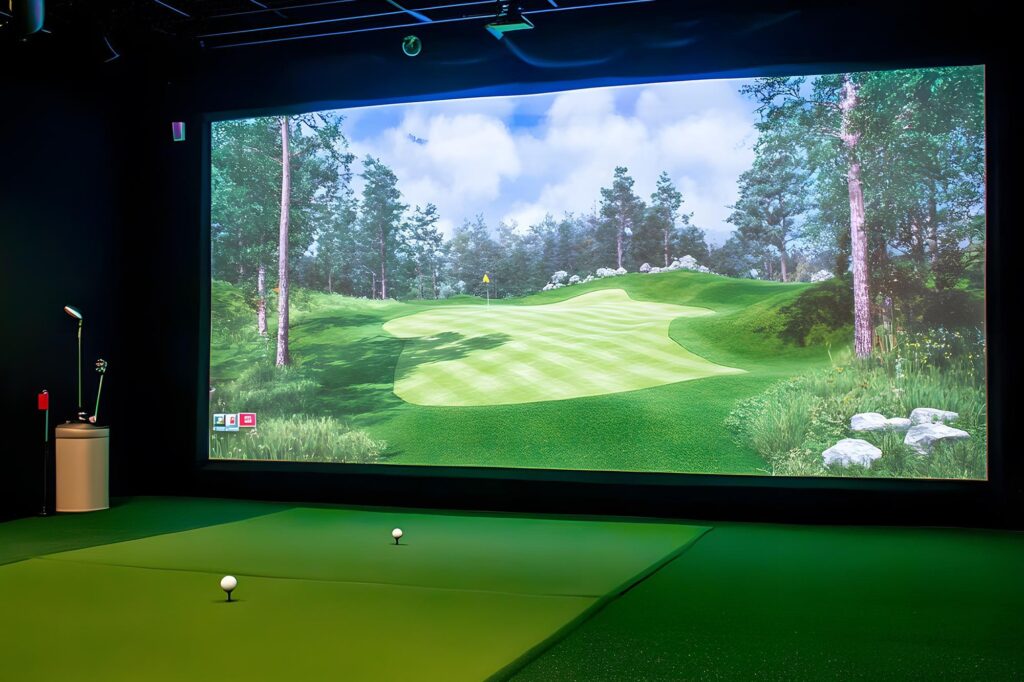
The projection system is the visual interface through which the simulation world is presented to the player and its specification must deliver the image quality, brightness, and response speed that make the virtual environment convincing under active playing conditions. Minimum projector brightness for a golf simulator bay in a controlled-light environment is 5,000 lumens, with 8,000 to 12,000 lumens recommended for bays where ambient light cannot be fully controlled or where a wider screen format is used. The impact screen, which receives the physical ball strike and simultaneously serves as the projection surface, must be specified to withstand repeated high-velocity impacts across a multi-year operational lifecycle without degrading image quality or developing localised weaknesses that create safety risk. Commercial-grade impact screens for golf and cricket simulation are typically manufactured from multiple layers of woven polyester and tensioned within a structural frame that absorbs impact energy without transmitting it to the surrounding structure.
Centralised Scoring Dashboards
A centralised scoring and performance dashboard, accessible from both the individual bay interfaces and a management workstation, is the technology platform that connects the individual simulation experience to the broader competitive and developmental ecosystem of the club. Real-time scoring data from all active bays, displayed on the club’s spectator screens during tournament events, creates the shared competitive context that transforms individual bay sessions into a community experience. The performance dashboard’s historical data layer, which stores every player’s session statistics and allows comparison across visits, is the technology that powers the skill development narrative that motivates members to return: the ability to see objectively that your handicap has improved, your average bat speed has increased, or your first-serve percentage has reached a new personal best is among the most powerful repeat visit motivators available in any sport simulation format.
Routine Calibration and Performance Accuracy
The calibration discipline of a multi-sport simulation club is the operational practice that determines whether the technology investment delivers its promised performance accuracy day after day, or degrades progressively until the simulation quality drops below the standard that players expect. Each simulation system type has specific calibration requirements: golf simulators require regular camera alignment verification and ball flight model validation against known reference shots, cricket bowling machines require periodic speed and line calibration against reference measurements, and projection systems require brightness and colour calibration to maintain consistent image quality as lamp hours accumulate. A documented calibration schedule, with specific procedures and frequency requirements for every simulation system in the venue, should be developed in consultation with the technology vendors before the venue opens and managed as a mandatory operational standard thereafter. Player-reported accuracy issues should be treated as a calibration audit trigger rather than as an acceptable operational variance.
STEP 3 | Monetisation and Community Building |
The commercial strength of a multi-sport simulation club lies in the breadth and depth of its revenue architecture. A venue that operates purely as a bay booking facility leaves the majority of its commercial potential unrealised. The most commercially successful simulation clubs build their revenue model around the interplay of hourly bookings, structured membership, coaching and development programmes, competitive events, and corporate formats, each reinforcing the others to create a community ecosystem in which high engagement in any one channel drives participation across all the others.
Revenue Stream | Format | Commercial Profile |
Hourly Bay Bookings | Standard and peak session pricing per simulation bay | Primary, high-frequency |
League Memberships | Monthly and annual club memberships with priority bay access | Recurring, loyalty-building |
Coaching and Skill Certification | One-on-one and group coaching with tracked progression and badges | High-margin, retention-driving |
Corporate Sports Leagues | Structured inter-company competition with scoring and season finale | High-yield B2B |
Youth Academy Programmes | Term-based training with coaching, performance tracking, and grading | Recurring, community-building |
Event and Tournament Nights | Themed competition evenings open to walk-in and pre-registered players | Demand surge, social media driver |
Private Group and Party Hire | Exclusive multi-bay hire with F&B and facilitated competition | Premium, pre-booked |
F&B and Merchandise | Club lounge food and beverage and branded sport performance gear | Ancillary, high-margin |
League Memberships and Club Identity
A well-structured membership programme is the commercial and community foundation of a multi-sport simulation club and the investment that most directly determines whether the venue becomes a transactional booking facility or a genuine club destination with loyal members who identify with its brand and community. Monthly and annual membership tiers that offer priority bay access, discounted hourly rates, and inclusion in league competition formats convert casual visitors into committed regulars whose relationship with the venue is sustained by competitive investment as much as by convenience. The design of membership benefits should explicitly create situations in which members encounter each other in shared competitive contexts, because these inter-member relationships are the social infrastructure that makes membership feel valuable independent of any individual session quality.
Skill Certification and Coaching Programmes
Skill certification programmes are among the most commercially distinctive revenue streams available to a multi-sport simulation club and among the most powerful tools for building the developmental identity that differentiates a premium simulation club from a recreational booking venue. A structured certification pathway, whether a golf handicap progression system, a cricket batting grade structure, or a football skills assessment framework, gives members a visible progression narrative that motivates ongoing engagement and investment in coaching. Certified coaches delivering structured programmes within the venue’s simulation bays generate coaching revenue at margins that significantly exceed the hourly bay rate, and create the visible performance improvement outcomes that drive the word-of-mouth recommendation and social media sharing that build the club’s reputation as a serious training destination.
Corporate Sports Leagues
Corporate sports leagues are a particularly high-value revenue format for a multi-sport simulation club because they combine the high-yield characteristics of corporate event bookings with the recurring commitment of a league programme structure. An inter-company golf league, a corporate cricket championship, or a multi-sport corporate challenge series that runs across eight to twelve weeks generates predictable weekly revenue from a cohort of pre-committed corporate clients whose participation is sustained by competitive stakes, inter-company rivalry, and the social prestige of performing well in a visible corporate context. Corporate league participants also represent the single most effective channel for new membership acquisition, as individuals who experience the club as corporate league participants frequently convert to personal members once their engagement with the simulation environment deepens beyond the competitive event context.
Youth Academies and Loyalty Programmes
Youth academy programmes build the long-term community pipeline that sustains a simulation club’s membership base across generational transitions and create a family engagement dimension that generates strong weekend and holiday footfall. Term-based youth programmes, structured around age-appropriate skill development, regular performance assessment, and a progression framework that tracks improvement over months and years, create the parental investment and loyalty that is among the most durable in any sport or education context. Digital performance tracking apps that allow youth academy members to review their session data, track their progression against personal bests and cohort benchmarks, and share achievements with their networks extend the club’s engagement with its youngest members between visits and create the digital touchpoints that sustain motivation throughout the programme term.
International Case Studies: Three Venues Setting the Benchmark
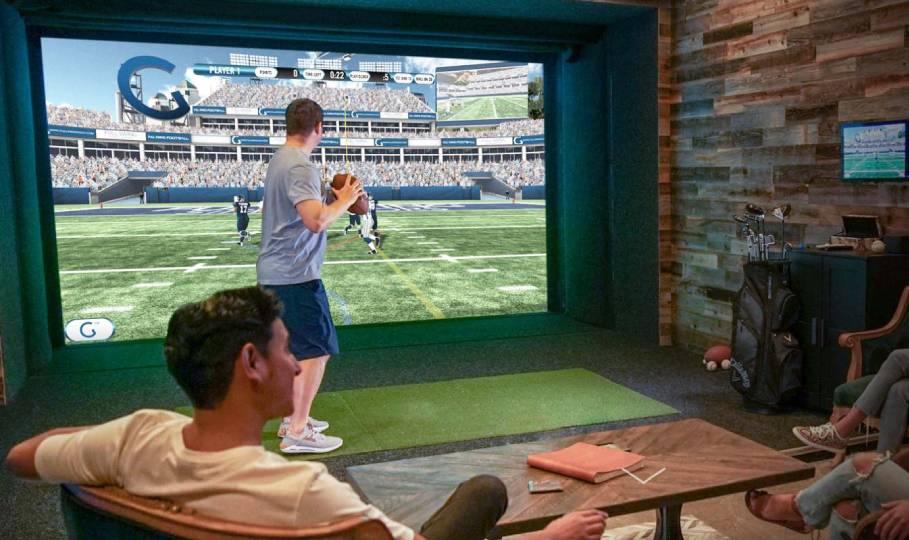
The multi-sport simulation sector has produced a compelling set of international precedents that illustrate different approaches to the format across diverse markets, sport portfolios, and audience positioning strategies. The following three venues represent distinct but equally instructive models.
01 | Five Iron Golf USA (Multiple Cities) Five Iron Golf is the defining reference point for premium golf simulator club development in the United States and has built one of the most commercially sophisticated and rapidly scaling models in the digital sports entertainment sector. Operating across multiple major city locations with a consistent premium brand identity, Five Iron combines high-specification golf simulator bays with a full-service hospitality offering that includes craft cocktails, food menus, and a social lounge environment that transforms the simulator session into a broader evening out rather than a purely sporting activity. The commercial intelligence of the Five Iron model lies in its recognition that the target demographic for premium golf simulator experiences, young urban professionals aged 25 to 45, values social experience and hospitality quality as highly as simulation accuracy, and that the most commercially effective positioning is one that serves both simultaneously without compromising either. Five Iron’s membership programme, which provides priority access, dedicated locker storage, and exclusive member events, builds the loyal regular player base that provides commercial stability independent of walk-in demand variation. Its corporate event product, which generates significant revenue from group bookings that treat the simulator bays as a backdrop for entertaining rather than purely a training environment, illustrates the breadth of commercial application that a premium golf simulator club can support. |
02 | InPlay Sports Singapore InPlay Sports in Singapore represents one of the most successful implementations of the multi-sport simulator model in Asia and demonstrates how a venue that combines youth training programming with social gaming formats can serve a genuinely diverse audience across serious developmental and recreational dimensions simultaneously. InPlay’s portfolio of simulation offerings, which spans cricket, football, and other sports within a single venue, directly addresses the multi-sport appetite of Singapore’s young urban demographic and provides the variety that sustains long-term engagement from members whose sporting interests evolve over time. The venue’s emphasis on youth training and coaching programmes, delivered within the simulation environment with technology-powered performance feedback, reflects the particularly strong parental investment in structured youth sport development that characterises the Singapore family demographic and generates the term-based programme revenue that provides commercial stability alongside session-based bookings. InPlay’s social gaming dimension, which frames simulation sessions as competitive social activities rather than training exercises for casual visitors, broadens the accessible audience to include groups seeking an entertaining shared activity rather than a developmental experience, and demonstrates the commercial value of designing a simulation venue that speaks to both motivations without forcing a choice between them. |
03 | Urban Cricket Australia Urban Cricket in Australia represents the specialist single-sport simulation model at its most commercially refined and provides a compelling example of how depth of focus within a single sport’s simulation and coaching ecosystem can build the kind of passionate, loyal community that broad-portfolio venues sometimes struggle to achieve. Urban Cricket combines high-quality indoor cricket simulation technology with professional-standard coaching, structured competition leagues, and a strong connection to the competitive cricket community, positioning itself as a serious training and competition destination for cricketers of all levels from recreational players to state-level athletes seeking off-season conditioning. The venue’s competition league programme, which runs year-round and accommodates both individual and team formats, creates a competitive identity and community belonging among its members that generates exceptional repeat visitation and word-of-mouth advocacy. For developers considering whether to pursue a multi-sport portfolio approach or a single-sport depth approach for a simulation venue, Urban Cricket demonstrates that the specialist model can achieve very strong commercial performance when the target sport has a large enough passionate participant base in the catchment area and when the venue’s programming and community investment are sufficient to make it the definitive home of that sport in its market. |
Future-Proofing the Digital Sports Investment
The digital sports simulation sector is evolving rapidly, driven by advances in tracking technology, simulation software, and the growing sophistication of the audience’s expectations for both the accuracy and the experiential richness of simulation environments. A venue that is state-of-the-art at opening must be managed as an asset that requires active investment in its technology layer, content library, and community infrastructure to remain competitive over a five to ten year operating horizon.
Software Upgrades and Stadium Integrations
Simulation software platforms for golf, cricket, and other sports are updated regularly with new course or stadium environments, improved physics models, enhanced ball tracking algorithms, and new game formats that expand the range of experiences available within existing hardware. Maintaining current software subscriptions and implementing updates promptly as they become available is the minimum investment required to keep the simulation library relevant for regular members. Beyond routine updates, new official stadium or course integrations, which bring the simulation of globally recognised sporting venues into the player’s bay, are among the highest-impact content additions available and should be prioritised in the venue’s technology refresh planning. A simulator that offers a player the ability to bat in a replica of the MCG or play a round at St Andrews delivers an aspirational appeal that no locally built simulation environment can match.
Tournament Broadcasting and Influencer Collaborations
Tournament broadcasting, whether through a venue-produced social media live stream or a partnership with a regional sports media platform, transforms the competitive events at a simulation club from a private member experience into a public brand-building asset that reaches a far broader audience than the event’s physical participants. A well-produced stream of a corporate golf championship or a cricket batting challenge final, with live commentary, on-screen statistics, and player reaction footage, creates genuinely compelling sports content that is shareable across the club’s community and discoverable by new audiences interested in the sport. Influencer collaborations with sports content creators, fitness personalities, and professional or semi-professional athletes who have genuine audiences within the club’s target demographic generate the kind of authentic brand association and audience reach that no conventional advertising format can replicate at equivalent cost.
Data-Driven CRM and Repeat Booking Optimisation
The performance data generated by a multi-sport simulation club’s tracking and booking systems is a commercially valuable asset that most venues are significantly underutilising. A data-driven CRM strategy that uses session history, performance progression metrics, and booking pattern data to personalise communication, targeted re-engagement campaigns, and proactive coaching recommendations for individual members can meaningfully improve retention rates and average session frequency among the active member base. Automated re-engagement triggers, for example a personalised message to a member who has not booked in three weeks referencing their last personal best and inviting them to beat it, combine the efficiency of automation with the personal relevance that drives response. Predictive booking optimisation, which identifies lower-demand time slots and directs targeted promotions to member segments most likely to book them, improves capacity utilisation and revenue per available bay hour across the full operating calendar.
Frequently Asked Questions
The following questions address the most important strategic and technical planning considerations for developers and investors approaching the multi-sport simulation club opportunity.
What is the ideal sport mix for a multi-sport simulation club in the Indian market? |
The Indian market context makes cricket the non-negotiable anchor sport for any multi-sport simulation club, given the depth and passion of cricket participation and followership across virtually every demographic segment. A cricket batting cage with high-quality bowling machine simulation and video replay capability will be the highest-utilisation zone in almost any Indian venue. Golf simulation is a strong secondary offering, serving the rapidly growing urban upper-middle and affluent family demographic whose aspirations include golf participation and who are well-served by simulator access in lieu of the limited and expensive physical course availability in most Indian cities. Football simulation pods serve the youth demographic with strong complementary demand, and tennis reaction walls offer a lower infrastructure cost zone with broad demographic appeal. Developers should weight their bay allocation toward cricket and golf in the initial phase, with flexibility to add or expand other sport zones based on actual demand data from the first year of operation. |
How does hourly bay pricing compare to membership revenue in the overall commercial model? |
In a well-operated multi-sport simulation club, hourly bay bookings and membership-based revenue should each contribute approximately 35 to 45 per cent of total revenue, with coaching, corporate events, and ancillary spending accounting for the remainder. The balance between these channels is commercially important because each has distinct characteristics: bay bookings are demand-responsive and generate higher revenue during peak periods but are volatile during quieter periods, while membership revenue is predictable, recurring, and substantially independent of week-to-week demand variation. A venue that has successfully converted a significant proportion of its regular visitors into members achieves a revenue stability that allows it to invest confidently in programming, technology, and community development, which in turn drives higher engagement and spending across all channels. Venues that remain dependent on walk-in bay bookings for the majority of their revenue are significantly more exposed to competitive entry and demand variation. |
What are the key technical differences between a golf simulator and a cricket batting cage simulation system? |
The fundamental technical difference lies in the nature of the object being tracked and the direction of the interaction. A golf simulator tracks a small ball struck by a club, measuring launch conditions including ball speed, launch angle, spin rate, and direction from the point of impact forward, and uses these measurements to simulate the full flight trajectory within a virtual environment. A cricket batting cage simulation primarily tracks a ball delivered toward the batsman from a bowling machine, measuring delivery speed, swing, seam movement, and landing position, and provides performance feedback through cameras that analyse the batsman’s shot response and bat speed. The structural requirements also differ significantly: a cricket batting cage requires a longer bay length of at least 8 metres to accommodate a realistic delivery distance, more robust screen and netting systems to handle the high-energy impact of cricket balls at delivery pace, and typically a higher floor-to-ceiling height to accommodate the full range of delivery and shot trajectories. |
How should a multi-sport simulation club approach corporate sales? |
Corporate sales for a simulation club should be approached as a structured B2B sales function rather than a passive response to inbound enquiries, given the high revenue potential and recurring commitment that well-developed corporate relationships generate. The most effective approach combines outreach to HR departments and office managers at target organisations with a clear event product offer that is easy to understand, quick to book, and demonstrably distinctive from conventional team-building formats. A corporate sports day format, combining rounds on the golf simulator, a cricket batting challenge, and a football skills competition with cumulative team scoring, a live leaderboard, and a post-event prize ceremony, provides the narrative structure and competitive engagement that HR teams need to justify the booking to their stakeholders. Corporate league programmes, which convert the one-off event booking into a multi-week commitment, should be actively proposed at the event debrief stage when participant enthusiasm is at its highest. |
What floor area is required to develop a commercially viable multi-sport simulation club? |
A commercially viable multi-sport simulation club with three to four sport zones, a performance analytics area, a coaching space, and a full-service lounge requires a minimum total floor area of approximately 5,000 to 7,000 square feet of net usable space. A more fully developed club with five to six sport zones, multiple bays within the highest-demand sport categories, dedicated tournament spectator space, and a full hospitality lounge and F&B operation typically requires between 8,000 and 12,000 square feet. The acoustic separation requirements for high-impact simulation bays add construction cost relative to a conventional commercial fit-out, and the ceiling height requirement of 4 to 5 metres for cricket simulation is a physical constraint that eliminates some otherwise suitable premises. Developers should complete a detailed spatial programming exercise, mapping every bay, circulation, lounge, and back-of-house requirement against the available floor plate, before committing to a specific site. |
How can a multi-sport simulation club sustain member engagement and avoid attrition over time? |
Member retention in a simulation club context depends on three compounding engagement drivers that must all be actively maintained. The first is performance progression: members who can see their skills improving over time through their session data have an intrinsic motivation to continue that no external incentive can replicate. This requires consistent calibration standards that make performance data comparable across sessions and a coaching offer that helps members translate data insights into genuine skill improvement. The second is competitive community: members who are embedded in a league, a team, or a peer group within the club are far less likely to lapse than those who book bays individually without competitive or social connection to other members. The third is content freshness: regular software updates, new stadium and course environments, and new game formats within existing simulation systems ensure that even the most regular visitor encounters genuinely new content regularly enough to sustain curiosity and engagement. |
Partner with Experienced Entertainment Consultants
Developing a multi-sport simulation club that delivers predictable revenue, strong community loyalty, and genuine premium positioning requires the kind of integrated specialist expertise that spans spatial design, acoustic engineering, technology specification, programming strategy, and commercial financial modelling simultaneously. The decisions made at the planning stage, about sport zone selection and sizing, technology vendor choice, membership architecture, and revenue stream development, shape the commercial performance of the venue for its entire operating life.
Peach Prime Consultancy delivers integrated planning for digital sports club projects across the full development lifecycle. Our services cover layout optimisation and acoustic design strategy, technology vendor evaluation and coordination, financial modelling and revenue architecture design, community programming and membership strategy development, and operational playbook preparation for launch and beyond. We bring deep expertise in the digital sports entertainment sector and the structured planning methodology that ensures every dimension of the venue is engineered for both experiential quality and commercial scalability.
Whether you are assessing the feasibility of a simulation club concept, developing a detailed brief for investor presentation, or preparing to move into design and procurement, Peach Prime Consultancy provides the expert support that reduces your execution risk and positions your venue for long-term success. Visit www.peachprime.in to explore our full services or contact our team directly to arrange a strategic planning consultation.
WHAT PEACH PRIME DELIVERS | Layout optimisation and acoustic design strategy, sport zone and technology vendor evaluation, revenue architecture and financial modelling, community programming and membership strategy design, operational playbook development, and full investor presentation support. |