

A comprehensive design and investment guide for developers, cultural entrepreneurs, and entertainment investors creating fantasy storyworld attractions rooted in mythology, legend, and heritage that deliver strong visitor engagement and sustainable commercial returns.
Introduction: Why Mythology Is the Most Powerful Story Material Available to Immersive Designers
Every culture that has ever existed has created mythology. Stories of creation, of gods and mortals in conflict, of heroes undertaking impossible journeys, of forces beyond human understanding made tangible and narrative. These stories are not merely entertainment. They are the encoded psychology of civilisations: the values, fears, aspirations, and explanations that a culture has found so important that it has passed them from generation to generation for centuries or millennia. They carry an emotional weight and a universal resonance that no original fiction can approach, because they are already woven into the identity of everyone who encounters them.
For immersive attraction developers, this makes mythology an extraordinarily powerful creative foundation. A well-designed mythology experience centre does not need to build emotional investment from scratch. The raw material of its story world, whether it draws on Hindu mythology, Greek legend, Japanese folklore, Celtic tradition, or the vast pantheons of any culture’s narrative heritage, arrives pre-loaded with associations, characters, and dramatic stakes that visitors bring with them. The design challenge is not to create emotional resonance but to give physical and sensory form to resonance that already exists, to build the environments, encounters, and narrative sequences that make people feel that they have genuinely entered a world they already know and love.
This guide provides a structured framework for translating that creative opportunity into a commercially viable and operationally sustainable attraction. It covers the narrative architecture that organises the visitor journey, the technology systems that bring the story world to life, the operational planning that sustains experience quality at commercial throughput, and the long-term content strategy that maintains relevance and repeat visitation across a multi-year operating lifecycle. For developers operating in markets like India, where the depth and richness of mythological heritage is matched by an enormous and passionate audience, the opportunity is particularly compelling.
CREATIVE OPPORTUNITY | India’s mythological heritage, spanning the epic narratives of the Ramayana and Mahabharata, the divine pantheons of Shaivism and Vaishnavism, the folklore traditions of every regional culture, and the cosmic philosophy of the Upanishads, represents one of the richest and most emotionally resonant story libraries available to immersive attraction designers anywhere in the world. |
Storyworld Architecture and Visitor Journey Design
The architecture of a mythology experience centre is fundamentally a narrative design problem. The physical space must be organised to deliver a story, not merely to display objects or environments. Every spatial decision, from the sequence in which zones are encountered to the threshold designs that signal transitions between story states, must serve the emotional arc of the visitor’s journey through the mythology world. A space that is visually spectacular but narratively incoherent will impress on first impression and frustrate on reflection. A space that is beautifully designed around a clear and emotionally compelling story will create the kind of complete, satisfying experience that visitors talk about for weeks and want to repeat.
The Four-Zone Narrative Structure
The most structurally effective approach to visitor journey design in a mythology experience centre organises the space around a four-zone narrative arc that mirrors the classic structure of the mythological hero’s journey. This structure is not an arbitrary imposition of story theory on a physical space. It reflects the same underlying narrative logic that makes mythology itself compelling, and it creates the emotional escalation arc that ensures visitors arrive in a state of wonder and leave in a state of catharsis. The following table maps each zone to its narrative function, primary experience modality, and intended emotional register.
Narrative Zone | Story Function | Experience Modality | Emotional Arc |
Origin Myth Chamber | Establishes the world, its gods, and the cosmic order | Immersive projection, spatial audio, ambient animatronics | Wonder, reverence |
Hero’s Quest Zone | Introduces the protagonist, the call to adventure, and early trials | Interactive RFID missions, tactile props, character encounters | Curiosity, agency |
Conflict Realm | Escalates stakes through confrontation with antagonist forces | Multi-sensory environments, programmable lighting, live performance | Tension, urgency |
Resolution Chamber | Delivers narrative climax and emotional payoff | Immersive dome projection, celebration effects, reflection space | Catharsis, awe |
Reflection and Retail Zone | Sustains emotional connection and extends the story world | Curated mythology merchandise, digital keepsakes, F&B | Pride, belonging |
Origin Myth Chamber
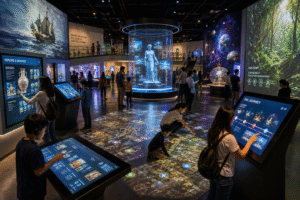
The origin myth chamber is the visitor’s first immersive encounter with the story world and must establish the fundamental character of the mythology being presented with immediate clarity and emotional power. This is the zone that answers the question every visitor carries with them on entry: what world am I entering? The scenic design, lighting, audio environment, and atmospheric detail of the origin chamber must collectively communicate the specific cultural and aesthetic identity of the mythology: the colour palette, material vocabulary, architectural reference, and character iconography that distinguish this particular story world from any other. Immersive projection mapping that animates the creation story across the full surface of the chamber, combined with spatial audio that places the visitor at the centre of the cosmic narrative, creates the entry experience that orients the visitor emotionally and sets the experiential standard for everything that follows.
Hero’s Quest Zone
The hero’s quest zone is where visitor agency enters the experience. Having established the story world in the origin chamber, this zone invites visitors to become participants in the narrative rather than observers of it. RFID-based mission systems, where visitors are assigned a hero identity or quest objective at the zone entry and must collect artefacts, solve challenges, or make story choices as they move through the space, create the personalised narrative thread that connects the individual visitor’s experience to the larger story of the mythology world. The hero’s quest zone must balance challenge and accessibility, offering enough interactive depth to genuinely engage motivated participants while remaining welcoming and navigable for visitors who prefer a more exploratory, less structured mode of engagement.
Conflict Realm
The conflict realm is the emotional heart of the experience: the zone where the stakes of the narrative are felt most intensely and where the full sensory capability of the attraction’s technology systems is deployed. The conflict between heroic and antagonist forces in mythology, whether the battle between gods and asuras in Hindu tradition, the war of the Olympians and the Titans in Greek legend, or any culture’s equivalent cosmic conflict, provides the dramatic material for an environment of maximum atmospheric intensity. Programmable lighting that shifts from warm heroic tones to cold threatening hues as visitors move between the zones of competing forces, animatronic creatures that embody the antagonist powers of the mythology, and spatial audio that creates the soundscape of cosmic conflict all converge in this zone to produce the most memorable and shareable moments of the entire visit.
Resolution Chamber and Reflection Zone
The resolution chamber delivers the emotional payoff that the conflict realm has built toward, and its design must communicate with equal clarity the sense of victory, peace, or transcendence that the mythology’s climactic resolution represents. A full-dome projection environment that fills the visitor’s entire visual field with the imagery of divine resolution, whether the restoration of cosmic order, the hero’s apotheosis, or the return of light to a world that has known darkness, creates the cathartic peak experience that defines the visitor’s emotional memory of the entire attraction. The subsequent reflection zone, adjacent to the retail and F&B spaces, sustains this emotional state and creates the conditions in which visitors are most open to extending their relationship with the story world through merchandise, digital keepsakes, and the social sharing that generates the organic reach that drives new visitor acquisition.
Technology Integration for Modern Mythology Attractions
The technology layer of a mythology experience centre is the instrument through which the story world is made sensory and present. The principle that should govern every technology decision is stated simply but demands rigorous discipline in application: technology exists to enhance storytelling, not to demonstrate itself. A projection mapping installation that creates a breathtaking animated recreation of a creation myth serves the story. A projection installation that is technically impressive but narratively purposeless creates spectacle without meaning, and spectacle without meaning does not create the emotional memory that drives repeat visitation or the word-of-mouth advocacy that builds the venue’s reputation.
Technology System Overview
The following table maps the eight core technology systems of a mythology experience centre to their primary narrative application, key specification requirements, and the critical operational criteria that must be maintained to sustain their performance over time.
Technology System | Narrative Application | Key Specification |
Projection Mapping | Transforming scenic surfaces into animated story environments | Minimum 10,000 lumens, edge blending, content management access |
Animatronics | Bringing mythological characters and creatures to life | Public-grade mechanisms, sealed against humidity, maintenance access |
Programmable LED Lighting | Creating emotional tone, guiding visitor movement, signalling story shifts | DMX control, game-state synchronisation, sealed outdoor-rated units |
Spatial Audio | Delivering immersive soundscapes and directional character voices | Zoned speaker arrays, sub 10ms inter-zone delay, independent channel control |
Interactive RFID Missions | Personalising the hero’s journey and tracking visitor progress | Visitor-held token or wristband, real-time progress logging, content unlocking |
LED Immersive Tunnels | Zone transitions that signal story world shifts to visitors | Full 360-degree addressable LED, synchronised with audio and projection |
Centralised Show Control | Coordinating all AV, lighting, animatronics, and effects in real time | Single-point monitoring, emergency override, content update capability |
Projection Mapping as Narrative Architecture
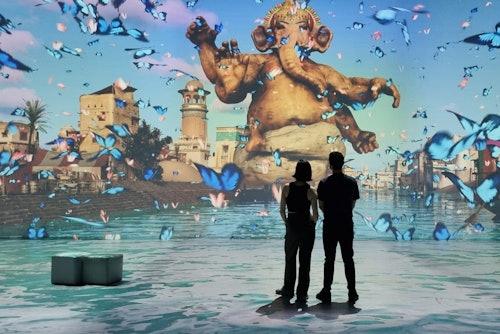
Projection mapping in a mythology experience centre is most powerfully deployed not as a surface decoration but as a narrative architecture tool that transforms the physical character of a space in response to story state changes. A chamber that appears as an ancient stone temple under one projection state and transforms into a celestial realm under another, triggered by a visitor’s RFID mission completion or by the programmed story progression timer, creates a dynamic spatial experience that a fixed scenic installation can never replicate. The content management system that controls the projection layer must be accessible to the venue’s own content team, allowing narrative updates, seasonal overlays, and new story sequences to be introduced without dependence on the original technology vendor.
Animatronics and Character Presence
In a mythology experience centre, animatronic characters serve a function that no digital technology can fully replicate: they create the visceral, immediate impression of genuine presence for the mythological creatures and characters they portray. A deity figure whose eyes follow visitors as they enter a chamber, whose lips move to deliver an oracle, or whose limbs respond to proximity with slow, deliberate movement creates an encounter that is felt as well as seen. Animatronic specifications for a public attraction must prioritise durability and maintenance accessibility alongside the quality of the character portrayal: mechanisms that fail regularly or require lengthy downtime for repair damage the experience quality and the operational economics of the venue simultaneously.
Spatial Audio and Mythological Soundscapes
Sound is the most emotionally direct sensory channel available to an immersive designer and is consistently the most underinvested dimension of mythology experience centre design. A spatial audio system that delivers the ambient soundscape of a mythological environment with directional precision, placing the sound of distant battle to the left, the voice of a deity above and behind, and the whisper of an oracle directly in the visitor’s ear, creates an immediacy and intimacy of narrative engagement that visual design alone cannot achieve. The audio content must be designed with the same care and ambition as the visual design: original musical compositions that reference the musical traditions of the mythology’s culture, sound design that makes the physical forces of the story world audible, and voice performances for key characters that carry the gravity and authority their mythological status demands.
Operational and Throughput Planning
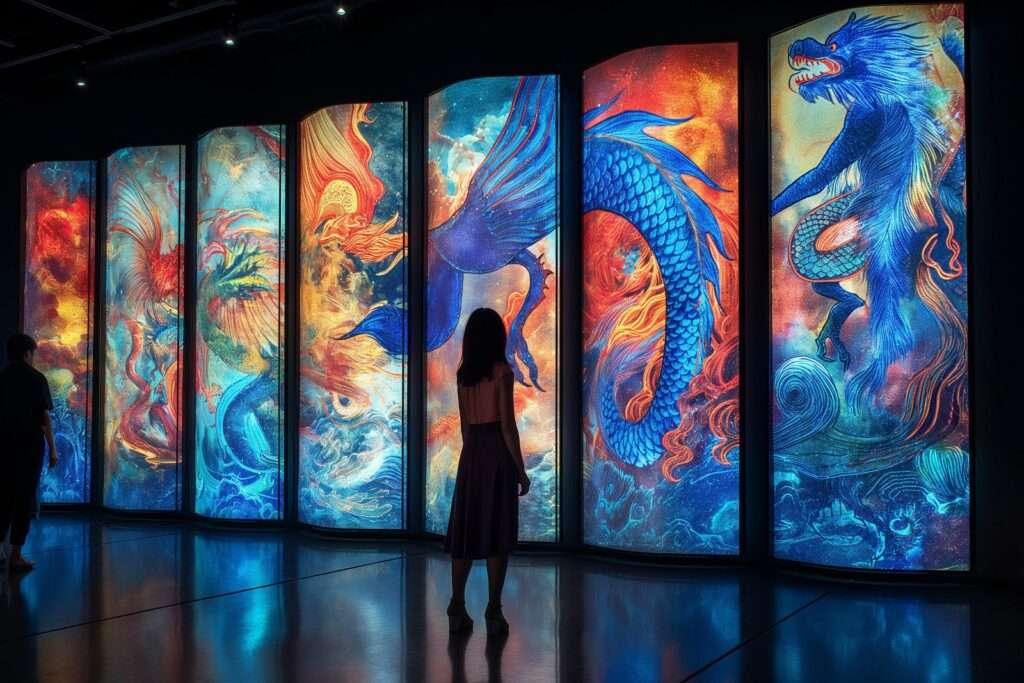
The operational design of a mythology experience centre is the discipline through which the creative vision is delivered consistently at commercial scale. The challenges of managing visitor flow through an emotionally immersive environment, maintaining the quality of technology systems that are in continuous public use, and sustaining the atmospheric standards that justify premium admission pricing across every session of every operating day, all demand the same precision and discipline as the creative and technical design of the attraction itself.
Timed Group Entry and Visitor Flow Management
Timed group entry is the primary throughput management tool for a mythology experience centre and must be calibrated with care to balance three competing requirements simultaneously. Groups must be small enough that the immersive atmosphere of each zone is not diluted by overcrowding and visitors can move through interactive elements without queuing. Groups must be large enough to justify the operational cost of each entry cycle. And the interval between groups must allow the attraction’s automated reset systems to return all interactive elements to their starting states before the next group arrives. A group size of 20 to 30 visitors with an entry interval of 12 to 18 minutes is a commonly effective balance for mid-scale mythology attractions, but the specific calibration should be established through pre-opening operational trials that test actual dwell time and flow behaviour under realistic visitor conditions.
Structured Queue Experiences
The time visitors spend waiting for their session entry is a commercial and experiential opportunity that mythology experience centre operators consistently underexploit. A structured queue experience that introduces the story world through environmental design, ambient audio, short-form video content featuring the mythology’s characters, and interactive elements that build anticipation and narrative context transforms a functional waiting period into the first chapter of the visitor’s journey. Visitors who arrive at the entry threshold already emotionally engaged with the story world enter the attraction in a state of preparedness and anticipation that significantly enhances their experience of everything that follows. The queue environment is also the optimal location for upsell touchpoints such as premium experience upgrade offers and merchandise pre-ordering.
Automated Resets and Scenic Maintenance
Interactive elements in a mythology experience centre, from RFID mission stations to animatronic characters and projection-triggered story events, must reset automatically between visitor groups without requiring manual staff intervention for every element. Show control software that executes a complete automated reset sequence on the departure of each visitor group, returning all elements to their start states, resetting RFID mission progress, and verifying the operational status of all critical systems before the next group entry, is the technology infrastructure that makes commercial throughput sustainable. Scenic material quality is an equally critical operational consideration: materials that degrade rapidly under the physical contact of thousands of daily visitors create a maintenance burden that erodes both the experience quality and the operating margin of the venue, and high-quality scenic specification at the construction stage is consistently more economical than ongoing repair and replacement of inferior materials.
Long-Term Profit Optimisation
The commercial sustainability of a mythology experience centre depends on the breadth of its revenue architecture and the vitality of its content evolution programme. A venue that relies primarily on general admission ticket revenue and does not invest in seasonal programming, premium experience formats, or community-building content will experience the natural revenue plateau that affects all single-experience attractions once the initial novelty period passes. The venues that achieve sustained commercial performance are those that treat content evolution and revenue diversification as ongoing operational priorities from the first day of operation.
Revenue Stream | Format | Commercial Profile |
Ticketed General Entry | Standard and premium timed admission sessions | Primary, high-frequency |
Limited-Time Quests | Seasonal narrative overlays with exclusive mission content | Demand surge, social media driver |
Seasonal Festivals | Major event programming tied to cultural and mythological calendar | High-footfall, media-generating |
Themed Merchandise Drops | Character artefacts, story world collectibles, limited editions | Ancillary, brand-extending |
Premium Interactive Experiences | Private guided tours, character encounters, exclusive zone access | High-margin upsell |
School and Group Programmes | Curriculum-linked mythology and cultural heritage visits | Volume-driving, institutional |
Private and Corporate Hire | Exclusive evening venue hire for events and brand experiences | Premium, pre-booked |
F&B and Experience Dining | Mythology-themed menu within the immersive environment | Ancillary, dwell-extending |
Limited-Time Quests and Seasonal Festivals
Seasonal content programming is the most commercially effective tool for sustaining repeat visitation in a mythology experience centre. A Navratri festival overlay that transforms the conflict realm into a celebration of the divine feminine, a Diwali edition that fills the resolution chamber with the imagery of light’s triumph over darkness, or a seasonal quest that introduces a new mythological narrative thread through limited-time RFID missions can be delivered using the venue’s existing projection, audio, and show control infrastructure with targeted investment in new content rather than structural redesign. Each seasonal programming event creates a media-worthy announcement, a time-limited motivation to return for existing visitors, and a new reason to visit for potential first-time visitors who have been aware of the attraction but not yet motivated to attend.
Themed Merchandise and Collectible Drops
Merchandise for a mythology experience centre carries commercial value that is directly proportional to the quality of the story world investment visitors have made during their visit. Visitors who have been genuinely transported into a mythology world and have formed emotional connections with its characters, artefacts, and visual language are strongly motivated to carry something of that world home with them. Collectible merchandise drops, where new story-world artefacts, character figures, or limited-edition art prints are released in alignment with seasonal events or narrative milestones, create both the urgency of scarcity and the narrative extension of the story world into the visitor’s home. The quality and authenticity of the merchandise design is critical: products that reflect genuine cultural research and artistic craft reinforce the premium positioning of the attraction, while low-quality generic products undermine it.
Premium Interactive Experiences
Premium interactive experience packages, which offer visitors access to exclusive content, personalised narrative encounters, or extended zone experiences beyond the standard admission, create a high-margin upsell channel that serves the most engaged and highest-spending segment of the visitor demographic. A private guided tour delivered by a trained storyteller who contextualises the mythology’s cultural and philosophical dimensions, an exclusive character encounter in a dedicated space not accessible to general admission visitors, or a premium mission package with enhanced RFID content and a physical keepsake artefact at completion, all represent experiences that the most invested visitors will pay a meaningful premium for. These packages also generate the highest-quality social media content and the most enthusiastic word-of-mouth advocacy, creating marketing value that compounds their direct revenue contribution.
Global Benchmarks in Immersive Fantasy Experiences
The global immersive experience sector has produced a remarkable set of precedents for mythology and fantasy storyworld attractions, ranging from digitally sophisticated projection-based environments to live-actor narrative worlds of extraordinary ambition. The following three venues represent distinct creative and commercial approaches that offer directly applicable lessons for new mythology experience centre developers.
01 | Immersive Van Gogh and Digital Art Fantasy Exhibits Multiple Global Cities The global proliferation of large-scale digital art immersion experiences, led by formats such as Immersive Van Gogh, Atelier des Lumières, and similar projection-based installations across dozens of cities worldwide, has established proof of concept for one of the most important commercial insights available to mythology experience centre developers: that projection-based immersion can create profound emotional engagement at commercial scale without the heavy mechanical systems, complex operational requirements, or high maintenance burden of more physically elaborate attraction formats. These experiences use wall-to-floor-to-ceiling projection mapping across large continuous surfaces to create fully enveloping visual environments in which visitors move freely and experience the story or artistic world from any vantage point. The operational elegance of the model, which requires relatively compact technology infrastructure, generates minimal between-session reset requirements, and sustains high-quality throughput with modest staffing, has made it commercially viable across a wide range of venue sizes and market contexts. For mythology experience centre developers, the key lesson from this format is that the emotional power of a well-executed projection environment, combined with a compelling soundtrack and a story world of sufficient beauty and depth, can deliver visitor satisfaction at the highest tier of the immersive experience market without requiring the capital intensity of more complex formats. |
02 | Warner Bros. Studio Tour London, United Kingdom The Warner Bros. Studio Tour in London is one of the highest-revenue per-visitor cultural attractions in the United Kingdom and represents an outstanding model of how world-building, guided storytelling, themed retail, and the emotional power of beloved fictional universes can be combined into a destination experience of extraordinary commercial performance. The tour places visitors inside the physical sets, costumes, and props of the Harry Potter film series, providing a behind-the-scenes experience that combines the credibility of genuine production artefacts with the emotional resonance of a story world that billions of people have invested in across decades of books and films. For mythology experience centre developers, the Warner Bros. Studio Tour offers three specific lessons of direct commercial relevance. First, the combination of authentic cultural artefacts with immersive environmental design creates a depth of visitor engagement that pure technology-based experiences cannot match. Second, the retail environment, which accounts for a significant proportion of total visitor spend, is most effective when the merchandise is closely integrated with the specific story world experiences of the visit rather than offering generic branded products. Third, the premium pricing that world-class attraction positioning supports is achievable when the quality of every touchpoint in the visitor experience, from the entrance architecture to the exit retail environment, is consistent with the brand’s premium identity. |
03 | Evermore Park Utah, USA Evermore Park in Utah, USA, is one of the most ambitious live-actor fantasy storytelling experiences in the world and stands as a compelling example of how seasonal world evolution and character-driven narrative immersion can build the kind of passionate repeat visitor community that sustains an experiential attraction over years rather than months. The park creates a fantasy story world that evolves across the calendar year through themed seasonal events, each introducing new narrative chapters, new characters, and new interactive storylines that give the existing community of regular visitors genuinely new content to discover and engage with on every return visit. The live actor integration model at Evermore, which places trained performer-characters throughout the park environment to deliver personalised narrative interactions with individual visitors, creates moments of genuine emotional surprise and intimacy that no pre-programmed technology system can replicate. For mythology experience centre developers, the Evermore model is most instructive as evidence of the exceptional loyalty and community investment that a story world with genuine narrative depth, consistently delivered through live performance and seasonal evolution, can generate among its most passionate visitors. The repeat visitation rates and community advocacy intensity of Evermore’s dedicated visitor base illustrate the commercial value of investing in the kind of story world richness and live performance quality that creates visitors who identify with the attraction as members of a community rather than consumers of a product. |
Frequently Asked Questions
The following questions address the most important creative, technical, and commercial planning considerations for developers approaching a mythology experience centre project.
What mythology traditions offer the strongest commercial potential for an immersive experience centre in India? |
Indian mythology offers an extraordinarily rich creative library for immersive experience design, with several traditions offering particularly strong commercial potential. The epic narratives of the Ramayana and Mahabharata provide the most universally recognised and emotionally resonant story material across all Indian demographics and generations, with deeply familiar characters, dramatic conflicts, and moral frameworks that give visitors immediate emotional entry points into the story world. The Shaivite and Vaishnava divine traditions offer visually spectacular character iconography and cosmological narratives that translate powerfully into immersive scenic design. Regional mythology traditions, from the folk deities of Rajasthan and the goddess traditions of Bengal to the maritime mythology of Tamil Nadu and the tribal narratives of central India, offer distinctive and underexplored story material that can differentiate a venue from the most expected mythological references and appeal to audiences seeking something beyond the most familiar narratives. |
What is the appropriate capital investment range for a mid-scale mythology experience centre? |
A mid-scale mythology experience centre of 8,000 to 15,000 square feet with a full technology stack including projection mapping, spatial audio, programmable lighting, animatronic characters, and RFID interactive systems typically requires a total investment in the range of INR 8 to 20 crore, depending on the complexity of the scenic design, the quality and quantity of animatronic elements, and the specification of the projection and audio systems. Scenic design and construction typically accounts for 35 to 45 per cent of total investment, technology systems for 30 to 40 per cent, and fit-out, FF&E, and pre-opening operational costs for the remainder. Smaller projection-led experiences with limited animatronic content can be realised at lower investment levels, while venues with extensive live character integration, signature architectural installations, and premium hospitality spaces will exceed the upper end of this range. Developers should engage specialist consultants for technology and scenic cost estimation at an early stage, as the variance between preliminary and detailed cost estimates in this sector is significant. |
How does RFID mission technology enhance the visitor experience in a mythology attraction? |
RFID mission technology transforms a mythology experience centre from a passive observation environment into a participatory narrative world by giving each visitor a personalised story identity and a progressive quest objective that connects their individual journey through the physical space to the larger mythology being presented. At entry, each visitor receives an RFID token or wristband that identifies them as a specific hero archetype within the story world. As they move through the attraction, interaction with RFID-enabled mission stations unlocks story content, awards quest artefacts, and tracks their progress toward the quest objective that will determine their individual story outcome in the resolution chamber. This personalisation mechanism creates a meaningfully different experience for each visitor even within the same visit, motivates thorough exploration of the attraction to find all mission stations, and generates the narrative investment that makes the resolution chamber payoff emotionally resonant rather than merely visually spectacular. |
How should a mythology experience centre approach school and educational group programming? |
School and educational group programming is one of the most commercially valuable and reputationally significant revenue streams available to a mythology experience centre, and one that is particularly relevant in the Indian context where mythology and cultural heritage are formally integrated into national curriculum frameworks. Curriculum-linked programme packages, designed in partnership with educators to align with the cultural heritage, language, and history learning objectives of relevant school year groups, command a premium per-head rate above general admission and fill weekday capacity during school hours. Facilitated group sessions delivered by trained cultural storytellers within the attraction environment extend the educational dimension of the visit and create the institutional credibility that supports long-term partnerships with school systems and education departments. A well-developed school programme that covers cultural context, narrative analysis, and artistic tradition alongside the immersive experience positions the venue as a genuine educational resource rather than simply an entertainment attraction, which both strengthens its public funding and partnership opportunities and differentiates it from competing entertainment venues targeting the same school group booking market. |
What are the most effective strategies for sustaining repeat visitation in a mythology experience centre? |
Repeat visitation in a mythology experience centre is sustained through four compounding strategies that must all be actively managed. Seasonal content programming, including festival overlays, limited-time quests, and narrative expansion events tied to the mythological calendar, gives the existing visitor audience time-limited reasons to return that are anchored to story content rather than simply promotional discounts. Community building, through membership programmes that create a sense of belonging among regular visitors and competitive RFID mission leaderboards that motivate return visits to improve quest performance, creates the social identity investment that makes visitors reluctant to defect to competing experiences. Digital extension, through app-based story world content that connects the in-venue experience to ongoing digital engagement between visits, sustains the visitor’s relationship with the mythology world beyond the physical attraction. And content depth, ensuring that the story world contains more detail, hidden narrative elements, and environmental storytelling than any single visit can exhaust, creates the intrinsic motivation of discovery that makes return visits feel like genuinely new experiences rather than repetitions of a familiar one. |
How important is cultural authenticity to the commercial success of a mythology experience centre? |
Cultural authenticity is not simply an ethical obligation for a mythology experience centre. It is a direct commercial asset that determines the depth of visitor engagement, the credibility of the attraction’s positioning, and the sustainability of its reputation among the most influential members of its target audience. Visitors who have grown up within the mythology being presented bring a level of cultural knowledge and emotional investment that makes inauthenticity immediately perceptible and deeply unsatisfying. A mythology experience that misrepresents iconography, conflates different traditions, or treats sacred narrative material with insufficient care will generate the kind of passionate criticism from culturally knowledgeable visitors that spreads rapidly through social media and permanently undermines the venue’s credibility in its most important audience segment. Conversely, a mythology experience that demonstrates genuine cultural research, presents the tradition with intellectual and artistic seriousness, and creates its immersive environments in consultation with scholars, artists, and community representatives earns the kind of enthusiastic cultural advocacy that is worth more than any marketing budget. |
Work with Experienced Immersive Designers
Creating a mythology experience centre that is genuinely magical in its creative ambition, technically precise in its execution, commercially structured for sustainable returns, and culturally authentic in its treatment of the story world it presents, requires the kind of integrated specialist expertise that very few development teams possess independently. The decisions made at the concept and design stage, about narrative architecture, technology specification, operational capacity planning, and revenue structure, determine the visitor experience quality and financial performance of the venue for the entirety of its operating life.
Peach Prime Consultancy helps developers create scalable, immersive, and financially structured mythology and fantasy attraction experiences from concept through to operational launch and beyond. Our services span concept development and storyworld architecture, technology vendor evaluation and integration strategy, spatial and acoustic design briefing, capacity and throughput planning, revenue architecture and financial modelling, and community programming strategy. We bring deep expertise in immersive attraction development and the structured planning methodology that ensures every dimension of the venue is designed for both emotional impact and commercial sustainability.
Whether you are exploring the concept stage, preparing a detailed development brief, or ready to move into technology procurement and design execution, Peach Prime Consultancy provides the expert guidance that transforms your mythology experience centre vision into a commercially strong and culturally significant destination. Visit www.peachprime.in to explore our services or contact our team directly to arrange a strategic planning consultation.
WHAT PEACH PRIME DELIVERS | Storyworld concept development and narrative zone architecture, technology system specification and vendor evaluation, spatial design briefing and acoustic planning, throughput and capacity management design, revenue architecture and financial modelling, community programming strategy, and full investor presentation support. |