

A structured planning and investment guide for developers, hospitality entrepreneurs, and entertainment investors building themed mini golf attractions that deliver sustained commercial performance across indoor and outdoor formats.
Introduction: The Social Entertainment Opportunity in Miniature Golf
Miniature golf is not a new concept. It has existed as a leisure format for well over a century, and its fundamental appeal, the combination of gentle physical challenge, accessible competition, and the particular pleasure of a well-designed course environment, has sustained it through many cycles of cultural change. But something significant has happened to the miniature golf category in the past decade, and developers and investors who understand this shift are positioning themselves to capture one of the most compelling opportunities in the contemporary social entertainment sector.
The transformation is this: miniature golf has moved from being a nostalgic family leisure activity at the modest end of the entertainment market to being a cornerstone format of the premium social entertainment sector. Driven by the broader cultural shift toward experience-oriented socialising, the rise of competitive socialising as a leisure category, and the appetite of affluent urban adults for entertainment experiences that are simultaneously active, photogenic, and conducive to group interaction, a new generation of themed, immersive mini golf venues has emerged that bears almost no resemblance to the roadside windmill-and-clown-face courses of the previous era.
These new venues combine genuinely ambitious thematic storytelling with sophisticated lighting technology, integrated hospitality, and the social mechanics of competitive play to create destinations that attract not just families and children but young professionals, corporate groups, and date-night seekers in large numbers. They generate strong repeat visitation through the combination of social motivation and content refresh, and they achieve revenue per square foot that compares favourably with bar and restaurant concepts of equivalent size. This framework provides a complete development roadmap for creating a miniature golf attraction that captures the full commercial potential of this transformation.
MARKET POSITION | Modern immersive mini golf operates at the intersection of competitive socialising, destination dining, and experiential entertainment. The most successful venues are not golf courses. They are social entertainment destinations that happen to feature golf as their interactive activity anchor. |
STEP 1 | Thematic Story Development and Course Flow |
The thematic story of an immersive mini golf attraction is its most fundamental commercial asset and its primary differentiator in a market where the basic format of hitting a small ball around a course is available at hundreds of competing venues. A compelling, coherently executed theme transforms a golf course into a destination: a specific world with a specific character that visitors want to enter, explore, and share. It is the foundation on which every subsequent design, technology, and marketing decision is built, and it is the element that visitors remember, talk about, and return for.
Choosing and Developing the Theme World
Theme selection for a mini golf attraction should be driven by three considerations in order of priority: the creative potential of the theme for immersive scenic and narrative development, the alignment of the theme with the target demographic and market context, and the operational sustainability of the theme over a multi-year venue lifecycle with seasonal refresh potential. A theme that is visually striking but narratively thin will exhaust its appeal quickly. A theme that resonates powerfully with the target audience but is difficult to refresh without significant capital expenditure will create commercial pressure in years two and three of operation. The ideal theme is one that offers deep creative territory, strong demographic resonance, and natural seasonal and narrative expansion possibilities.
The following table summarises the most commercially proven theme worlds in the contemporary mini golf market, their narrative and scenic characteristics, and the primary audience segments they serve most effectively.
Theme World | Narrative and Scenic Character | Primary Audience |
Fantasy Kingdom | Enchanted forests, castles, mythical creatures, magical lighting | Families, young children |
Underwater Adventure | Coral reefs, shipwrecks, sea creatures, UV blue and teal palette | Families, youth groups |
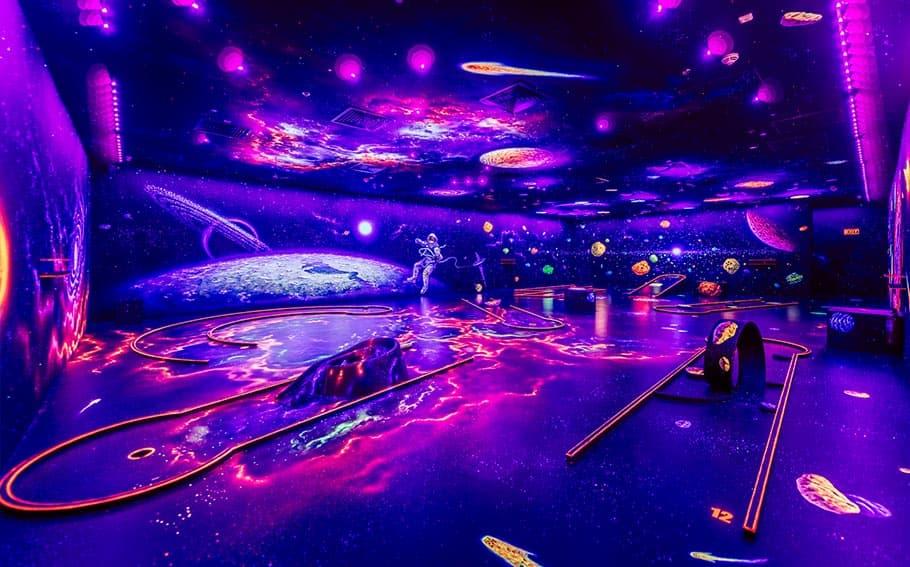
Space Exploration | Planets, astronauts, rocket ships, galaxy projection mapping | All ages, STEM audiences |
Retro Neon City | 80s arcade aesthetics, neon grids, pop culture references, UV glow | Young adults, corporate groups |
Jungle Expedition | Dense foliage, animatronics, ancient ruins, natural sound design | Families, tourists |
Cinematic Universe | Licensed or original film-inspired scenes, theatrical scenic design | Fans, young adults, families |
Narrative Structure Across 9 and 18 Holes
A coherent narrative structure across the full course is the design discipline that elevates a themed mini golf course from a collection of impressive individual holes to a unified story experience. The course should be conceived as a journey with a beginning, a development, and a climax: an opening sequence that establishes the story world and orients the visitor within it, a middle section that develops the narrative environment and escalates the thematic intensity of the scenic design, and a final sequence that delivers the most spectacular and memorable moments of the course. This narrative escalation serves both an experiential and a commercial function. Experientially, it gives the visit an emotional arc that makes it feel complete and satisfying. Commercially, it ensures that the most photogenic and shareable moments of the course are concentrated toward the end, motivating visitors to complete all 18 holes and maximising average dwell time.
Course Flow and Congestion Management
Smooth course progression is as important to the commercial performance of a mini golf attraction as the quality of its scenic design. A course that generates bottlenecks, creates queuing at individual holes, or allows faster groups to become frustrated behind slower ones, erodes the visitor experience and reduces throughput, directly impacting revenue capacity. Effective course flow design addresses the physical width and accessibility of pathways between holes, the spatial separation between consecutive holes to prevent visibility of queuing from the active play area, the placement of the most time-intensive and popular holes to distribute congestion across the course rather than concentrating it at predictable chokepoints, and the provision of overtaking opportunities at strategic intervals that allow faster groups to pass slower ones without confrontation or disruption.
- Minimum pathway width between holes should accommodate two adults walking side by side with golf equipment
- Consecutive holes should be visually separated to prevent early exposure to upcoming content and manage anticipation
- The most technically challenging holes should be distributed across the course to avoid consecutive congestion
- Course capacity per operating hour should be calculated conservatively, based on average group size and realistic per-hole play time, and used as the basis for timed entry interval planning
STEP 2 | Lighting and Technology Integration |
The lighting and technology layer of an immersive mini golf attraction is the primary tool through which the scenic design comes to life at an experiential level. A beautifully constructed course environment that is inadequately lit is a missed opportunity. A technically sophisticated lighting and projection installation that is not aligned with the thematic intent of the scenic design is an expensive irrelevance. The integration of lighting and technology with the creative vision of the course is the design discipline that separates the venues that visitors remember from those they merely appreciate.
Indoor Glow Golf: UV and LED Technology
For indoor mini golf venues, UV-reactive and LED-based glow golf design is the dominant aesthetic format and one of the most commercially powerful visual identities available to a new attraction. UV-reactive paints applied to all scenic elements, combined with controlled UV lighting throughout the course environment, create a visual transformation of the space that is dramatically different from any everyday visual experience and generates the kind of vivid, shareable imagery that drives organic social media reach. The design discipline of UV glow golf requires particular attention to the tonal coherence of the UV palette across the full course, ensuring that the overall visual environment reads as a unified world rather than a collection of individually lit holes. LED strip lighting integrated into course structures, pathway edges, and architectural elements adds spatial depth and allows dynamic colour programming that can be varied by time of day, special event, or seasonal overlay without physical changes to the scenic design.
Projection Mapping in Mini Golf
Projection mapping in a mini golf context ranges from ambient environmental projections that animate the scenic design of individual holes to full-course narrative sequences that use projected content to advance the story between holes or respond to player performance. The most commercially effective projection mapping applications in mini golf are those that enhance specific signature moments within the course experience rather than attempting to cover the entire surface area of the venue. A single spectacular projection-mapped centrepiece hole, where the walls, floor, and ceiling of a dedicated chamber transform into a fully animated story environment as the player takes their shot, creates a disproportionate level of visitor engagement and social media sharing relative to the cost of its installation. Ambient projection across all holes is a higher capital investment that delivers a consistent atmospheric enhancement but rarely generates the concentrated viral impact of a single signature moment.
Interactive Scoring Systems and Digital Integration
Digital scoring systems have transformed the competitive social experience of mini golf and are now a baseline expectation rather than a differentiating feature for any new immersive venue. RFID-enabled scorecards, mobile app-based scoring with real-time leaderboards, digital display scoreboards at each hole, and post-round performance summaries shared via app or email all contribute to the social and competitive engagement of the experience and provide the venue with valuable data on visitor behaviour, hole difficulty distribution, and throughput patterns. More sophisticated interactive scoring systems can integrate with the thematic narrative of the course, framing the visitor’s round as a mission within the story world and awarding narrative achievements alongside score-based outcomes. These systems require robust network infrastructure across the full course environment and a content management platform that allows the venue team to update scoring content and leaderboard configurations without specialist technical support.
Outdoor Architectural Lighting and Landscape Integration
Outdoor mini golf courses present a distinct and equally rich set of lighting design opportunities. Architectural lighting that highlights the structural and scenic features of the course environment after dark transforms an outdoor course into a genuinely spectacular evening destination, extending the operating hours and revenue potential of the venue significantly beyond what is achievable during daylight alone. Water features illuminated from below, animatronic installations enhanced by precisely aimed spotlighting, pathway lighting integrated into the landscape design rather than applied as afterthought infrastructure, and programmable colour-wash lighting that allows the visual character of the course to shift seasonally or for special events are all elements of a high-quality outdoor lighting design. Outdoor lighting specifications must also address the practical requirements of weather resistance, IP-rated equipment for all external installations, and cable routing that is both maintenance-accessible and visually invisible within the course environment.
Animatronic and Water Feature Integration
Animatronic installations and water features are the scenic elements that most powerfully establish the physical credibility of an outdoor themed mini golf course and most reliably generate the wide-eyed visitor response that drives social sharing and repeat visitation aspiration. A well-specified animatronic character, whether a jungle creature reacting to nearby player movement, a robot responding to a completed shot, or a mythical beast anchoring the course’s signature hole, creates a moment of genuine spectacle that no two-dimensional scenic flat or printed graphic can replicate. Water features serve simultaneously as scenic assets and practical course design elements, adding dynamic movement and sound to the course environment while creating natural hole boundary conditions that raise the challenge and visual interest of adjacent play areas. Both animatronics and water features require dedicated maintenance budgets and service schedules that must be factored into the operational cost model from the outset.
STEP 3 | Commercial Optimisation and Throughput Planning |
The commercial architecture of an immersive mini golf attraction is the framework through which the creative and experiential quality of the venue is translated into sustainable financial performance. A beautifully designed and technically sophisticated course that is not commercially optimised will consistently underperform its potential. The most successful venues in the contemporary mini golf sector treat commercial optimisation not as an afterthought to the creative process but as an integrated design consideration from the earliest stages of development.
Timed Entry and Capacity Management
Timed entry systems are the primary operational tool for managing throughput and ensuring that the visitor experience maintains its quality across all capacity levels from quiet midweek sessions to peak weekend periods. A well-calibrated timed entry system assigns each visitor group a specific tee-off time that is spaced to create the optimal balance between course utilisation and hole-by-hole congestion. The interval between tee-off times should be calculated based on empirical testing of actual group play speed across all 18 holes during pre-opening operational trials, not on theoretical assumptions. Timed entry also enables the venue to implement peak and off-peak pricing differentiation, advance booking incentives, and express pass upsells that improve both revenue per visitor and operational predictability.
Revenue Architecture
A well-structured revenue architecture for an immersive mini golf attraction captures value across the full range of visitor spending motivations and group types. The following table maps the primary revenue streams available to a mini golf operator against their format and commercial profile.
Revenue Stream | Format | Commercial Profile |
Ticketed Round Play | Standard and peak session pricing, 9 or 18 holes | Primary, high-frequency |
Express and Priority Passes | Queue bypass and reserved tee-off time upgrades | Upsell, margin-positive |
Corporate League Events | Recurring team competition formats with scoring and prizes | High-yield B2B |
Nighttime Programming | Themed evening sessions with enhanced lighting and music | Demand extension, premium |
Integrated F&B Zones | In-course and lounge food and beverage service | Ancillary, high-margin |
Private and Group Hire | Exclusive course hire for celebrations and events | Premium, pre-booked |
Loyalty and Membership | Season passes and regular player programmes | Recurring, loyalty-building |
Integrated F&B Zones
Food and beverage integration is one of the highest-return commercial enhancements available to a mini golf operator and is the single dimension that most clearly distinguishes the contemporary social entertainment positioning of premium venues from the conventional course-only format. An F&B zone positioned at the midpoint of the course, offering a drinks and light food selection that encourages groups to pause, refresh, and extend their dwell time before completing the back nine, generates incremental spend at the moment of highest visitor engagement and social energy. A post-round bar and lounge area, designed as a genuinely inviting social space rather than simply a service counter, converts the natural post-game socialising impulse of competitive groups into additional food and beverage revenue and significantly increases the average total spend per visit. The F&B concept must be calibrated to the demographic target of the venue: a premium craft cocktail offering for an adult competitive socialising positioning, a broad family-friendly menu for a family entertainment centre format.
Corporate League Events and Nighttime Programming
Corporate league events are among the most commercially valuable formats available to a mini golf operator and are the primary mechanism for generating high-yield weekday evening revenue during periods that would otherwise be among the lowest-footfall windows in the operational calendar. A structured corporate golf league, running across eight to twelve weeks with weekly rounds, cumulative scoring, and a season finale event, creates a recurring booking commitment from corporate clients that delivers predictable revenue, strong group food and beverage spend, and powerful word-of-mouth within professional networks. Nighttime programming, whether themed glow nights, late-night competitive sessions with DJ sets and cocktail service, or exclusive private hire evenings, extends the venue’s operating day into the high-value evening hospitality window and positions it as a genuine destination for the adult social entertainment market rather than a family attraction that closes at six.
International Case Studies: Three Venues Defining the Modern Standard
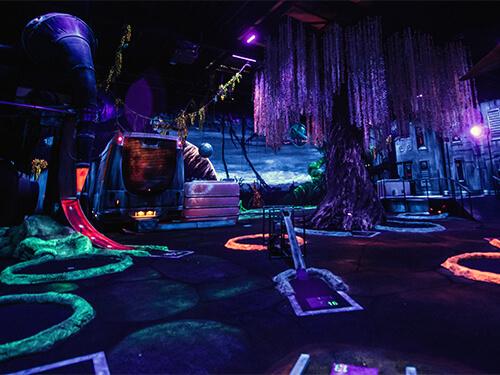
The contemporary immersive mini golf sector has produced a compelling set of international precedents that demonstrate the commercial viability and creative range of the format across diverse markets and positioning strategies. The following three venues represent distinct but equally instructive approaches.
01 | Swingers Crazy Golf United Kingdom and USA Swingers is the defining reference point for adult-focused competitive social mini golf in the English-speaking world and has built one of the most commercially successful and replicable models in the contemporary social entertainment sector. Operating venues in London, New York, and Washington DC, Swingers combines thoughtfully designed nine-hole crazy golf courses within a large-format hospitality venue that also includes multiple bar stations, street food offerings from rotating independent vendors, and a high-energy social atmosphere calibrated for the young professional and corporate group demographic. What distinguishes Swingers as a strategic model is the clarity and conviction of its positioning: it is not a family entertainment venue that also serves adults, and it is not a golf venue that happens to have a bar. It is an adult social entertainment destination in which mini golf is the activating mechanism for a hospitality-led social experience. This positioning allows Swingers to command premium pricing, attract high-spending corporate group bookings, and generate the kind of social media visibility among its target demographic that no conventional marketing spend could replicate. Its multi-venue rollout across international markets demonstrates the scalability of the social golf format when the concept, design, and operational model are executed with sufficient precision and consistency. |
02 | Lost Jungle Mini Golf USA Lost Jungle Mini Golf in the United States represents the outdoor scenic theming approach to premium mini golf development and demonstrates how a well-executed naturalistic theme can build strong and sustained tourist appeal in the right geographic market. The venue immerses players in a lushly landscaped jungle environment, complete with dense tropical planting, water features, carved stone installations, and theatrical scenic elements that create a convincing sense of deep jungle exploration across the full course. The scenic quality of Lost Jungle is its primary commercial asset and differentiator: in a market where conventional mini golf courses are ubiquitous, the depth and consistency of its immersive environment creates a destination appeal that draws visitors specifically for the quality of the experience rather than simply the proximity of the venue. For outdoor mini golf developers, Lost Jungle illustrates the commercial premium that genuinely ambitious landscape and scenic design investment can command in tourism-driven markets, and the long-term competitive advantage that a distinctive visual identity creates when it is maintained to a consistent standard over time. |
03 | Glowing Rooms Germany Glowing Rooms in Germany is one of Europe’s most successful UV indoor 3D mini golf concepts and demonstrates the powerful demographic breadth that a well-executed glow golf format can achieve. The venue combines UV-reactive scenic design with 3D elements that create a visually disorienting and highly engaging play environment under blacklight illumination, attracting a visitor mix that spans families with children, teenage groups, young adult friend groups, and corporate teams with unusual consistency across all demographic segments. Glowing Rooms has demonstrated the commercial viability of the UV glow golf format in a competitive European market through the combination of its distinctive visual identity, its strong social media presence driven by the inherently photogenic quality of UV-illuminated environments, and its pricing model that is accessible to a broad audience while maintaining the revenue per visitor required for commercial sustainability. For developers considering an indoor UV glow golf concept, Glowing Rooms provides direct evidence of the format’s ability to sustain high visitor volumes across a demographic range that most single-format entertainment attractions cannot serve simultaneously. |
Future-Proofing the Mini Golf Investment
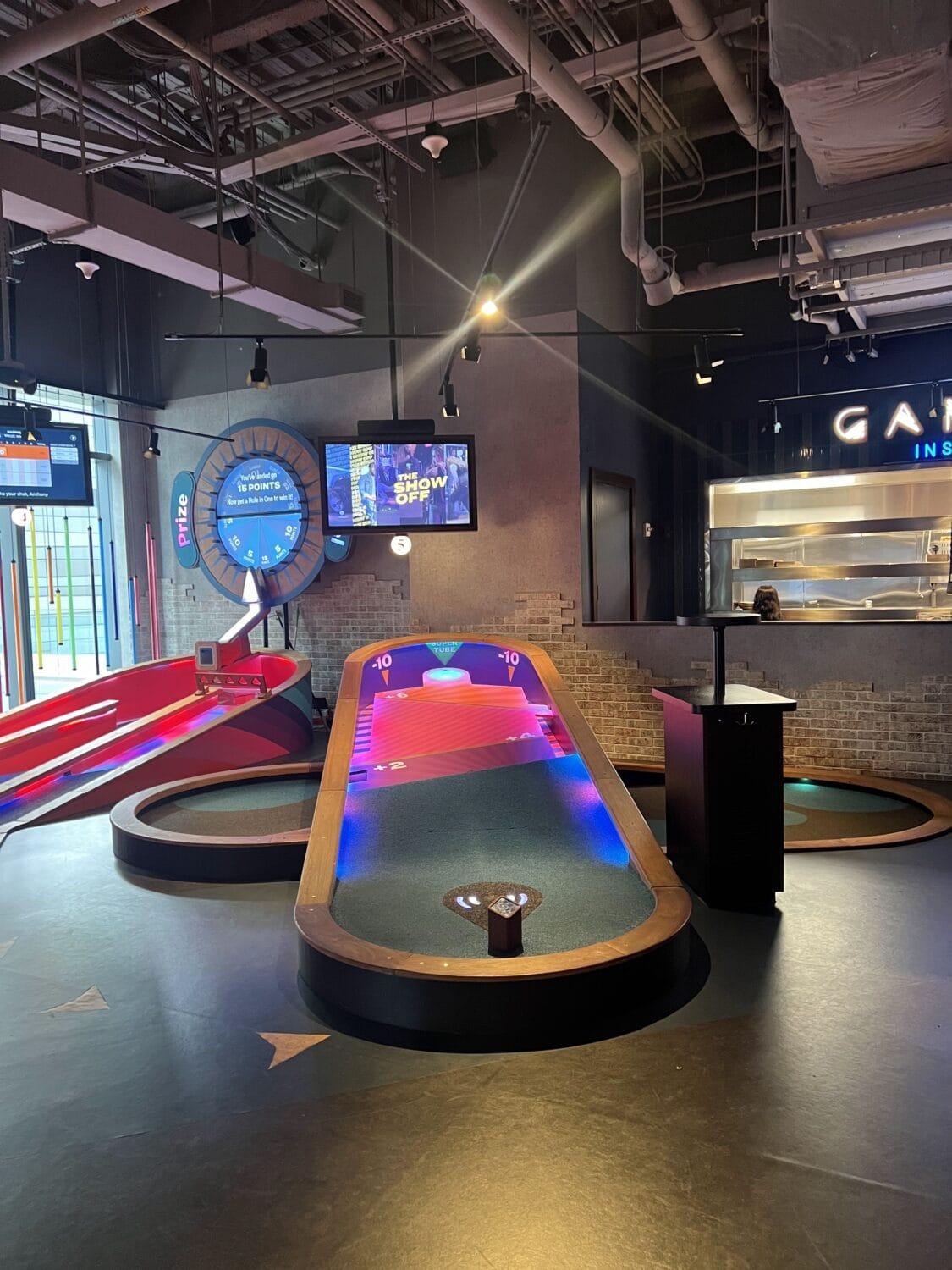
The long-term commercial performance of an immersive mini golf attraction depends on the operator’s ability to sustain visitor motivation to return beyond the initial visit. The format’s natural replayability, driven by the competitive and social dimensions of the game itself, provides a stronger baseline for repeat visitation than most passive entertainment attractions. But sustaining and growing that repeat motivation over a multi-year operating lifecycle requires active investment in content refresh, technology evolution, and loyalty programme development.
Seasonal Overlays and Rotating Themes
Seasonal theme overlays are the most cost-effective content refresh mechanism available to a mini golf operator and one of the most powerful demand-generation tools in the venue’s ongoing marketing arsenal. A Halloween transformation that repaints key scenic elements in UV-reactive seasonal colours, introduces animated projection content themed around the overlay narrative, and relaunches the venue with a dedicated media and social campaign can be executed using the modular design and programmable technology systems already in place at a fraction of the cost of a permanent course redesign. A winter wonderland overlay for the Christmas season, a spring floral theme for March and April, or a limited-run special theme tied to a cultural event or partnership opportunity all serve the same commercial function: they give the existing audience a time-limited reason to return and give potential new visitors a fresh reason to visit for the first time.
AR-Based Scoring and Interactive Technology
Augmented reality integration in mini golf scoring systems is an emerging technology dimension that is beginning to move from novelty to genuine commercial differentiator. AR-based scoring applications allow players to see interactive overlays of their shot trajectory predictions, narrative story elements triggered by proximity to specific course features, and real-time animated feedback on their performance, all delivered through a smartphone screen held over the course environment. These applications add a digital game layer to the physical course experience that is particularly compelling for younger adult audiences accustomed to layered digital interaction, and they generate content for social media sharing from within the play experience rather than only before and after it. Developers planning new venues should specify network infrastructure, specifically Wi-Fi coverage and bandwidth across the full course, that is capable of supporting AR applications even if these are not planned for the opening phase, as retrofitting network infrastructure into an operational course environment is significantly more disruptive and expensive than building it in from the start.
Loyalty Programmes and Community Building
A well-designed loyalty programme converts the casual repeat visitor into a committed venue advocate and is the commercial infrastructure through which the mini golf operator builds the community of regular players that provides long-term revenue stability. Points-based or tier-based loyalty programmes that reward visit frequency with escalating benefits, from priority booking access and F&B discounts to exclusive event invitations and branded merchandise, create ongoing engagement between visits and generate the social identity investment that makes members reluctant to defect to competing venues. Digital loyalty platforms that combine the programme membership function with course booking, digital scoring, and post-visit content sharing into a single app experience represent the current best-practice standard and should be specified as part of the technology brief for any new venue development.
Modular Course Elements and Refresh Cycles
Modular course design is the physical infrastructure investment that most directly determines the long-term commercial flexibility and lifecycle cost efficiency of the mini golf attraction. When individual holes are constructed as self-contained modular units with standardised connection interfaces to the course pathway and power and data infrastructure, they can be replaced, repositioned, or redesigned individually without disrupting the operation of adjacent holes or requiring full course closure. A planned modular refresh cycle, replacing two to four holes per year with new designs that introduce new scenic elements, updated technology features, or seasonal permanent additions, keeps the course feeling evolving and current for regular visitors without the capital expenditure of a full course replacement. Developers should specify modular design principles and component replacement pricing in their initial construction and fit-out contracts, ensuring that the refresh capability is built into the physical fabric of the venue from day one.
Frequently Asked Questions
The following questions address the most common and commercially important considerations raised by developers and investors planning an immersive mini golf attraction.
What is the minimum floor area required for a commercially viable indoor immersive mini golf venue? |
A nine-hole indoor immersive mini golf course can operate effectively from approximately 4,000 to 6,000 square feet of net play floor area, depending on the complexity of the hole designs and the width of the course pathways. An 18-hole course requires between 8,000 and 14,000 square feet for the play area alone, with additional space for entry, F&B, lounge, and back-of-house functions typically adding 30 to 40 per cent to the total footprint. Developers should resist the temptation to compress the floor area below these thresholds in the interests of real estate economy, as undersized course layouts consistently generate the bottlenecks and congestion that are the primary driver of negative visitor reviews in this format. |
How does an immersive mini golf venue generate revenue beyond basic ticket sales? |
The most commercially successful immersive mini golf venues generate between 40 and 60 per cent of their total revenue from sources other than basic ticket sales. Food and beverage is typically the largest secondary revenue stream, accounting for 25 to 35 per cent of total revenue in venues with well-designed integrated hospitality. Corporate league events and group hire packages contribute a high-yield B2B dimension that generates significantly above-average revenue per head. Express and priority passes, upsold at the point of booking or entry, add margin with minimal operational cost. Loyalty and membership programmes generate recurring revenue that smooths seasonal demand variation. Developers should build all of these revenue streams into their financial model from day one rather than treating them as future opportunities to be developed after opening. |
What makes a corporate league event product successful for a mini golf venue? |
A successful corporate league event product is built around four core elements. The first is a structured competitive format with clear rules, consistent scoring, and a cumulative season narrative that gives participants a reason to return each week beyond individual round enjoyment. The second is a hospitality package that includes food and beverage service, creating a social post-round environment that extends dwell time and per-head spend. The third is a recognisable brand identity for the league itself, including league branding, participant team names, and a trophy or award for the season winner, that creates the sense of membership in a genuine sporting community. The fourth is frictionless booking and communication management, with a dedicated corporate sales contact, automated score tracking and leaderboard updates, and flexible rescheduling options that accommodate the unpredictable diary pressures of corporate clients. |
How important is social media to the commercial success of an immersive mini golf venue? |
Social media is not simply an important marketing channel for an immersive mini golf venue. It is the primary mechanism through which the venue’s visual identity reaches its target audience, generates new visitor acquisition at low cost, and sustains ongoing brand awareness between visits. The venues that perform strongest on social media are those that are designed from the outset with social shareability as an explicit design criterion: signature holes that are visually spectacular and compositionally photogenic, course lighting that produces vivid and dramatic smartphone imagery, and interactive moments that create the kind of genuine emotion or delight that motivates spontaneous sharing. Venues that achieve strong organic social media reach consistently report new visitor acquisition costs that are a fraction of comparable entertainment concepts that rely primarily on paid media. |
What are the key operational differences between indoor and outdoor mini golf venue management? |
Indoor venues offer significantly greater control over the visitor experience environment, including consistent lighting conditions, weather independence, and easier management of hygiene and maintenance standards, but they require higher capital investment per square foot and are constrained by the fixed capacity of the built environment. Outdoor venues benefit from lower construction cost per square foot, the natural scenic quality of landscape settings, and the ability to scale more readily through course extension, but they are subject to weather dependency that creates revenue volatility and require significantly more robust maintenance programmes for scenic and technology elements exposed to the elements. Many of the most commercially successful contemporary mini golf concepts address these trade-offs by developing hybrid venues that combine an indoor course with an adjacent outdoor extension, allowing year-round weather-independent operation while offering the additional outdoor experience as a seasonal premium. |
How long does it typically take to develop and open an immersive mini golf venue? |
A full development cycle for an immersive indoor mini golf venue, from concept finalisation through to public opening, typically spans 12 to 20 months for a mid-scale 18-hole installation. The thematic concept and spatial design phase generally requires two to three months. Detailed design, technology specification, and contractor tendering typically adds a further two to three months. Construction, scenic build, technology installation, and systems integration generally requires six to ten months depending on the complexity of the scenic and technology elements. A pre-opening testing, staff training, and soft launch period of four to six weeks before full public opening is strongly recommended to identify and resolve operational issues before the venue reaches full capacity. Outdoor courses can sometimes be developed more quickly due to simpler structural requirements, but complex scenic and landscape elements can extend the outdoor timeline significantly. |
Partner with Experienced Entertainment Consultants
Developing a commercially successful immersive mini golf attraction requires the kind of integrated specialist expertise that spans creative concept development, spatial optimisation, technology specification, hospitality integration, and financial modelling simultaneously. The decisions made at the concept and planning stage determine the creative ambition, operational efficiency, and commercial performance of the venue for the entirety of its operating life, and the cost of misalignment between these dimensions is paid in both visitor experience quality and financial returns.
Peach Prime Consultancy delivers integrated planning for miniature golf attractions across the full development lifecycle. Our services cover spatial layout optimisation and course flow design, thematic concept development and scenic design briefing, technology specification and vendor coordination, F&B integration and hospitality concept planning, revenue modelling, and operational readiness support for launch and beyond. We bring deep specialist expertise in the social entertainment and immersive attraction sector, with a planning methodology that consistently ensures both creative excellence and commercial stability for our clients.
Whether you are at the early feasibility stage, developing a concept for investor presentation, or preparing for detailed design and construction, partnering with Peach Prime Consultancy provides the expert guidance that reduces execution risk and maximises the return on your investment. Visit www.peachprime.in to explore our full services or contact our team to arrange a strategic planning consultation.
WHAT PEACH PRIME DELIVERS | Thematic concept development and course narrative design, spatial layout and flow optimisation, lighting and technology specification, F&B and hospitality concept integration, revenue modelling and financial feasibility analysis, operational playbook development, and full investor presentation support. |