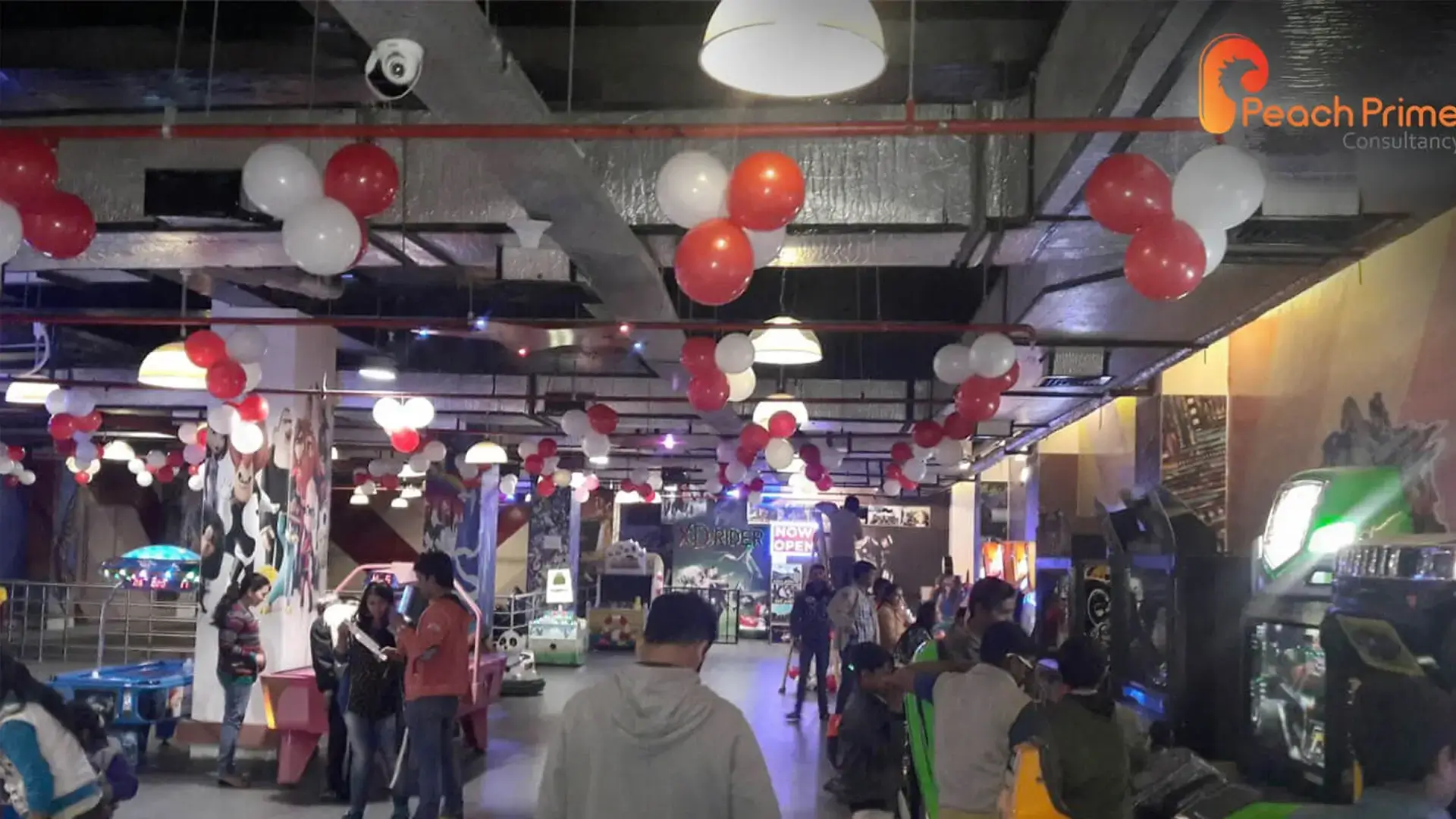
Peach Prime Consultancy is a game zone design company that helps you invest with confidence. As an independent game zone design consultant in India, we assess the catchment, project the footfall and revenue, and model the costs so you know whether an arcade and amusement gaming venue is viable, and at what scale, before you commit a rupee to equipment or fit out. We work with investors and operators across India and on projects across Asia and other global markets.
Feasibility is the first stage we recommend on any project, because it protects every decision that follows. A clear, honest study tells you whether to proceed, at what size, and on what budget, and it gives investors and lenders the evidence they need to back the venture.
What Is a Game Zone Feasibility Study?
A game zone feasibility study is a structured assessment of whether a gaming venue will work in a given location, and at what size and budget. It tests the demand, the costs, and the likely returns so an investor can decide on evidence rather than optimism. The output is an investor ready view of the opportunity that can also support a loan or partner discussion.
Why Feasibility Comes First
Committing capital without testing the catchment is the most expensive mistake in this sector, because the largest costs, the equipment and the fit out, are hard to reverse once spent. A feasibility study is a small fraction of the project cost and routinely saves far more, either by confirming a strong opportunity with the right scale or by steering you away from a weak one before the money is gone.
What Our Feasibility and Business Planning Covers
- Catchment and market analysis. Who lives and visits nearby, and what competing venues already serve them.
- Footfall and revenue projections. Realistic estimates of visitors and spend per visit.
- Capital expenditure estimate. What the venue will cost to build and equip.
- Operating cost modelling. Rent, staff, energy, maintenance, and other running costs.
- Revenue model. Play, prepaid cards, memberships, food and beverage, and party income.
- Break even and payback. When the venue is expected to cover its costs and return the investment.
- Investor ready plan. A business plan or detailed report suited to investors, banks, or partners.
What a Game Zone Feasibility Report Includes
The report is built to support a real investment decision. The table below sets out the main sections and what each covers.
Report section | What it covers |
|---|
Market and catchment analysis | Population, demographics, footfall sources, and competition |
Demand and footfall projections | Expected visitors, peak patterns, and spend per visit |
Capital expenditure | Equipment, fit out, theming, and pre opening costs |
Operating costs | Rent, staffing, utilities, maintenance, and prizes |
Revenue model | Income streams and pricing assumptions |
Returns and risk | Break even, payback, ROI, and key risks |
How Much Should You Invest in a Game Zone?
There is no single right number, because investment should follow the opportunity. The table below shows an indicative split of where the budget goes, which helps explain why equipment and fit out dominate the cost. The figures are directional and are confirmed against your specific site in the study.
Cost component | Indicative share | What it covers |
|---|
Gaming equipment and machines | 45 to 60 percent | Arcade, redemption, simulators, VR, kiddie rides, and prize stock |
Civil works, fit out, and interiors | 15 to 25 percent | Flooring, ceilings, partitions, counters, and finishes |
Theming, lighting, and signage | 8 to 12 percent | Theme build, lighting scheme, branding, and wayfinding |
Rent, deposit, and pre opening | 10 to 15 percent | Security deposit, fit out period rent, and launch costs |
Working capital and contingency | 8 to 12 percent | Staffing, utilities, prizes, and a buffer for overruns |
Game Zone Revenue Model
A strong game zone earns from several streams rather than depending on one, which steadies income across the week and the year. We model the mix that fits your venue and audience.
Revenue stream | How it earns |
|---|
Game play | Pay per play through cards, credits, or tokens, the core income of the venue |
Prepaid cards and recharges | Loaded and reloaded value that encourages visitors to spend in advance |
Memberships and packages | Repeat visits, loyalty, and predictable income |
Redemption and merchandise | Prize counter and retail sales tied to ticket games |
Food and beverage | Cafe or snack counter that lengthens visits and adds margin |
Parties and group bookings | Birthdays, school groups, and corporate events |
Events and tournaments | Footfall spikes, community building, and sponsorships |
Will Your Game Zone Be Profitable?
The honest answer is that it depends, and the value of a feasibility study is that it replaces hope with numbers. Profitability is driven by the location, the game mix, and a layout that maximises play density and dwell time. We model these together and set out the returns through measures such as break even, payback, and, where useful, NPV and IRR, so you can judge the venture the same way as any other investment and see the risks before you spend.
Location and Catchment Analysis
Location sets the ceiling on what a venue can earn, so we study it carefully. We look at the resident and visiting population, the footfall the site already attracts, accessibility and parking, and the competing venues nearby. This tells us whether the catchment can support the venue, at what scale, and what mix will suit the people most likely to visit.
Licences and Compliance in India
A game zone usually needs several approvals before it can open. These commonly include a public amusement or entertainment licence, a trade licence, shop and establishment registration, GST registration, and a fire safety clearance. The exact requirements vary by state and city, so we flag what applies to your location and recommend confirming the current rules with the local authorities, since these requirements differ between places and change over time.
Our Feasibility and Business Planning Process
- Brief and site review. We capture the location, budget, and objectives.
- Market and catchment analysis. We study demand and competition.
- Cost and revenue modelling. We build the capex, opex, and revenue picture.
- Returns and risk. We calculate break even and payback and test the risks.
- Reporting. We deliver an investor ready feasibility report or business plan.
Common Feasibility Mistakes to Avoid
- Optimistic footfall. Overstated visitor numbers make a weak site look viable.
- Underestimating running costs. Rent, staffing, and maintenance erode returns if they are not modelled honestly.
- Ignoring competition. A strong nearby venue can cap your share of the catchment.
- No contingency. Plans with no buffer struggle when costs or timelines slip.
Why Choose Peach Prime
- Honest assessment. We tell you when an opportunity does not stack up, which saves far more than our fee.
- Design led numbers. Because we also design and build game zones, our projections reflect what venues really cost and earn.
- Independent. We are not selling equipment, so the business case is built around your returns.
- Experience across markets. We assess gaming venue opportunities for clients in India and worldwide.
Global and Asia Reach
Peach Prime is headquartered in Vadodara, India, and our game zone feasibility and business planning work extends across India and into Asia, the Middle East, and other global markets. We support international clients through a blend of remote planning and on site engagement, and we adapt every project to local visitor preferences, building norms, and budgets while holding to the same structured process. Whether the venue is in an Indian metro, a Tier 2 city, or a development overseas, the method and the level of rigour stay the same.